Use the factor theorem and synthetic division to determine whether the second polynomial is a factor of the first.
Table of contents
- 0. Review of Algebra4h 18m
- 1. Equations & Inequalities3h 18m
- 2. Graphs of Equations1h 43m
- 3. Functions2h 17m
- 4. Polynomial Functions1h 44m
- 5. Rational Functions1h 23m
- 6. Exponential & Logarithmic Functions2h 28m
- 7. Systems of Equations & Matrices4h 5m
- 8. Conic Sections2h 23m
- 9. Sequences, Series, & Induction1h 22m
- 10. Combinatorics & Probability1h 45m
4. Polynomial Functions
Zeros of Polynomial Functions
Problem 30
Textbook Question
Find all rational zeros of each function.
Verified step by step guidance1
Identify the polynomial function: \(f(x) = 8x^4 - 14x^3 - 29x^2 - 4x + 3\).
List all possible rational zeros using the Rational Root Theorem. The possible rational zeros are of the form \(\pm \frac{p}{q}\), where \(p\) divides the constant term (3) and \(q\) divides the leading coefficient (8). So, possible values of \(p\) are \(\pm1, \pm3\) and possible values of \(q\) are \(\pm1, \pm2, \pm4, \pm8\).
Form the complete list of possible rational zeros: \(\pm1, \pm\frac{1}{2}, \pm\frac{1}{4}, \pm\frac{1}{8}, \pm3, \pm\frac{3}{2}, \pm\frac{3}{4}, \pm\frac{3}{8}\).
Test each possible rational zero by substituting it into \(f(x)\) to check if it equals zero. This can be done by direct substitution or synthetic division.
Once a zero is found, use polynomial division (synthetic or long division) to divide \(f(x)\) by the corresponding factor \((x - r)\), where \(r\) is the zero found, to reduce the polynomial degree and repeat the process to find all rational zeros.
Verified video answer for a similar problem:This video solution was recommended by our tutors as helpful for the problem above
Video duration:
3mPlay a video:
Was this helpful?
Key Concepts
Here are the essential concepts you must grasp in order to answer the question correctly.
Rational Root Theorem
The Rational Root Theorem helps identify possible rational zeros of a polynomial by considering factors of the constant term and the leading coefficient. For ƒ(x), possible rational roots are ±(factors of 3) divided by ±(factors of 8). This narrows down candidates to test.
Recommended video:
Guided course
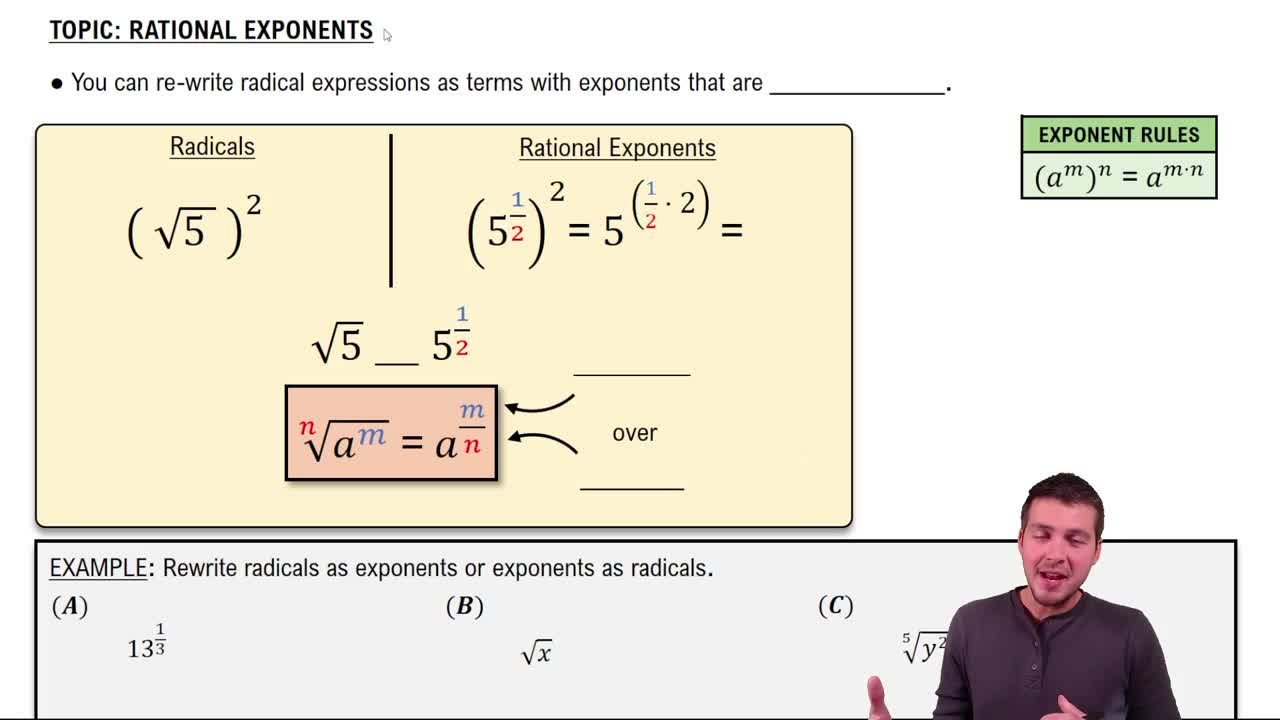
Rational Exponents
Polynomial Division (Synthetic or Long Division)
Polynomial division is used to divide the original polynomial by a candidate root's corresponding factor (x - r). If the remainder is zero, r is a root, and the quotient is a reduced polynomial to further factor or solve.
Recommended video:
Guided course
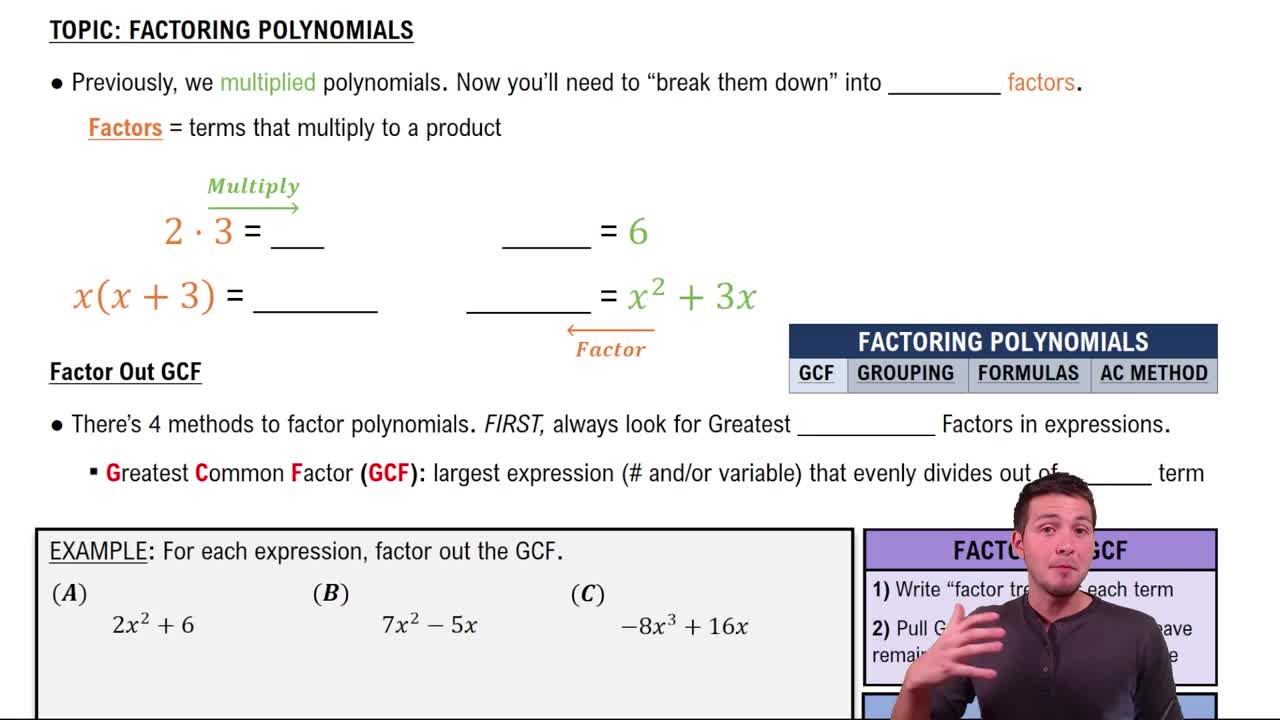
Introduction to Factoring Polynomials
Factoring and Solving Polynomial Equations
After identifying a root and dividing, the resulting polynomial can be factored further or solved using methods like factoring quadratics or applying the quadratic formula. This process helps find all rational zeros of the original polynomial.
Recommended video:
Guided course
Introduction to Factoring Polynomials
Related Videos
Related Practice
Textbook Question
534
views
