Without using a calculator, find the exact value of log4 [log3 (log₂ 8)].
Table of contents
- 0. Review of Algebra4h 18m
- 1. Equations & Inequalities3h 18m
- 2. Graphs of Equations1h 43m
- 3. Functions2h 17m
- 4. Polynomial Functions1h 44m
- 5. Rational Functions1h 23m
- 6. Exponential & Logarithmic Functions2h 28m
- 7. Systems of Equations & Matrices4h 5m
- 8. Conic Sections2h 23m
- 9. Sequences, Series, & Induction1h 22m
- 10. Combinatorics & Probability1h 45m
6. Exponential & Logarithmic Functions
Introduction to Logarithms
Problem 56
Textbook Question
Begin by graphing f(x) = log₂ x. Then use transformations of this graph to graph the given function. What is the vertical asymptote? Use the graphs to determine each function's domain and range. h(x) = 2 + log2x
Verified step by step guidance1
Start by understanding the base function: \(f(x) = \log_{2} x\). This function has a vertical asymptote at \(x = 0\), a domain of \((0, \infty)\), and a range of \((-\infty, \infty)\).
Next, analyze the given function \(h(x) = 2 + \log_{2} x\). Notice that this is a vertical shift of the base function \(f(x)\) upward by 2 units.
Since adding 2 shifts the graph vertically, the vertical asymptote remains unchanged at \(x = 0\) because vertical asymptotes depend on the input values where the function is undefined, which is not affected by vertical shifts.
Determine the domain of \(h(x)\) by considering where \(\log_{2} x\) is defined. Since \(\log_{2} x\) is defined for \(x > 0\), the domain of \(h(x)\) is also \((0, \infty)\).
Determine the range of \(h(x)\) by shifting the range of \(f(x)\) up by 2. Since the range of \(f(x)\) is \((-\infty, \infty)\), the range of \(h(x)\) remains \((-\infty, \infty)\) because adding a constant shifts the entire range but does not restrict it.
Verified video answer for a similar problem:This video solution was recommended by our tutors as helpful for the problem above
Video duration:
6mPlay a video:
Was this helpful?
Key Concepts
Here are the essential concepts you must grasp in order to answer the question correctly.
Graphing Logarithmic Functions
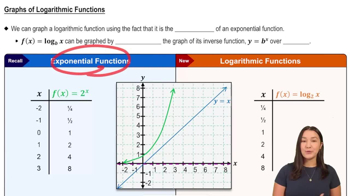
Graphing logarithmic functions involves plotting points based on the logarithm's definition and shape. For f(x) = log₂ x, the graph passes through (1,0), increases slowly, and has a vertical asymptote at x = 0. Understanding this base graph is essential before applying transformations.
Recommended video:
Graphs of Logarithmic Functions
Transformations of Functions
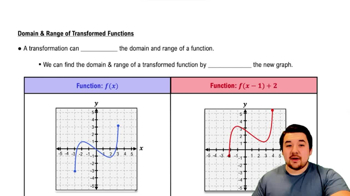
Transformations modify the graph of a base function by shifting, stretching, or reflecting it. For h(x) = 2 + log₂ x, the '+2' shifts the graph vertically upward by 2 units, affecting the range but not the vertical asymptote or domain.
Recommended video:
Domain & Range of Transformed Functions
Domain, Range, and Vertical Asymptotes of Logarithmic Functions
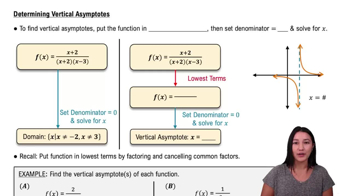
The domain of log₂ x is (0, ∞) because logarithms are undefined for non-positive values. The vertical asymptote is the line x = 0, where the function approaches negative infinity. Adding a constant shifts the range but does not change the domain or asymptote.
Recommended video:
Determining Vertical Asymptotes
Watch next
Master Logarithms Introduction with a bite sized video explanation from Patrick
Start learningRelated Videos
Related Practice
Textbook Question
765
views
