For each polynomial function, use the remainder theorem to find ƒ(k).ƒ(x) = x^2 + 4; k = 2i
Verified step by step guidance
1
Identify the polynomial function \( f(x) = x^2 + 4 \) and the value \( k = 2i \).
Recall the Remainder Theorem, which states that the remainder of the division of a polynomial \( f(x) \) by \( x - k \) is \( f(k) \).
Substitute \( k = 2i \) into the polynomial function \( f(x) \) to find \( f(2i) \).
Calculate \( f(2i) = (2i)^2 + 4 \).
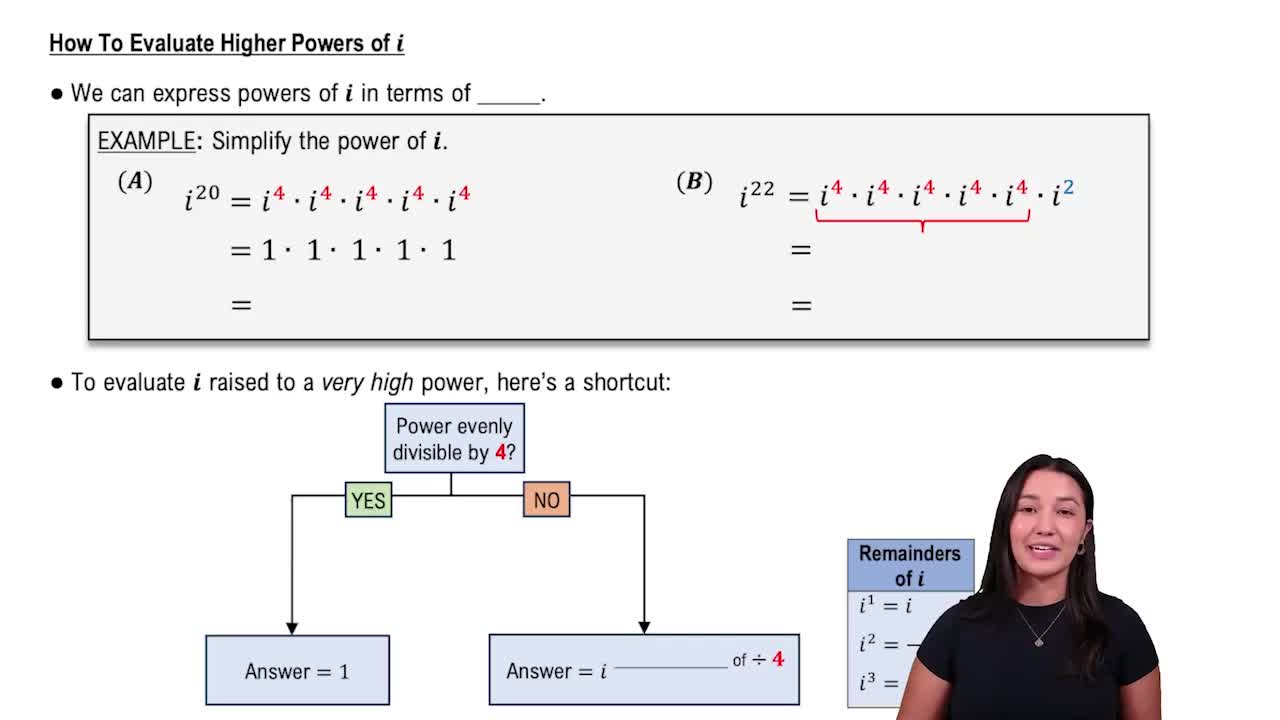
Simplify the expression \( (2i)^2 + 4 \) by calculating \( (2i)^2 = 4i^2 \) and using the fact that \( i^2 = -1 \).
Verified video answer for a similar problem:
This video solution was recommended by our tutors as helpful for the problem above
Video duration:
2m
Play a video:
Was this helpful?
Key Concepts
Here are the essential concepts you must grasp in order to answer the question correctly.
Polynomial Functions
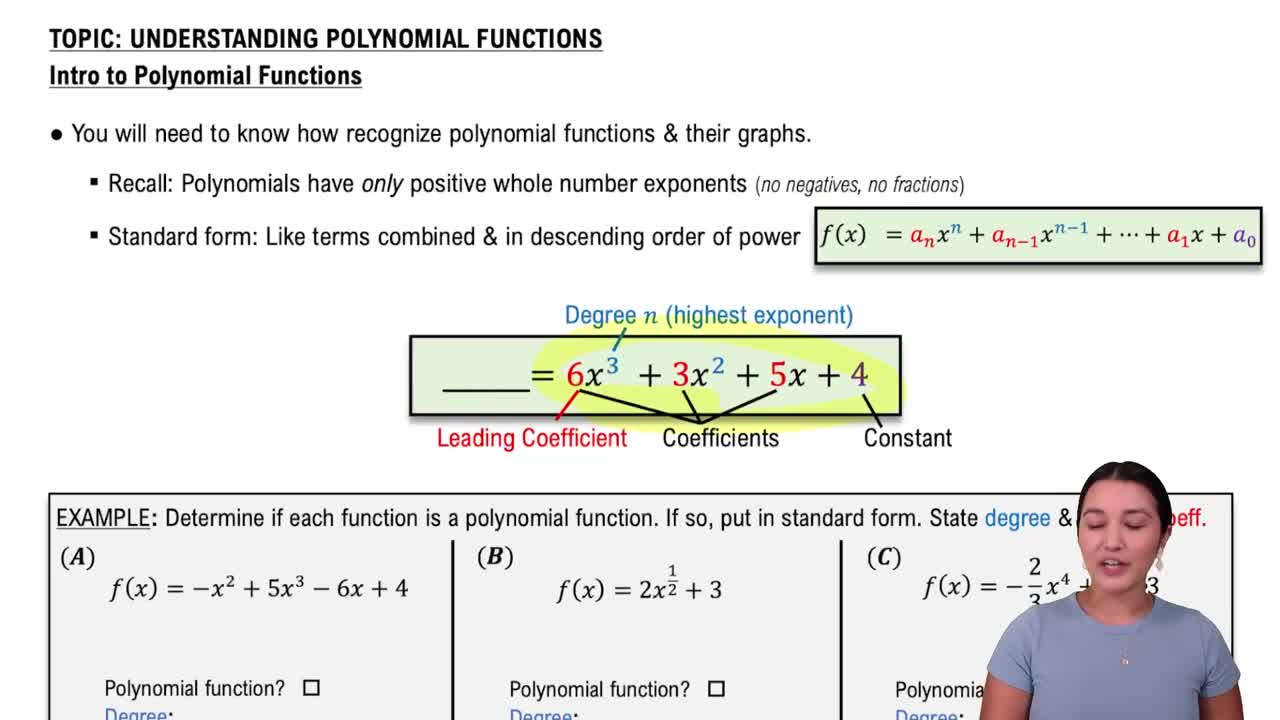
A polynomial function is a mathematical expression involving a sum of powers in one or more variables multiplied by coefficients. The general form of a polynomial in one variable is f(x) = a_n*x^n + a_(n-1)*x^(n-1) + ... + a_1*x + a_0, where 'n' is a non-negative integer and 'a_n' are constants. Understanding polynomial functions is essential for analyzing their behavior and properties.
The Remainder Theorem states that when a polynomial f(x) is divided by a linear divisor of the form (x - k), the remainder of this division is equal to f(k). This theorem allows us to evaluate the polynomial at specific points without performing long division, making it a powerful tool for finding function values efficiently.
Complex numbers are numbers that have a real part and an imaginary part, expressed in the form a + bi, where 'a' is the real part, 'b' is the imaginary part, and 'i' is the imaginary unit defined as the square root of -1. In this question, k = 2i is a purely imaginary number, and understanding how to work with complex numbers is crucial for evaluating polynomial functions at such points.