For each polynomial function, use the remainder theorem to find ƒ(k). ƒ(x) = 2x2 - 3x-3; k = 2
Verified step by step guidance
1
Recall the Remainder Theorem: For a polynomial function ƒ(x), the remainder when ƒ(x) is divided by (x - k) is equal to ƒ(k). This means to find ƒ(k), you simply substitute k into the polynomial.
Write down the given polynomial function: \(ƒ(x) = 2x^2 - 3x - 3\) and the value \(k = 2\).
Substitute \(x = 2\) into the polynomial: \(ƒ(2) = 2(2)^2 - 3(2) - 3\).
Simplify the expression step-by-step: First calculate the square, then multiply, and finally perform the addition and subtraction.
The simplified result after substitution is the value of \(ƒ(2)\), which is the remainder when dividing by \((x - 2)\) according to the Remainder Theorem.
Verified video answer for a similar problem:
This video solution was recommended by our tutors as helpful for the problem above
Video duration:
2m
Play a video:
Was this helpful?
Key Concepts
Here are the essential concepts you must grasp in order to answer the question correctly.
Polynomial Functions
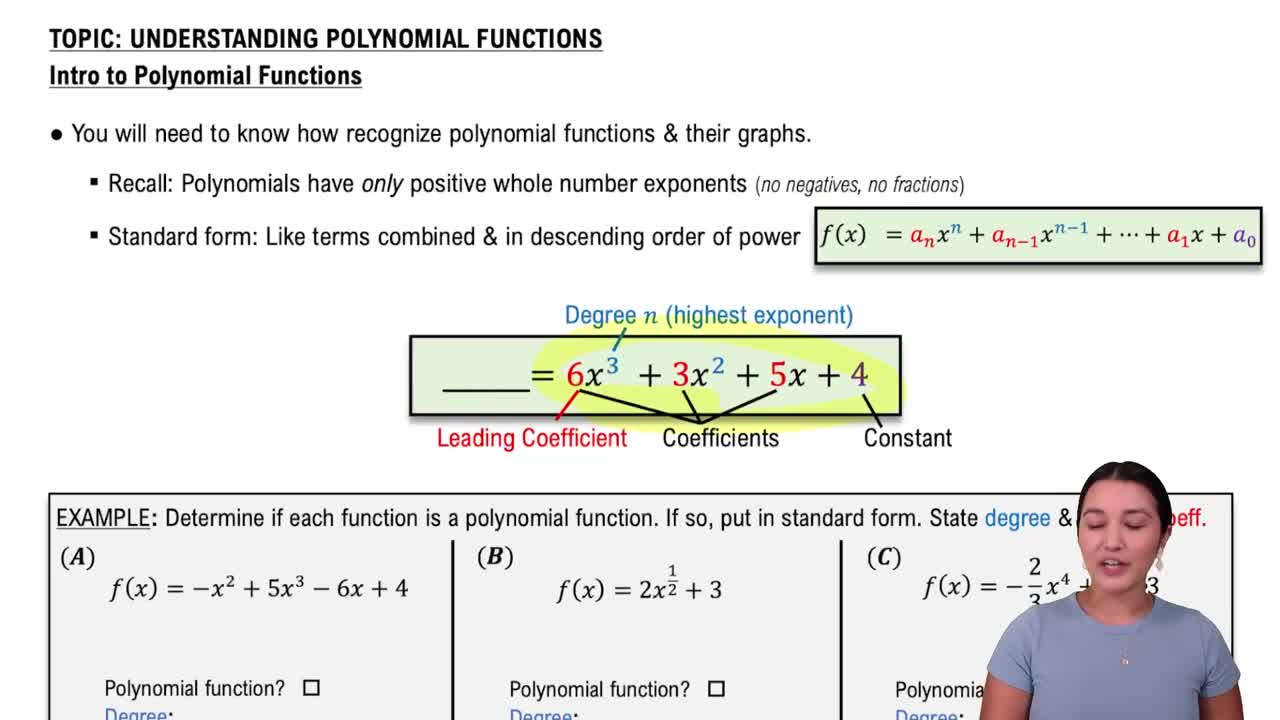
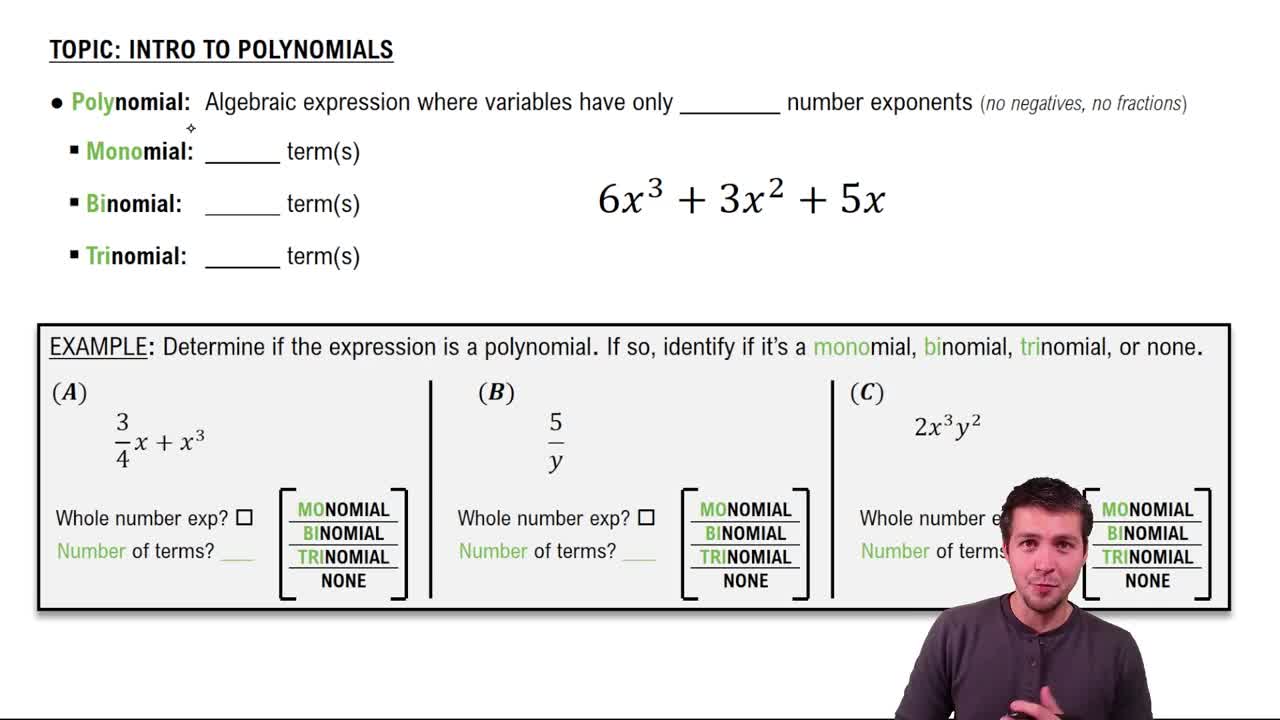
A polynomial function is an expression consisting of variables and coefficients combined using addition, subtraction, and multiplication, with non-negative integer exponents. Understanding the structure of polynomials helps in evaluating them at specific values and applying related theorems.
The Remainder Theorem states that when a polynomial ƒ(x) is divided by (x - k), the remainder is equal to ƒ(k). This allows us to find the value of the polynomial at x = k by simply evaluating ƒ(k), without performing full polynomial division.
Evaluating a polynomial at a specific value involves substituting the variable with that value and simplifying. This process is essential for applying the Remainder Theorem and finding the remainder or function value efficiently.