In Exercises 105–110, use an associative property to write an algebraic expression equivalent to each expression and simplify.
4+(6+x)
Verified step by step guidance
1
Identify the associative property of addition, which states that the way in which numbers are grouped in an addition problem does not change their sum: \((a + b) + c = a + (b + c)\).
Apply the associative property to the expression \(4 + (6 + x)\) by regrouping the terms: \((4 + 6) + x\).
Simplify the expression inside the parentheses: \(4 + 6\).
Rewrite the expression with the simplified sum: \(10 + x\).
The expression \(10 + x\) is the simplified form of the original expression using the associative property.
Verified video answer for a similar problem:
This video solution was recommended by our tutors as helpful for the problem above.
Video duration:
1m
Play a video:
0 Comments
Key Concepts
Here are the essential concepts you must grasp in order to answer the question correctly.
Associative Property
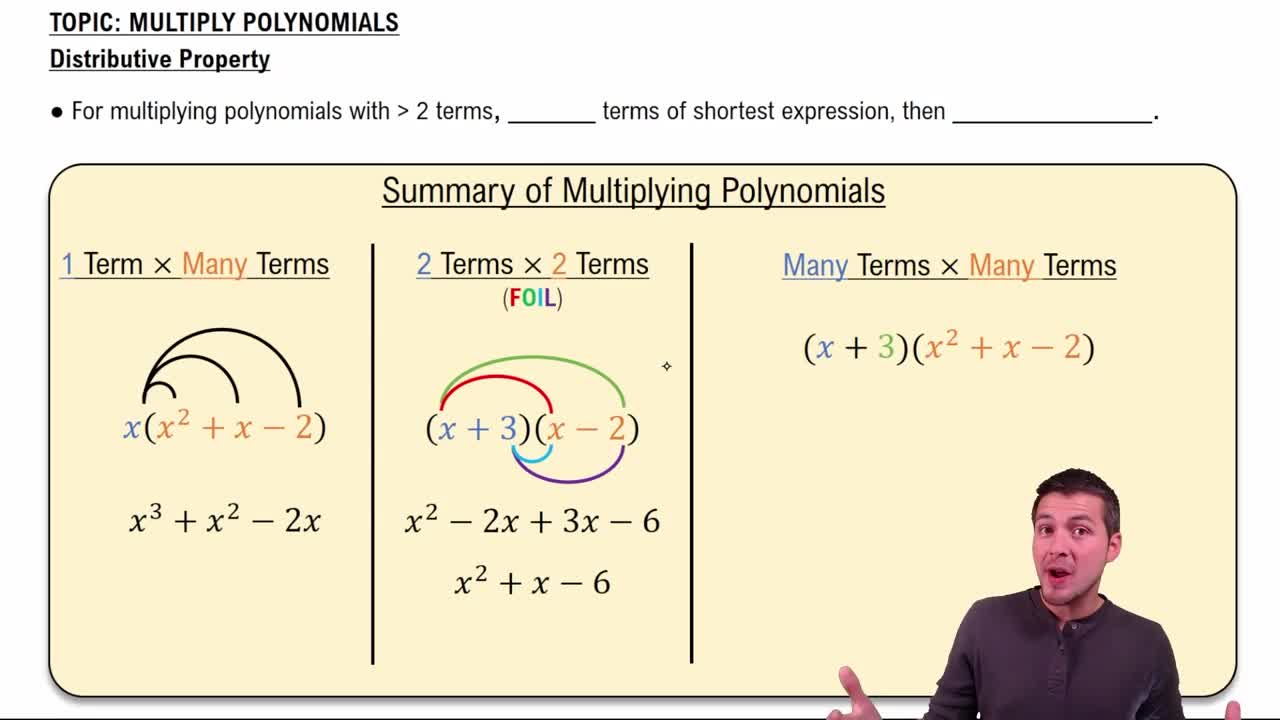
The associative property refers to the way in which numbers are grouped in addition or multiplication without affecting the result. For addition, it states that (a + b) + c = a + (b + c). This property allows us to rearrange and group terms in an expression to simplify calculations or to rewrite expressions in a more manageable form.
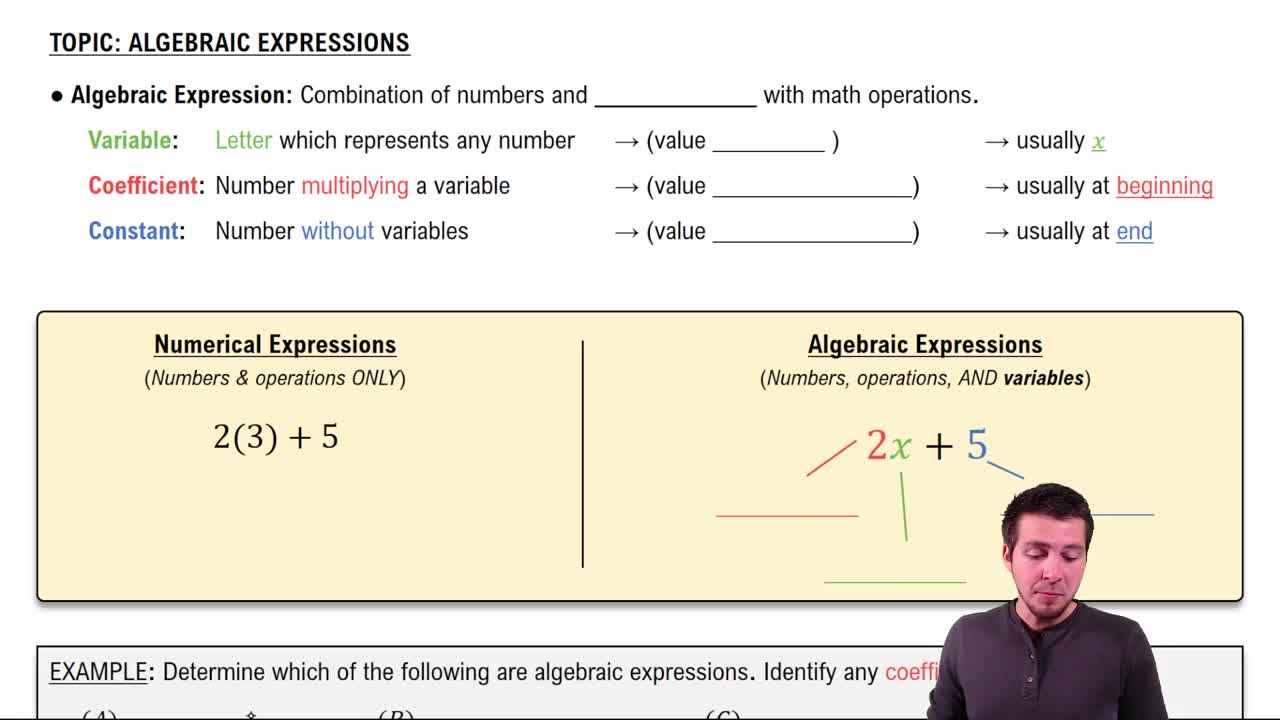
An algebraic expression is a mathematical phrase that can include numbers, variables, and operation symbols. It does not have an equality sign. In the context of the given question, the expression 4 + (6 + x) is an algebraic expression that can be manipulated using properties of operations to find equivalent forms.
Simplification is the process of reducing an expression to its simplest form. This involves combining like terms, applying properties of operations, and eliminating unnecessary parentheses. In the given expression, simplifying means rewriting 4 + (6 + x) in a way that makes it easier to understand or compute, such as combining the constants.

 1:11 minutes
 Verified step by step guidance
 5:36
5:36