Find the midpoint of each line segment with the given endpoints. (-2, -8) and (−6, −2)
Table of contents
- 0. Review of Algebra4h 18m
- 1. Equations & Inequalities3h 18m
- 2. Graphs of Equations1h 43m
- 3. Functions2h 17m
- 4. Polynomial Functions1h 44m
- 5. Rational Functions1h 23m
- 6. Exponential & Logarithmic Functions2h 28m
- 7. Systems of Equations & Matrices4h 5m
- 8. Conic Sections2h 23m
- 9. Sequences, Series, & Induction1h 22m
- 10. Combinatorics & Probability1h 45m
3. Functions
Intro to Functions & Their Graphs
Problem 103
Textbook Question
Exercises 103–105 will help you prepare for the material covered in the next section. Let (x1, y₁) = (7, 2) and (x2, y2) = (1, −1). Find √[(x2 − x1)² + (y2 − y₁)²]. Express the - answer in simplified radical form.
Verified step by step guidance1
Identify the formula for the distance between two points in a coordinate plane: d = √[(x₂ − x₁)² + (y₂ − y₁)²].
Substitute the given coordinates (x₁, y₁) = (7, 2) and (x₂, y₂) = (1, −1) into the formula: d = √[(1 − 7)² + (−1 − 2)²].
Simplify the expressions inside the parentheses: (1 − 7) becomes −6, and (−1 − 2) becomes −3. The formula now becomes d = √[(-6)² + (-3)²].
Square the values: (-6)² = 36 and (-3)² = 9. The formula now becomes d = √[36 + 9].
Add the squared values: 36 + 9 = 45. The distance formula simplifies to d = √45. Simplify the radical by factoring: √45 = √(9 × 5) = 3√5.
Verified video answer for a similar problem:This video solution was recommended by our tutors as helpful for the problem above
Video duration:
2mPlay a video:
Was this helpful?
Key Concepts
Here are the essential concepts you must grasp in order to answer the question correctly.
Distance Formula
The distance formula is a mathematical equation used to determine the distance between two points in a Cartesian coordinate system. It is derived from the Pythagorean theorem and is expressed as √[(x2 - x1)² + (y2 - y1)²]. This formula calculates the straight-line distance between points (x1, y1) and (x2, y2), which is essential for solving problems involving spatial relationships.
Recommended video:
Solving Quadratic Equations Using The Quadratic Formula
Simplified Radical Form
Simplified radical form refers to the expression of a square root in its simplest terms, where no perfect square factors remain under the radical sign. For example, √8 can be simplified to 2√2. Understanding how to simplify radicals is crucial for presenting answers in a clear and concise manner, especially in algebraic contexts.
Recommended video:
Guided course
Adding & Subtracting Unlike Radicals by Simplifying
Coordinate System
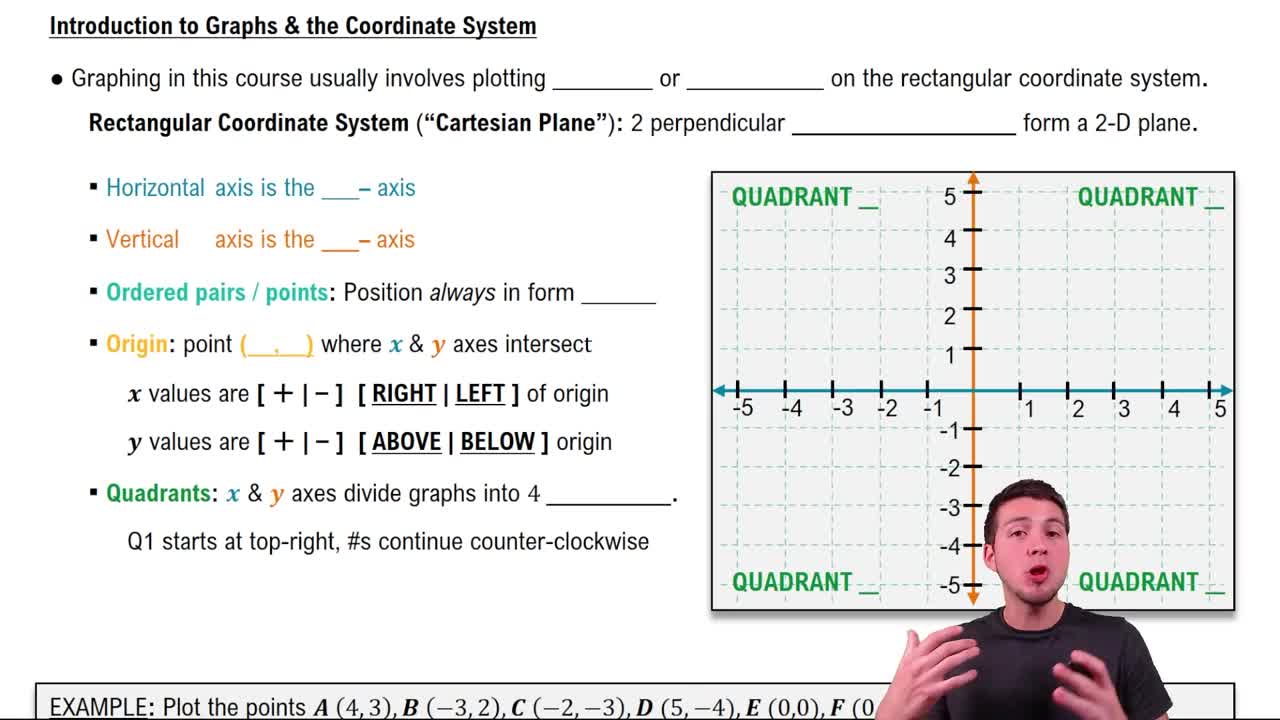
A coordinate system is a two-dimensional plane defined by a horizontal axis (x-axis) and a vertical axis (y-axis). Each point in this system is represented by an ordered pair (x, y), which indicates its position relative to the axes. Familiarity with the coordinate system is vital for interpreting and solving problems involving points, distances, and geometric figures.
Recommended video:
Guided course
Graphs & the Rectangular Coordinate System
Watch next
Master Relations and Functions with a bite sized video explanation from Patrick
Start learningRelated Videos
Related Practice
Textbook Question
645
views