Solve each equation. In Exercises 11–34, give irrational solutions as decimals correct to the nearest thousandth. In Exercises 35-40, give solutions in exact form. e3x-7 • e-2x = 4e
Table of contents
- 0. Review of Algebra4h 18m
- 1. Equations & Inequalities3h 18m
- 2. Graphs of Equations1h 43m
- 3. Functions2h 17m
- 4. Polynomial Functions1h 44m
- 5. Rational Functions1h 23m
- 6. Exponential & Logarithmic Functions2h 28m
- 7. Systems of Equations & Matrices4h 5m
- 8. Conic Sections2h 23m
- 9. Sequences, Series, & Induction1h 22m
- 10. Combinatorics & Probability1h 45m
6. Exponential & Logarithmic Functions
Solving Exponential and Logarithmic Equations
Problem 25
Textbook Question
Solve each equation. In Exercises 11–34, give irrational solutions as decimals correct to the nearest thousandth. In Exercises 35-40, give solutions in exact form. (1/3)x = -3
Verified step by step guidance1
Recognize that the equation is \(\left(\frac{1}{3}\right)^x = -3\). Here, the base \(\frac{1}{3}\) is a positive number less than 1, and the expression represents an exponential function.
Recall that an exponential function with a positive base (other than 1) raised to any real power will always yield a positive result. This means \(\left(\frac{1}{3}\right)^x > 0\) for all real values of \(x\).
Since the right side of the equation is \(-3\), which is negative, there is no real value of \(x\) that can satisfy the equation \(\left(\frac{1}{3}\right)^x = -3\).
Conclude that the equation has no real solutions because an exponential function with a positive base cannot equal a negative number.
If complex solutions are considered, you would need to use logarithms with complex numbers, but since this is a College Algebra problem focusing on real solutions, the answer is that no real solution exists.
Verified video answer for a similar problem:This video solution was recommended by our tutors as helpful for the problem above
Video duration:
2mPlay a video:
Was this helpful?
Key Concepts
Here are the essential concepts you must grasp in order to answer the question correctly.
Properties of Exponential Functions
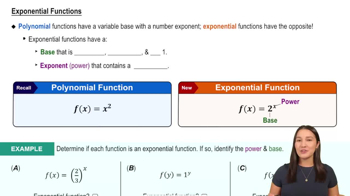
Exponential functions have the form a^x where the base a is positive and not equal to 1. Their outputs are always positive numbers, meaning expressions like (1/3)^x cannot equal a negative number. Understanding this helps identify when an equation has no real solution.
Recommended video:
Exponential Functions
Domain and Range of Exponential Functions
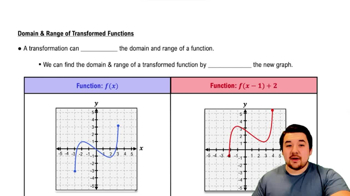
The domain of an exponential function is all real numbers, but its range is strictly positive real numbers (0, ∞). This means exponential expressions cannot produce zero or negative values, which is crucial when solving equations involving exponentials.
Recommended video:
Domain & Range of Transformed Functions
Solving Exponential Equations
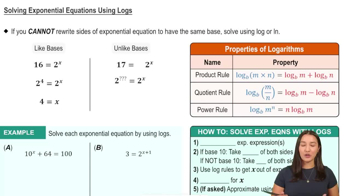
To solve exponential equations, isolate the exponential expression and apply logarithms if necessary. However, if the equation sets an exponential equal to a negative number, no real solution exists because exponentials never output negatives.
Recommended video:
Solving Exponential Equations Using Logs
Watch next
Master Solving Exponential Equations Using Like Bases with a bite sized video explanation from Patrick
Start learningRelated Videos
Related Practice
Textbook Question