Find the vertical asymptotes, if any, and the values of x corresponding to holes, if any, of the graph of each rational function. h(x)=(x+7)/(x2+4x−21)
Table of contents
- 0. Review of Algebra4h 18m
- 1. Equations & Inequalities3h 18m
- 2. Graphs of Equations1h 43m
- 3. Functions2h 17m
- 4. Polynomial Functions1h 44m
- 5. Rational Functions1h 23m
- 6. Exponential & Logarithmic Functions2h 28m
- 7. Systems of Equations & Matrices4h 5m
- 8. Conic Sections2h 23m
- 9. Sequences, Series, & Induction1h 22m
- 10. Combinatorics & Probability1h 45m
5. Rational Functions
Asymptotes
Problem 47
Textbook Question
Use transformations of f(x)=1/x or f(x)=1/x2 to graph each rational function. h(x)=(1/x) + 2
Verified step by step guidance1
Identify the base function given, which is \( f(x) = \frac{1}{x} \). This is a rational function with a vertical asymptote at \( x = 0 \) and a horizontal asymptote at \( y = 0 \).
Look at the given function \( h(x) = \frac{1}{x} + 2 \). Notice that it is the base function \( \frac{1}{x} \) plus 2, which means the graph of \( f(x) \) is shifted vertically.
Understand that adding 2 to the function shifts the entire graph up by 2 units. This means the horizontal asymptote, originally at \( y = 0 \), will move to \( y = 2 \).
The vertical asymptote remains unchanged at \( x = 0 \) because the transformation does not affect the denominator.
To sketch the graph, start with the graph of \( f(x) = \frac{1}{x} \), then shift every point up by 2 units, and draw the new horizontal asymptote at \( y = 2 \) while keeping the vertical asymptote at \( x = 0 \).
Verified video answer for a similar problem:This video solution was recommended by our tutors as helpful for the problem above
Video duration:
5mPlay a video:
Was this helpful?
Key Concepts
Here are the essential concepts you must grasp in order to answer the question correctly.
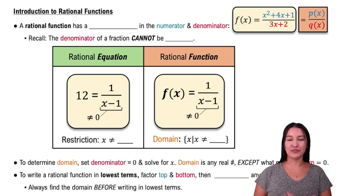
Parent Rational Functions
The parent functions f(x) = 1/x and f(x) = 1/x² are basic rational functions with distinct shapes and asymptotes. Understanding their graphs, including vertical and horizontal asymptotes, is essential as they serve as the starting point for transformations.
Recommended video:
Intro to Rational Functions
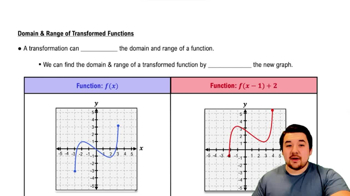
Transformations of Functions
Transformations involve shifting, stretching, compressing, or reflecting the graph of a function. For h(x) = 1/x + 2, the '+ 2' indicates a vertical shift upward by 2 units, moving the entire graph and its horizontal asymptote accordingly.
Recommended video:
Domain & Range of Transformed Functions
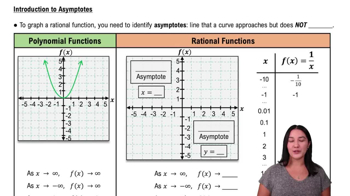
Asymptotes of Rational Functions
Asymptotes are lines that the graph approaches but never touches. For rational functions like 1/x, vertical asymptotes occur where the denominator is zero, and horizontal asymptotes describe end behavior. Transformations affect the position of these asymptotes.
Recommended video:
Introduction to Asymptotes
Watch next
Master Introduction to Asymptotes with a bite sized video explanation from Patrick
Start learningRelated Videos
Related Practice
Textbook Question
854
views
