Without using a calculator, find the exact value of: [log3 81 - log𝝅 1]/[log2√2 8 - log 0.001]
Table of contents
- 0. Review of Algebra4h 18m
- 1. Equations & Inequalities3h 18m
- 2. Graphs of Equations1h 43m
- 3. Functions2h 17m
- 4. Polynomial Functions1h 44m
- 5. Rational Functions1h 23m
- 6. Exponential & Logarithmic Functions2h 28m
- 7. Systems of Equations & Matrices4h 5m
- 8. Conic Sections2h 23m
- 9. Sequences, Series, & Induction1h 22m
- 10. Combinatorics & Probability1h 45m
6. Exponential & Logarithmic Functions
Introduction to Logarithms
Problem 43
Textbook Question
Graph f(x) = 4x and g(x) = log4 x in the same rectangular coordinate system.
Verified step by step guidance1
Recognize that the functions given are inverses of each other: \(f(x) = 4^x\) is an exponential function, and \(g(x) = \log_4 x\) is its inverse logarithmic function.
Create a table of values for \(f(x) = 4^x\) by choosing several values of \(x\) (such as \(-2\), \(-1\), \$0\(, \)1\(, \)2\() and calculating the corresponding \)f(x)$ values.
Create a table of values for \(g(x) = \log_4 x\) by choosing several positive values of \(x\) (such as \(\frac{1}{16}\), \(\frac{1}{4}\), \$1\(, \)4\(, \)16\() and calculating the corresponding \)g(x)$ values.
Plot the points from both tables on the same rectangular coordinate system, noting that \(f(x)\) will be increasing and \(g(x)\) will be increasing but only defined for \(x > 0\).
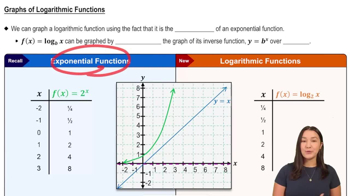
Draw the graphs smoothly through the plotted points, remembering that the graph of \(g(x)\) is the reflection of the graph of \(f(x)\) across the line \(y = x\).
Verified video answer for a similar problem:This video solution was recommended by our tutors as helpful for the problem above
Video duration:
5mPlay a video:
Was this helpful?
Key Concepts
Here are the essential concepts you must grasp in order to answer the question correctly.
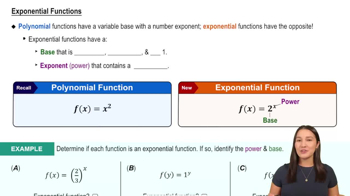
Exponential Functions
An exponential function has the form f(x) = a^x, where the base a is a positive constant not equal to 1. It models rapid growth or decay and has a domain of all real numbers and a range of positive real numbers. For f(x) = 4^x, the graph passes through (0,1) and increases rapidly as x increases.
Recommended video:
Exponential Functions
Logarithmic Functions
A logarithmic function is the inverse of an exponential function and is written as g(x) = log_a(x), where a is the base. It is defined only for positive x-values and has a range of all real numbers. For g(x) = log_4(x), the graph passes through (1,0) and increases slowly, reflecting the inverse relationship to 4^x.
Recommended video:
Graphs of Logarithmic Functions
Inverse Functions and Their Graphs
Inverse functions reverse the effect of each other, so their graphs are symmetric about the line y = x. Since g(x) = log_4(x) is the inverse of f(x) = 4^x, plotting both on the same coordinate system shows this symmetry, helping to understand their relationship visually.
Recommended video:
Graphs of Logarithmic Functions
Watch next
Master Logarithms Introduction with a bite sized video explanation from Patrick
Start learningRelated Videos
Related Practice
Textbook Question
1232
views
1
rank