Solve each inequality. Give the solution set in interval notation. (x+7)/(2x+1)<0
Verified step by step guidance
1
Identify the critical points by setting the numerator and denominator equal to zero separately: solve \(x + 7 = 0\) and \(2x + 1 = 0\).
Find the values of \(x\) that make the numerator and denominator zero: \(x = -7\) and \(x = -\frac{1}{2}\), respectively. These points divide the number line into intervals.
Determine the sign of the expression \(\frac{x+7}{2x+1}\) on each interval created by the critical points \(-\infty, -7\), \((-7, -\frac{1}{2})\), and \((-\frac{1}{2}, \infty)\) by choosing test points from each interval.
Analyze the inequality \(\frac{x+7}{2x+1} < 0\) to find where the expression is negative, considering the signs found in the previous step and excluding points where the denominator is zero (since the expression is undefined there).
Express the solution set in interval notation by combining the intervals where the inequality holds true, making sure to exclude the points where the expression is undefined.
Verified video answer for a similar problem:
This video solution was recommended by our tutors as helpful for the problem above
Video duration:
6m
Play a video:
Was this helpful?
Key Concepts
Here are the essential concepts you must grasp in order to answer the question correctly.
Solving Rational Inequalities
Rational inequalities involve expressions with variables in the numerator and denominator. To solve them, identify where the expression is positive, negative, or zero by analyzing critical points from the numerator and denominator. These points divide the number line into intervals to test for the inequality.
Critical points are values where the numerator or denominator equals zero, causing the expression to be zero or undefined. These points split the number line into intervals. By testing a value from each interval, you determine the sign of the expression and identify where the inequality holds true.
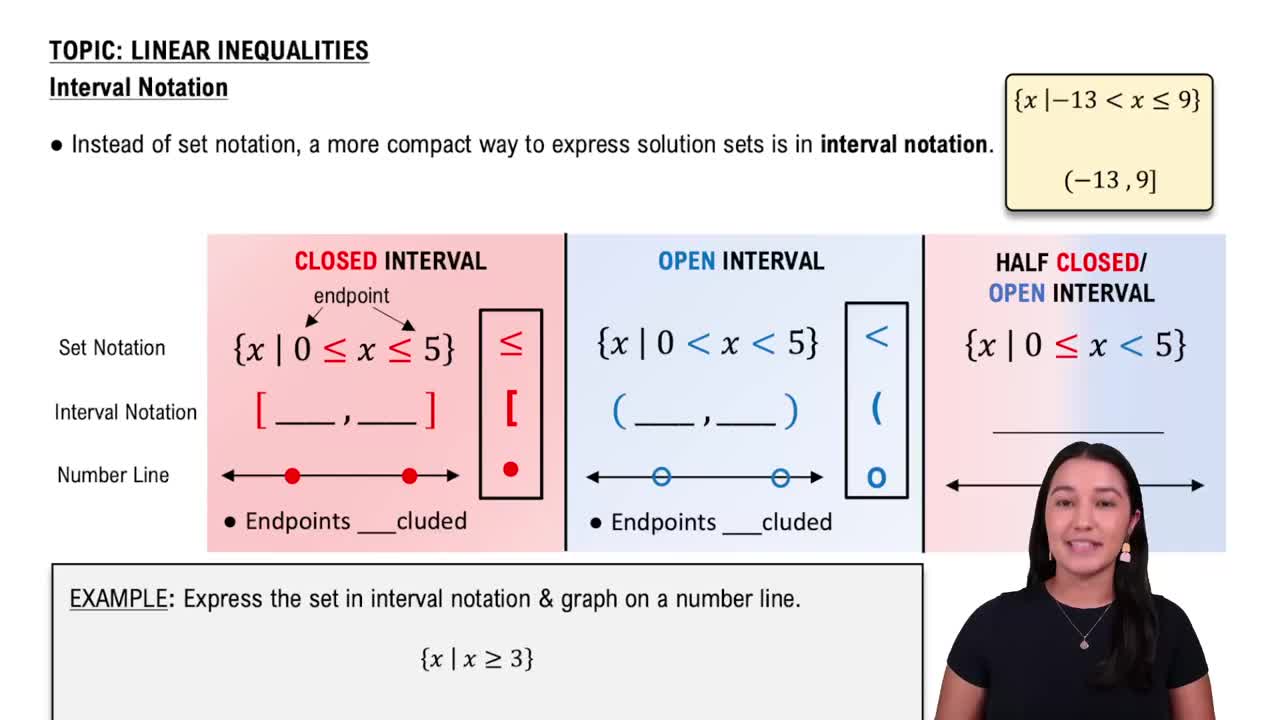
Interval notation is a concise way to represent solution sets on the number line. It uses parentheses for values not included (open intervals) and brackets for included values (closed intervals). For inequalities, intervals show where the variable satisfies the condition, excluding points where the expression is undefined.