Find each product. Assume all variables represent positive real numbers. -4k(k^7/3-6k^1/3)
Verified step by step guidance
1
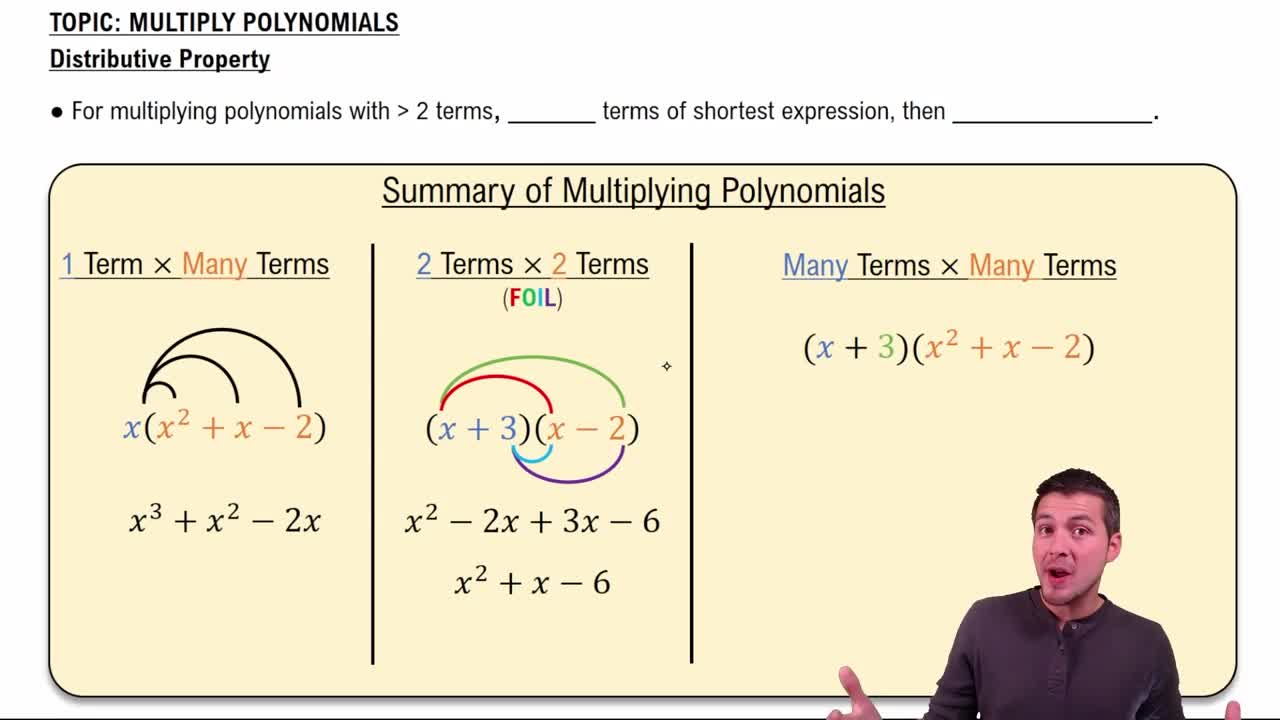
Distribute the term \(-4k\) to each term inside the parentheses.
Multiply \(-4k\) by \(k^{7/3}\).
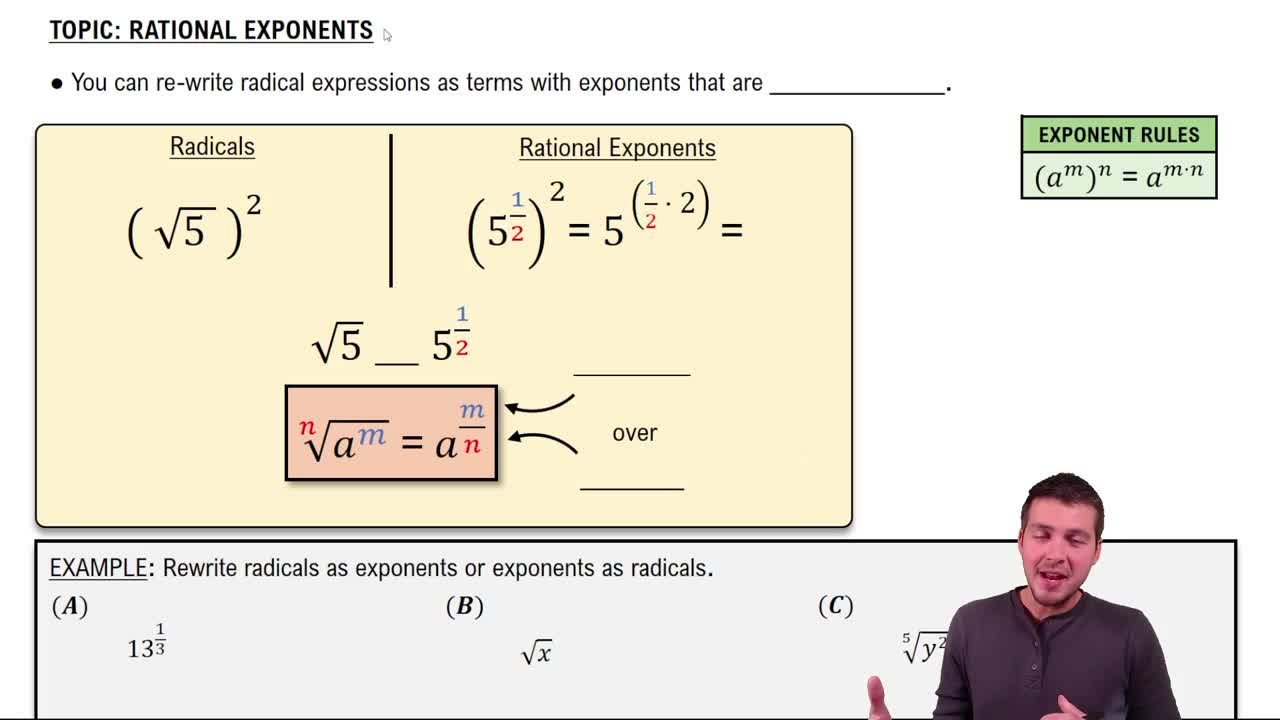
Recall that when multiplying powers with the same base, you add the exponents: \(k^a \cdot k^b = k^{a+b}\).
Multiply \(-4k\) by \(-6k^{1/3}\).
Combine the results from the previous steps to express the final product.
Verified video answer for a similar problem:
This video solution was recommended by our tutors as helpful for the problem above
Video duration:
2m
Play a video:
Was this helpful?
Key Concepts
Here are the essential concepts you must grasp in order to answer the question correctly.
Factoring
Factoring is the process of breaking down an expression into simpler components, or factors, that when multiplied together yield the original expression. In this case, recognizing common factors in the expression -4k(k^7/3 - 6k^1/3) is essential for simplifying the product. This technique is fundamental in algebra for simplifying expressions and solving equations.
Exponents represent repeated multiplication of a base number. In the expression k^7/3 and k^1/3, the exponents indicate how many times the base k is multiplied by itself. Understanding how to manipulate exponents, including the rules for multiplying and subtracting them, is crucial for simplifying expressions involving powers.
The Distributive Property states that a(b + c) = ab + ac, allowing us to distribute a factor across terms within parentheses. In the expression -4k(k^7/3 - 6k^1/3), applying the distributive property will help in finding the product by multiplying -4k with each term inside the parentheses, leading to a simplified expression.