Find each product. See Examples 3–5. 2b^3(b^2-4b+3)
Verified step by step guidance
1
Identify the expression to be expanded: \(2b^3(b^2 - 4b + 3)\).
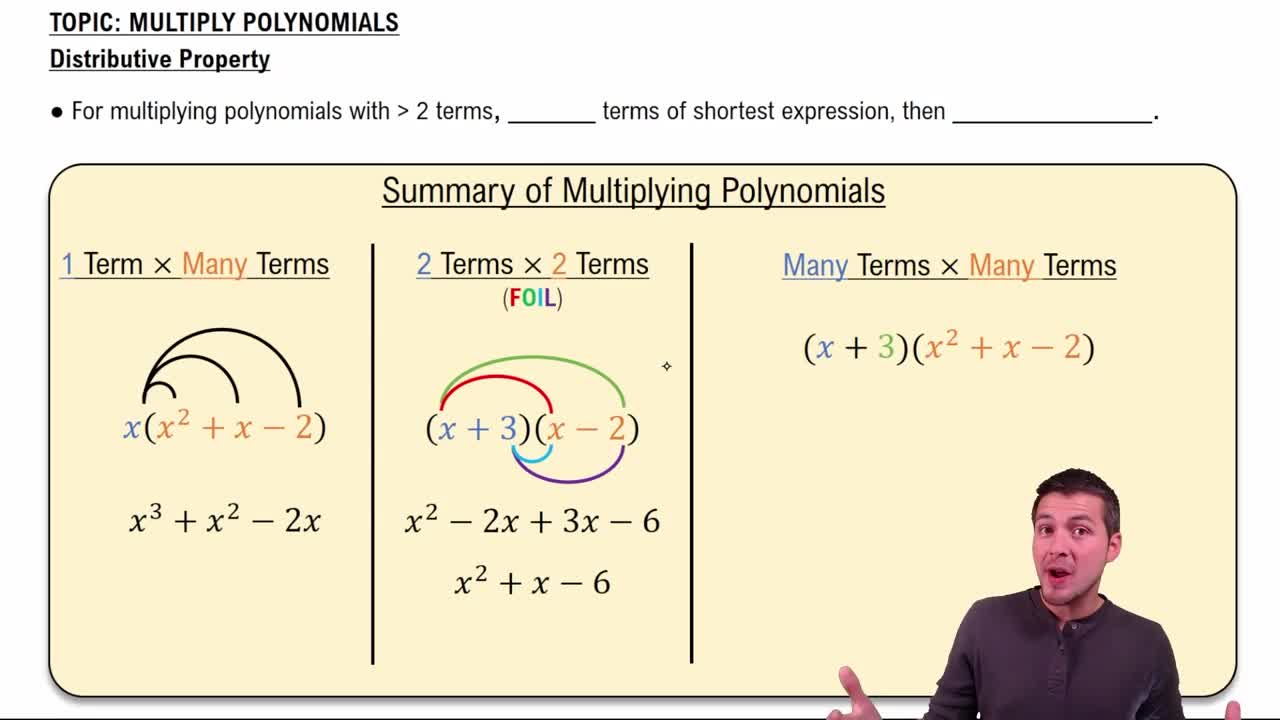
Apply the distributive property, which states \(a(b + c) = ab + ac\), to multiply \(2b^3\) by each term inside the parentheses.
Multiply \(2b^3\) by the first term \(b^2\) to get \(2b^3 \cdot b^2 = 2b^{3+2} = 2b^5\).
Multiply \(2b^3\) by the second term \(-4b\) to get \(2b^3 \cdot (-4b) = -8b^{3+1} = -8b^4\).
Multiply \(2b^3\) by the third term \(3\) to get \(2b^3 \cdot 3 = 6b^3\).
Verified video answer for a similar problem:
This video solution was recommended by our tutors as helpful for the problem above
Video duration:
1m
Play a video:
Was this helpful?
Key Concepts
Here are the essential concepts you must grasp in order to answer the question correctly.
Polynomial Multiplication
Polynomial multiplication involves distributing each term in one polynomial to every term in another polynomial. This process is often referred to as the distributive property. For example, in the expression 2b^3(b^2 - 4b + 3), you would multiply 2b^3 by each term in the polynomial (b^2, -4b, and 3) to find the resulting polynomial.
Combining like terms is the process of simplifying an expression by adding or subtracting terms that have the same variable raised to the same power. After multiplying polynomials, you may end up with several terms that can be combined. For instance, if the multiplication yields terms like 2b^5 and -8b^4, these can be simplified into a single expression.
The degree of a polynomial is the highest power of the variable in the expression. It provides insight into the polynomial's behavior and the number of roots it may have. In the expression resulting from the multiplication, identifying the degree helps in understanding the polynomial's characteristics, such as its end behavior and the number of turning points.