Choose the correct answer: For function ƒ, the notation ƒ(3) means A. the variable f times 3, or 3f. B. the value of the dependent variable when the independent variable is 3. C. the value of the independent variable when the dependent variable is 3. D. f equals 3.
Verified step by step guidance
1
Understand that the notation \( f(3) \) represents the function \( f \) evaluated at the input value 3.
Recall that in a function, the independent variable (often \( x \)) is the input, and the dependent variable (often \( y \) or \( f(x) \)) is the output.
Recognize that \( f(3) \) means we substitute 3 into the function as the input and find the corresponding output value.
Therefore, \( f(3) \) is the value of the dependent variable when the independent variable is 3.
This matches option B: 'the value of the dependent variable when the independent variable is 3.'
0 Comments
Key Concepts
Here are the essential concepts you must grasp in order to answer the question correctly.
Function Notation
Function notation, written as ƒ(x), represents the output value of the function ƒ when the input is x. It is a way to denote the dependent variable as a function of the independent variable, making it clear which value is being evaluated.
In a function, the independent variable is the input value you choose, often represented by x, while the dependent variable is the output value, often represented by ƒ(x). The dependent variable depends on the independent variable's value.
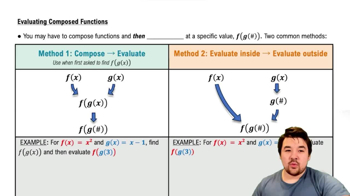
Evaluating a function at a specific input means substituting the input value into the function to find the corresponding output. For example, ƒ(3) means finding the output when the input is 3, not multiplying f by 3.

 Verified step by step guidance
 05:18
05:18