Graph each function. ƒ(x) = 2∛(x+1)-2
Table of contents
- 0. Review of Algebra4h 18m
- 1. Equations & Inequalities3h 18m
- 2. Graphs of Equations1h 43m
- 3. Functions2h 17m
- 4. Polynomial Functions1h 44m
- 5. Rational Functions1h 23m
- 6. Exponential & Logarithmic Functions2h 28m
- 7. Systems of Equations & Matrices4h 5m
- 8. Conic Sections2h 23m
- 9. Sequences, Series, & Induction1h 22m
- 10. Combinatorics & Probability1h 45m
3. Functions
Intro to Functions & Their Graphs
Problem 53
Textbook Question
For each equation, (a) give a table with at least three ordered pairs that are solutions, and (b) graph the equation. y=√(x-3)
Verified step by step guidance1
Identify the domain of the function \(y = \sqrt{x - 3}\). Since the expression inside the square root must be non-negative, set \(x - 3 \geq 0\), which means \(x \geq 3\).
Choose at least three values of \(x\) that satisfy the domain condition (i.e., \(x \geq 3\)). For example, select \(x = 3\), \(x = 4\), and \(x = 7\).
Calculate the corresponding \(y\) values by substituting each chosen \(x\) into the equation \(y = \sqrt{x - 3}\). For instance, for \(x=3\), compute \(y = \sqrt{3 - 3}\); for \(x=4\), compute \(y = \sqrt{4 - 3}\); and for \(x=7\), compute \(y = \sqrt{7 - 3}\).
Create a table of ordered pairs \((x, y)\) using the values found in the previous step. This table will show at least three points that lie on the graph of the equation.
To graph the equation, plot the ordered pairs from the table on the coordinate plane. Then, draw a smooth curve starting at the point where \(x=3\) (the domain's start) and continuing to the right, reflecting the shape of the square root function.
Was this helpful?
Key Concepts
Here are the essential concepts you must grasp in order to answer the question correctly.
Domain of a Function
The domain is the set of all input values (x-values) for which the function is defined. For the equation y = √(x - 3), the expression inside the square root must be non-negative, so x - 3 ≥ 0, meaning the domain is x ≥ 3.
Recommended video:
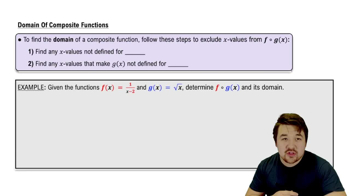
Domain Restrictions of Composed Functions
Evaluating Functions and Ordered Pairs
To find ordered pairs (x, y) that satisfy the equation, substitute values of x from the domain into the function and calculate the corresponding y-values. These pairs represent points on the graph of the function.
Recommended video:
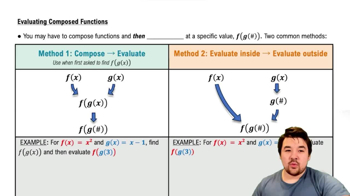
Evaluating Composed Functions
Graphing Square Root Functions
Graphing y = √(x - 3) involves plotting points from the ordered pairs and understanding the shape of the square root function, which starts at the domain boundary (x=3) and increases gradually, forming a curve that rises slowly to the right.
Recommended video:
Imaginary Roots with the Square Root Property
Watch next
Master Relations and Functions with a bite sized video explanation from Patrick
Start learningRelated Videos
Related Practice
Textbook Question
532
views