Solve each rational inequality. Give the solution set in interval notation. 4/(2-x)≥3/(1-x)
Verified step by step guidance
1
Start by writing down the inequality: \(\frac{4}{2 - x} \geq \frac{3}{1 - x}\).
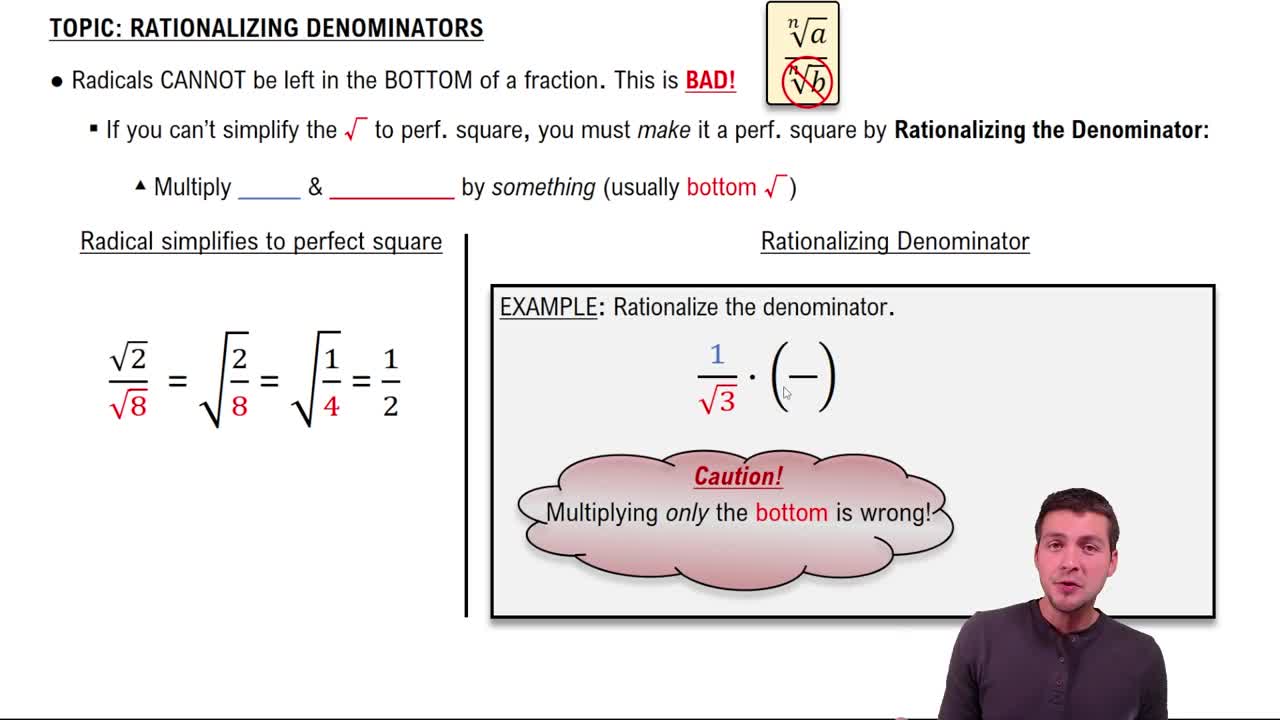
Identify the domain restrictions by setting the denominators not equal to zero: \$2 - x \neq 0\( and \)1 - x \neq 0\(, which means \)x \neq 2\( and \)x \neq 1$.
Bring all terms to one side to have a single rational expression: \(\frac{4}{2 - x} - \frac{3}{1 - x} \geq 0\).
Find a common denominator, which is \((2 - x)(1 - x)\), and combine the fractions: \(\frac{4(1 - x) - 3(2 - x)}{(2 - x)(1 - x)} \geq 0\).
Simplify the numerator and analyze the sign of the rational expression by considering critical points from the numerator and denominator, then determine the solution intervals where the expression is greater than or equal to zero, excluding points where the denominator is zero.
Verified video answer for a similar problem:
This video solution was recommended by our tutors as helpful for the problem above
Video duration:
12m
Play a video:
0 Comments
Key Concepts
Here are the essential concepts you must grasp in order to answer the question correctly.
Rational Inequalities
Rational inequalities involve expressions with variables in the denominator. Solving them requires finding values that satisfy the inequality while ensuring denominators are not zero, as division by zero is undefined.
Finding a Common Denominator and Combining Fractions
To compare or combine rational expressions, rewrite them with a common denominator. This allows you to create a single inequality involving a single rational expression, simplifying the process of solving.
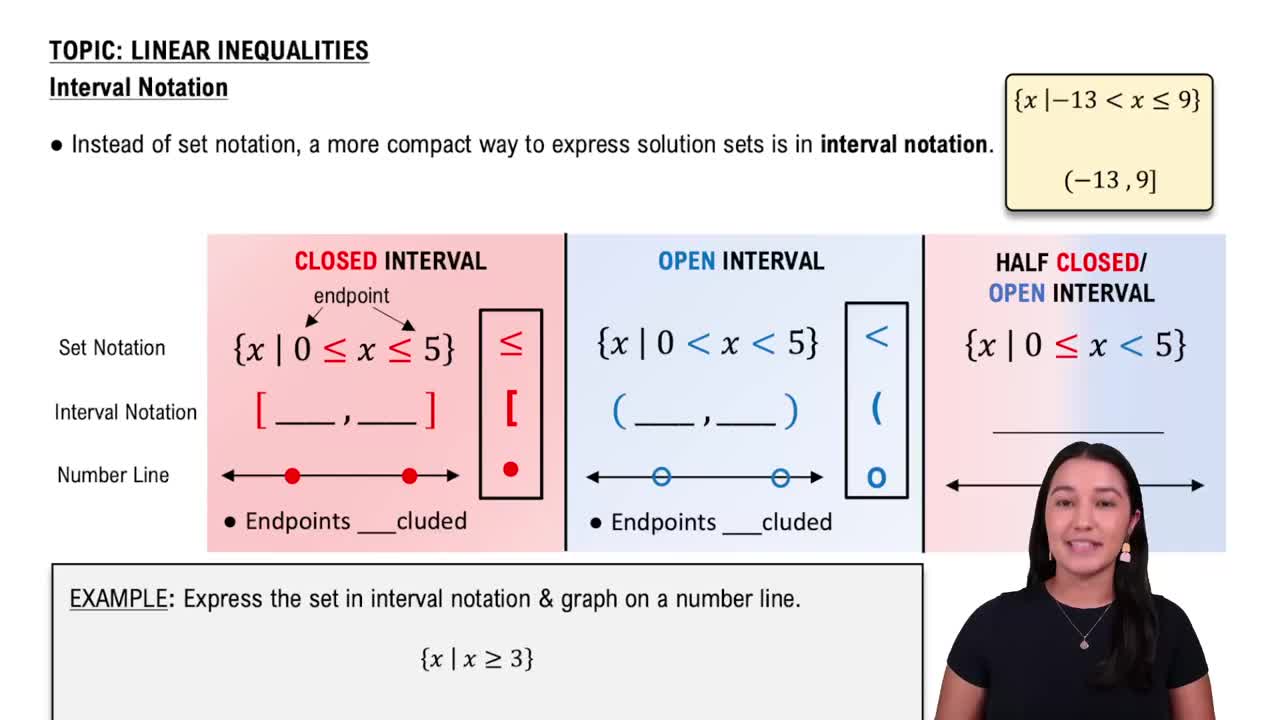
After rewriting the inequality, determine where the numerator and denominator are positive or negative. Use critical points to divide the number line into intervals and test each to find where the inequality holds true.


 12:29 minutes
 Verified step by step guidance
 3:21
3:21