The equations in Exercises 79–90 combine the types of equations we have discussed in this section. Solve each equation. Then state whether the equation is an identity, a conditional equation, or an inconsistent equation. 4/(x - 2) + 3/(x + 5) = 7/(x + 5)(x - 2)
Table of contents
- 0. Review of Algebra4h 18m
- 1. Equations & Inequalities3h 18m
- 2. Graphs of Equations1h 43m
- 3. Functions2h 17m
- 4. Polynomial Functions1h 44m
- 5. Rational Functions1h 23m
- 6. Exponential & Logarithmic Functions2h 28m
- 7. Systems of Equations & Matrices4h 5m
- 8. Conic Sections2h 23m
- 9. Sequences, Series, & Induction1h 22m
- 10. Combinatorics & Probability1h 45m
1. Equations & Inequalities
Linear Equations
Problem 99
Textbook Question
In Exercises 99–106, solve each equation. [(3 + 6)2 ÷ 3] × 4 = - 54 x
Verified step by step guidance1
First, simplify the expression inside the parentheses: calculate \$3 + 6$.
Next, square the result from the first step: compute \((3 + 6)^2\).
Then, divide the squared result by 3: calculate \(\frac{(3 + 6)^2}{3}\).
Multiply the quotient by 4 as indicated: compute \(\left(\frac{(3 + 6)^2}{3}\right) \times 4\).
Set the expression equal to \(-54x\) and solve for \(x\) by isolating \(x\) on one side of the equation.
Verified video answer for a similar problem:This video solution was recommended by our tutors as helpful for the problem above
Video duration:
2mPlay a video:
Was this helpful?
Key Concepts
Here are the essential concepts you must grasp in order to answer the question correctly.
Order of Operations
The order of operations dictates the sequence in which mathematical operations are performed: parentheses first, then exponents, followed by multiplication and division (from left to right), and finally addition and subtraction. Correctly applying this ensures accurate simplification of expressions.
Recommended video:
Guided course
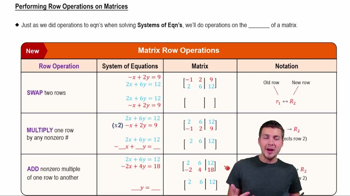
Performing Row Operations on Matrices
Solving Linear Equations
Solving linear equations involves isolating the variable on one side of the equation using inverse operations such as addition, subtraction, multiplication, or division. The goal is to find the value of the variable that makes the equation true.
Recommended video:
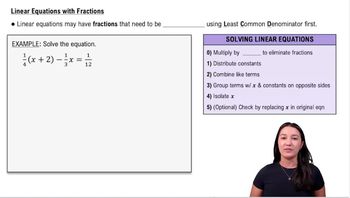
Solving Linear Equations with Fractions
Distributive Property and Simplification
The distributive property allows you to multiply a sum by multiplying each addend separately and then adding the products. Simplifying expressions using this property helps in reducing complex expressions to simpler forms, making it easier to solve equations.
Recommended video:
Guided course
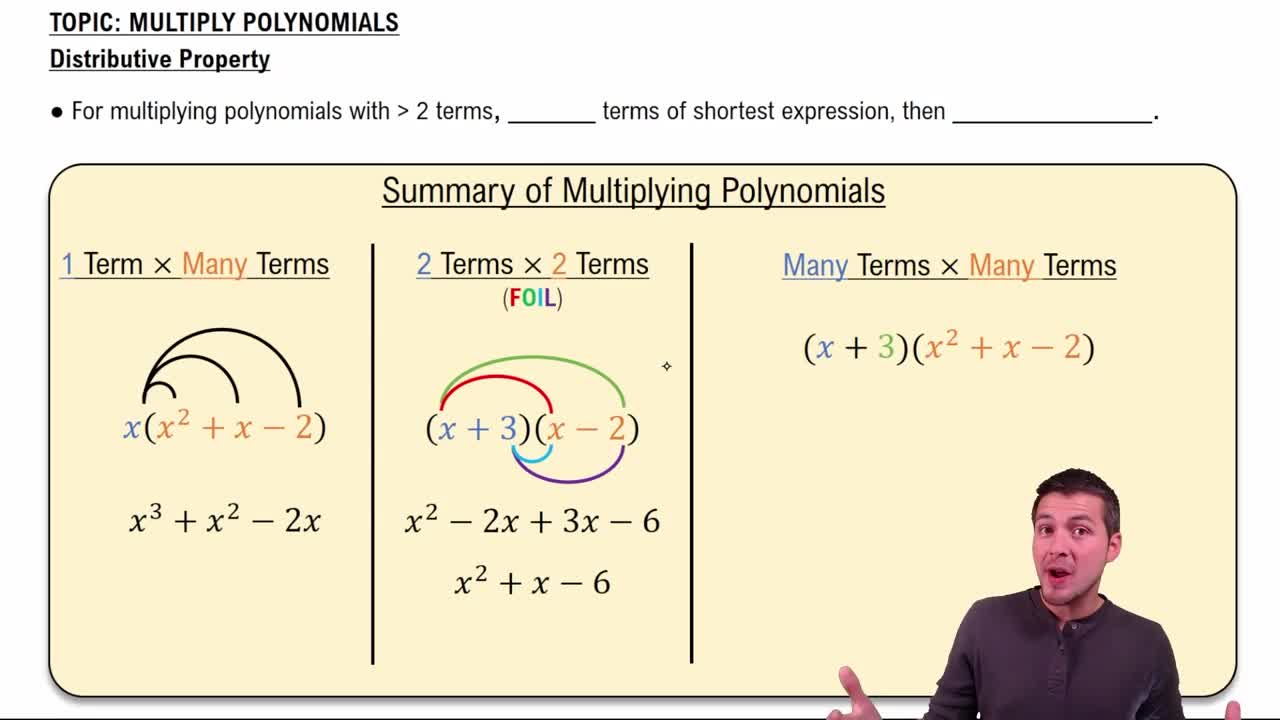
Multiply Polynomials Using the Distributive Property
Watch next
Master Introduction to Solving Linear Equtions with a bite sized video explanation from Patrick
Start learningRelated Videos
Related Practice
Textbook Question
760
views