Simplify each radical. Assume all variables represent positive real numbers. ⁶√x¹⁸y²
Verified step by step guidance
1
Identify the expression: \( \sqrt[6]{x^{18}y^2} \).
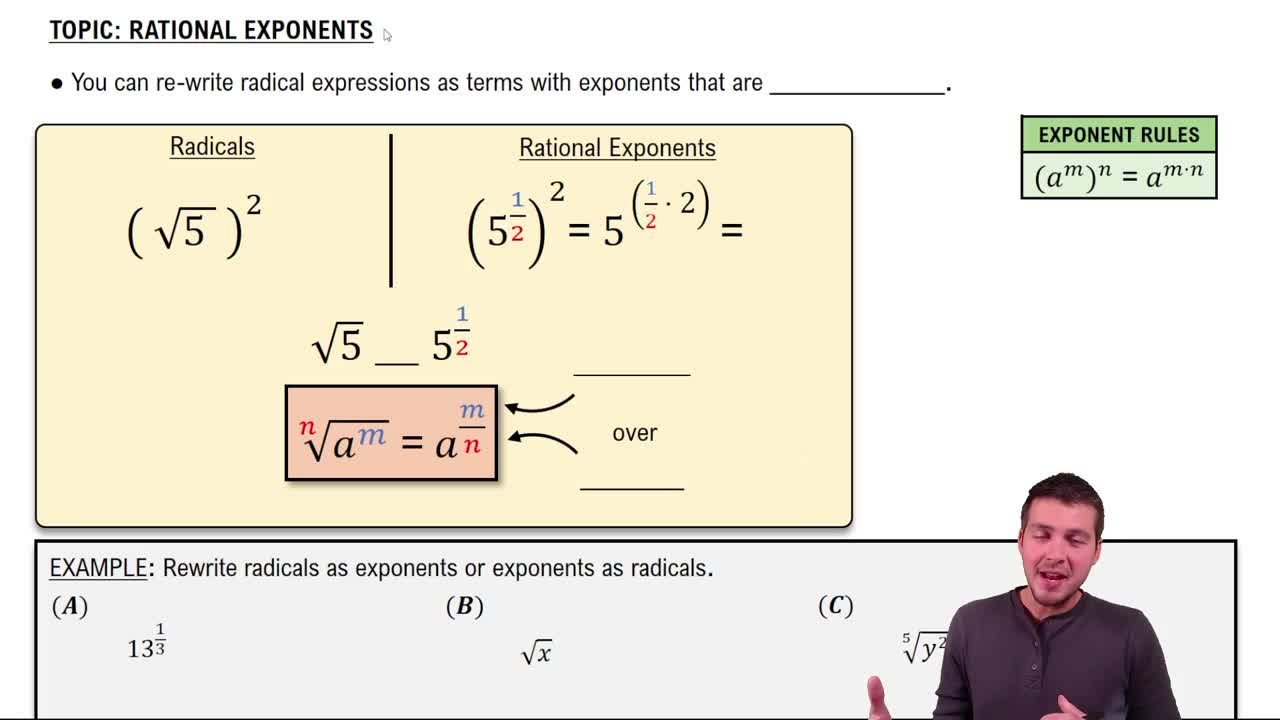
Apply the property of radicals: \( \sqrt[n]{a^m} = a^{m/n} \).
Rewrite the expression using the property: \( (x^{18}y^2)^{1/6} \).
Distribute the exponent \( \frac{1}{6} \) to each term inside the parentheses: \( x^{18/6} \cdot y^{2/6} \).
Simplify the exponents: \( x^3 \cdot y^{1/3} \).
Verified video answer for a similar problem:
This video solution was recommended by our tutors as helpful for the problem above
Video duration:
2m
Play a video:
Was this helpful?
Key Concepts
Here are the essential concepts you must grasp in order to answer the question correctly.
Radical Expressions
Radical expressions involve roots, such as square roots or cube roots. The notation ⁶√ indicates a sixth root, which means finding a number that, when raised to the sixth power, equals the expression inside the radical. Understanding how to manipulate and simplify these expressions is crucial for solving problems involving radicals.
Exponents represent repeated multiplication, while roots are the inverse operation. For example, the sixth root of a variable raised to a power can be simplified using the property that ⁶√(a^b) = a^(b/6). This concept is essential for simplifying radical expressions, especially when dealing with variables and their powers.
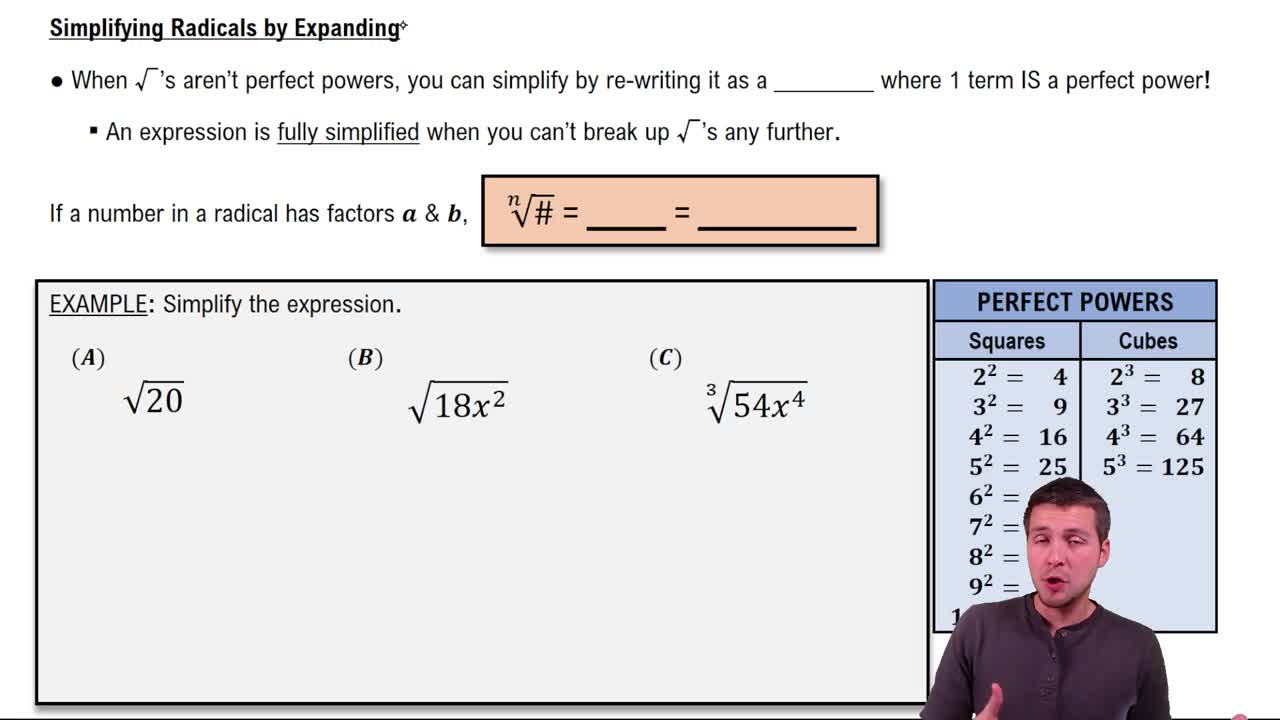
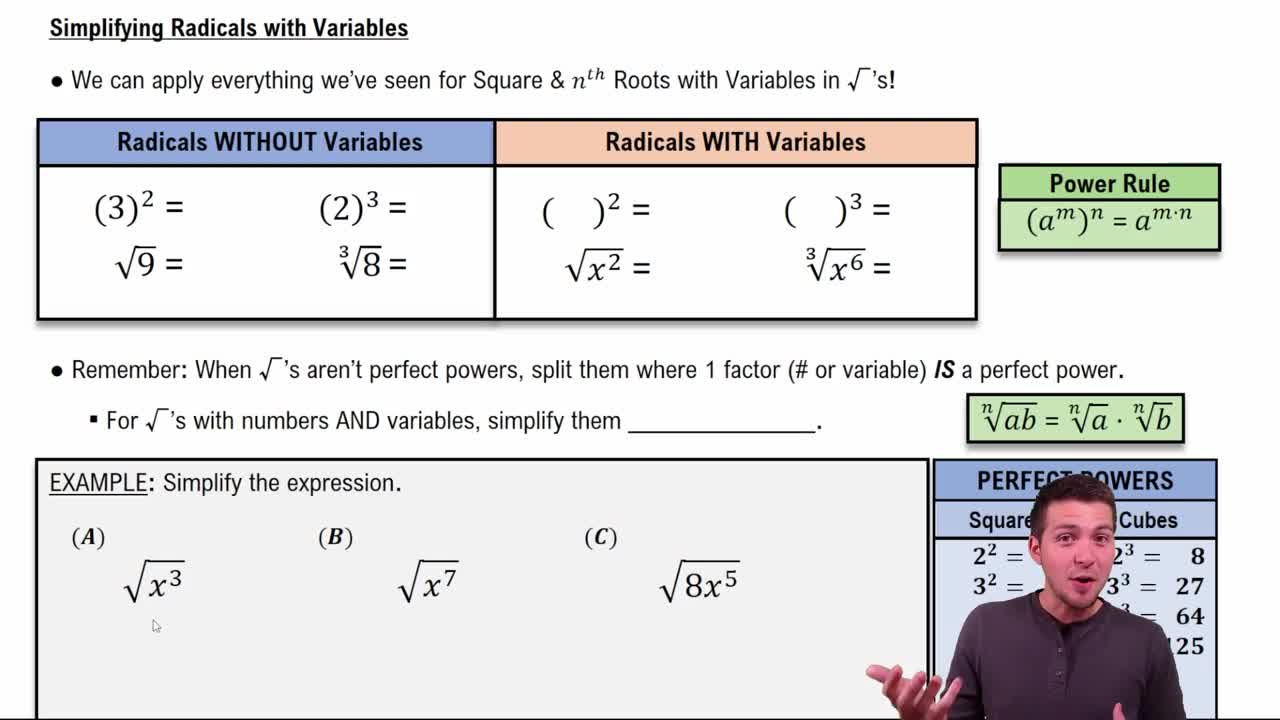
Simplifying radicals involves reducing the expression to its simplest form by factoring out perfect powers. For instance, in the expression ⁶√(x¹⁸y²), we can separate the variables and simplify each part individually. This process helps in expressing the radical in a more manageable form, making it easier to work with in algebraic equations.