Solve each exponential equation in Exercises 23–48. Express the solution set in terms of natural logarithms or common logarithms. Then use a calculator to obtain a decimal approximation, correct to two decimal places, for the solution. 3e^5x=1977
Table of contents
- 0. Review of Algebra4h 18m
- 1. Equations & Inequalities3h 18m
- 2. Graphs of Equations1h 43m
- 3. Functions2h 17m
- 4. Polynomial Functions1h 44m
- 5. Rational Functions1h 23m
- 6. Exponential & Logarithmic Functions2h 28m
- 7. Systems of Equations & Matrices4h 5m
- 8. Conic Sections2h 23m
- 9. Sequences, Series, & Induction1h 22m
- 10. Combinatorics & Probability1h 45m
6. Exponential & Logarithmic Functions
Solving Exponential and Logarithmic Equations
Problem 35
Textbook Question
Solve each equation. In Exercises 11–34, give irrational solutions as decimals correct to the nearest thousandth. In Exercises 35-40, give solutions in exact form. See Examples 1–4.e^2x - 6e^x + 8 = 0
Verified step by step guidance1
Let \( u = e^x \). This substitution transforms the equation into a quadratic form: \( u^2 - 6u + 8 = 0 \).
Factor the quadratic equation: \( (u - 2)(u - 4) = 0 \).
Set each factor equal to zero and solve for \( u \): \( u - 2 = 0 \) or \( u - 4 = 0 \).
Solve for \( u \): \( u = 2 \) or \( u = 4 \).
Substitute back \( u = e^x \) and solve for \( x \): \( e^x = 2 \) or \( e^x = 4 \). Use natural logarithms to find \( x \).
Verified video answer for a similar problem:This video solution was recommended by our tutors as helpful for the problem above
Video duration:
6mPlay a video:
Was this helpful?
Key Concepts
Here are the essential concepts you must grasp in order to answer the question correctly.
Exponential Equations
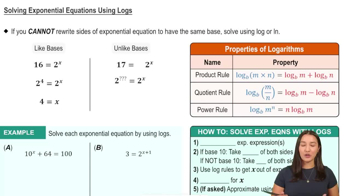
Exponential equations involve variables in the exponent, such as e^x. To solve these equations, one often uses substitution to simplify the expression. For example, if we let y = e^x, the equation can be transformed into a quadratic form, making it easier to solve.
Recommended video:
Solving Exponential Equations Using Logs
Quadratic Formula
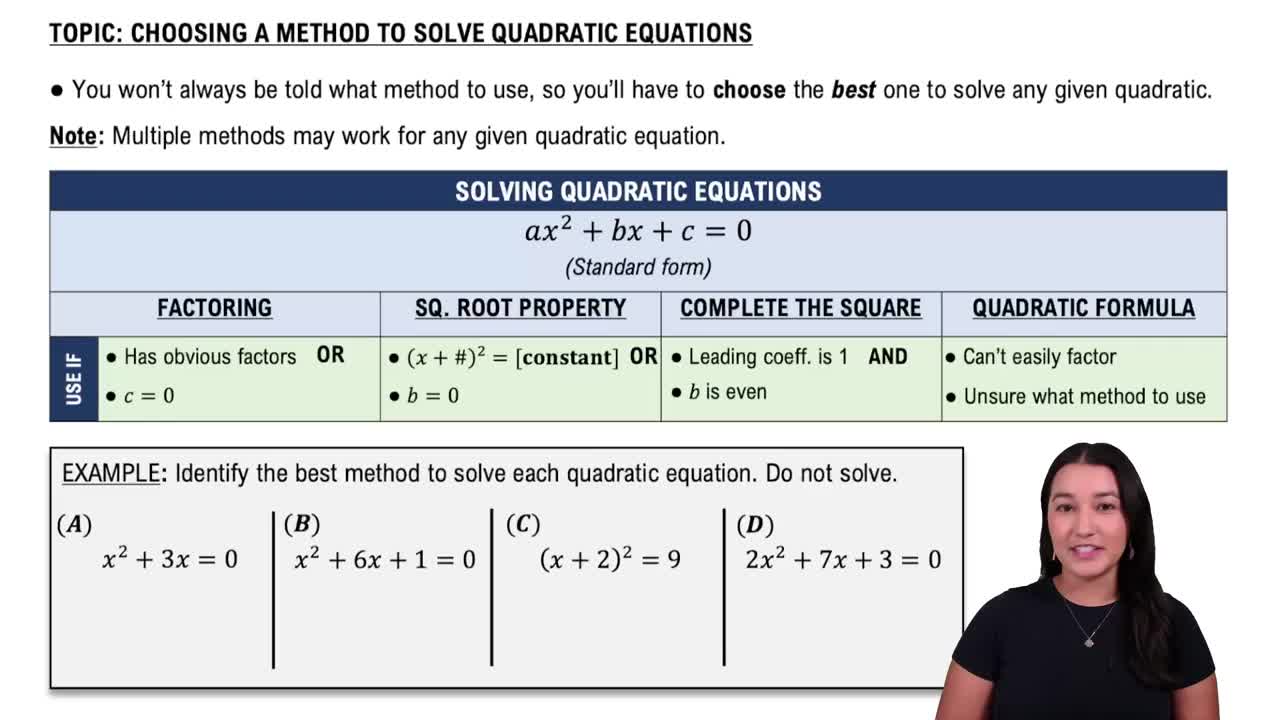
The quadratic formula is a method for solving quadratic equations of the form ax^2 + bx + c = 0. It states that the solutions for x can be found using x = (-b ± √(b² - 4ac)) / (2a). This formula is essential for finding exact solutions, especially when the equation does not factor easily.
Recommended video:
Solving Quadratic Equations Using The Quadratic Formula
Irrational and Exact Solutions
Irrational solutions are those that cannot be expressed as simple fractions and often involve square roots or other non-repeating decimals. In contrast, exact solutions are expressed in their simplest radical form. Understanding how to convert between these forms is crucial for providing answers in the required format.
Recommended video:
Guided course
Systems of Inequalities
Watch next
Master Solving Exponential Equations Using Like Bases with a bite sized video explanation from Patrick
Start learningRelated Videos
Related Practice
Textbook Question
702
views