Solve each exponential equation in Exercises 23–48. Express the solution set in terms of natural logarithms or common logarithms. Then use a calculator to obtain a decimal approximation, correct to two decimal places, for the solution. 5ex=23
Table of contents
- 0. Review of Algebra4h 18m
- 1. Equations & Inequalities3h 18m
- 2. Graphs of Equations1h 43m
- 3. Functions2h 17m
- 4. Polynomial Functions1h 44m
- 5. Rational Functions1h 23m
- 6. Exponential & Logarithmic Functions2h 28m
- 7. Systems of Equations & Matrices4h 5m
- 8. Conic Sections2h 23m
- 9. Sequences, Series, & Induction1h 22m
- 10. Combinatorics & Probability1h 45m
6. Exponential & Logarithmic Functions
Solving Exponential and Logarithmic Equations
Problem 33
Textbook Question
Solve each equation. In Exercises 11–34, give irrational solutions as decimals correct to the nearest thousandth. In Exercises 35-40, give solutions in exact form. 5(1.015)x-1980 = 8
Verified step by step guidance1
Start with the given equation: \$5(1.015)^{x-1980} = 8$.
Isolate the exponential expression by dividing both sides of the equation by 5: \((1.015)^{x-1980} = \frac{8}{5}\).
To solve for the exponent \(x - 1980\), take the natural logarithm (ln) of both sides: \(\ln\left((1.015)^{x-1980}\right) = \ln\left(\frac{8}{5}\right)\).
Use the logarithm power rule to bring down the exponent: \((x - 1980) \cdot \ln(1.015) = \ln\left(\frac{8}{5}\right)\).
Finally, solve for \(x\) by dividing both sides by \(\ln(1.015)\) and then adding 1980: \(x = \frac{\ln\left(\frac{8}{5}\right)}{\ln(1.015)} + 1980\).
Verified video answer for a similar problem:This video solution was recommended by our tutors as helpful for the problem above
Video duration:
1mPlay a video:
Was this helpful?
Key Concepts
Here are the essential concepts you must grasp in order to answer the question correctly.
Exponential Equations
An exponential equation involves variables in the exponent, such as a^(x) = b. Solving these requires isolating the exponential expression and often using logarithms to solve for the variable in the exponent.
Recommended video:
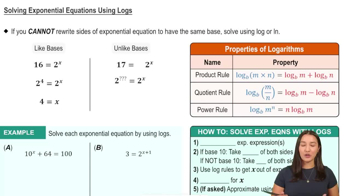
Solving Exponential Equations Using Logs
Logarithms and Their Properties
Logarithms are the inverse operations of exponentials, allowing us to solve equations where the variable is an exponent. Key properties include log(a^b) = b*log(a), which helps isolate the variable when taking logarithms of both sides.
Recommended video:
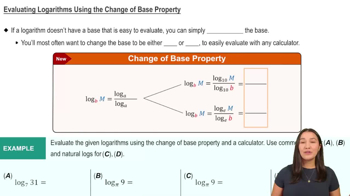
Change of Base Property
Rounding Decimal Answers
When solutions are irrational, they are often expressed as decimals rounded to a specified place value. Here, answers must be rounded to the nearest thousandth, meaning three digits after the decimal point.
Recommended video:
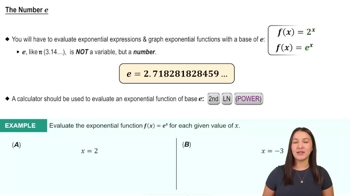
The Number e
Watch next
Master Solving Exponential Equations Using Like Bases with a bite sized video explanation from Patrick
Start learningRelated Videos
Related Practice
Textbook Question
626
views