Table of contents
- 0. Review of Algebra4h 18m
- 1. Equations & Inequalities3h 18m
- 2. Graphs of Equations1h 43m
- 3. Functions2h 17m
- 4. Polynomial Functions1h 44m
- 5. Rational Functions1h 23m
- 6. Exponential & Logarithmic Functions2h 28m
- 7. Systems of Equations & Matrices4h 5m
- 8. Conic Sections2h 23m
- 9. Sequences, Series, & Induction1h 22m
- 10. Combinatorics & Probability1h 45m
4. Polynomial Functions
Zeros of Polynomial Functions
Problem 8
Textbook Question
Determine whether each statement is true or false. If false, explain why. The product of a complex number and its conjugate is always a real number.
Verified step by step guidance1
Recall the definition of a complex number: it is of the form \(z = a + bi\), where \(a\) and \(b\) are real numbers and \(i\) is the imaginary unit with \(i^2 = -1\).
The conjugate of a complex number \(z = a + bi\) is given by \(\overline{z} = a - bi\).
To find the product of a complex number and its conjugate, multiply \(z\) and \(\overline{z}\): \(z \times \overline{z} = (a + bi)(a - bi)\).
Use the distributive property (FOIL) to expand the product: \((a + bi)(a - bi) = a^2 - abi + abi - b^2 i^2\).
Simplify the expression by combining like terms and using \(i^2 = -1\): the middle terms cancel out, and \(-b^2 i^2\) becomes \(+b^2\), so the product is \(a^2 + b^2\), which is a real number.
Verified video answer for a similar problem:This video solution was recommended by our tutors as helpful for the problem above
Video duration:
2mPlay a video:
Was this helpful?
Key Concepts
Here are the essential concepts you must grasp in order to answer the question correctly.
Complex Numbers
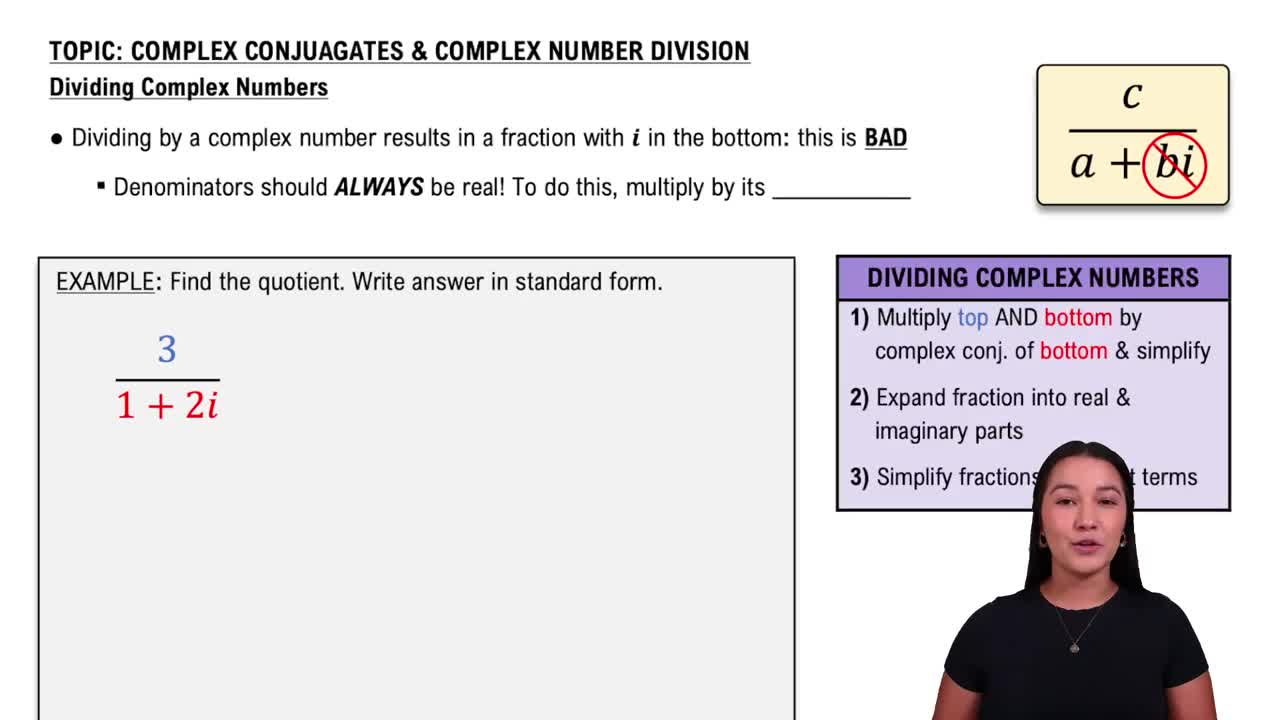
A complex number is a number in the form a + bi, where a and b are real numbers and i is the imaginary unit with the property i² = -1. Complex numbers extend the real number system and are used to represent quantities with both real and imaginary parts.
Recommended video:
Dividing Complex Numbers
Complex Conjugate
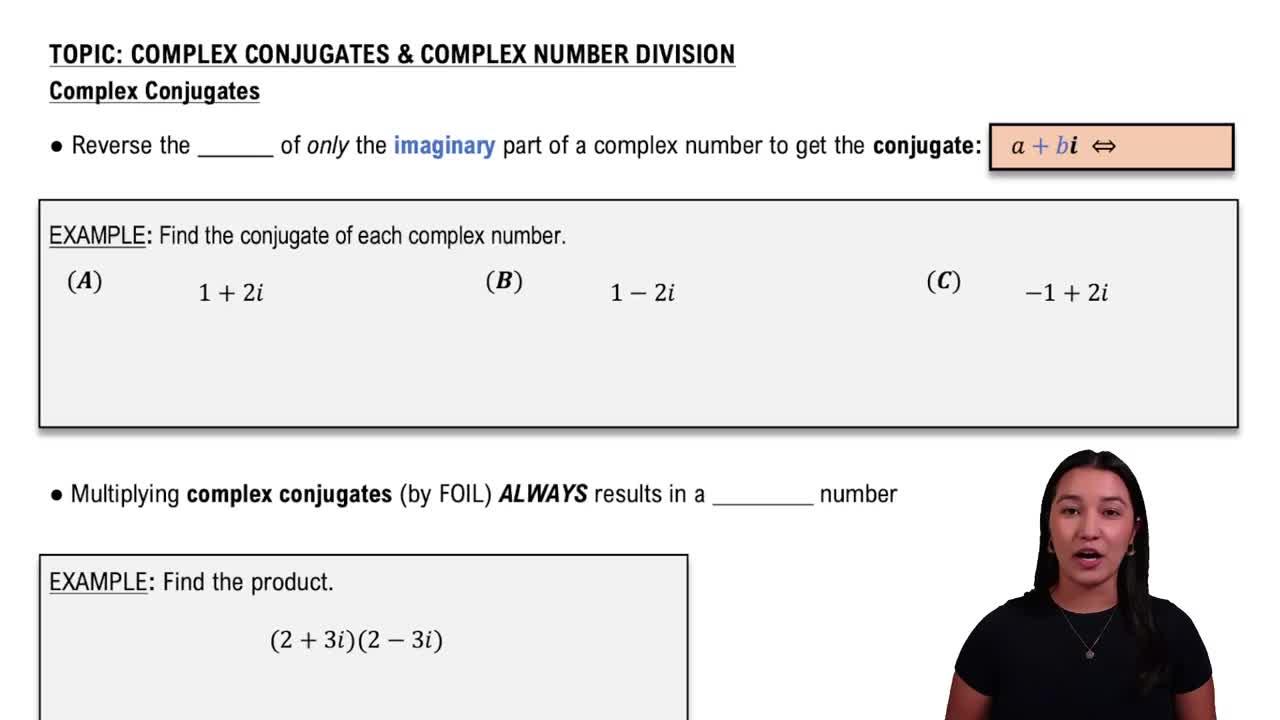
The complex conjugate of a complex number a + bi is a - bi. It reflects the number across the real axis in the complex plane, changing the sign of the imaginary part while keeping the real part the same.
Recommended video:
Complex Conjugates
Product of a Complex Number and Its Conjugate
Multiplying a complex number by its conjugate results in a real number equal to a² + b², which is the sum of the squares of the real and imaginary parts. This product is always non-negative and has no imaginary component.
Recommended video:
Complex Conjugates
Related Videos
Related Practice
Textbook Question
Determine the different possibilities for the numbers of positive, negative, and nonreal complex zeros of each function. See Example 7. ƒ(x)=5x^6-6x^5+7x^3-4x^2+x+2
262
views