Write each root using exponents and evaluate. ∛-343
Verified step by step guidance
1
Identify the expression: \( \sqrt[3]{-343} \).
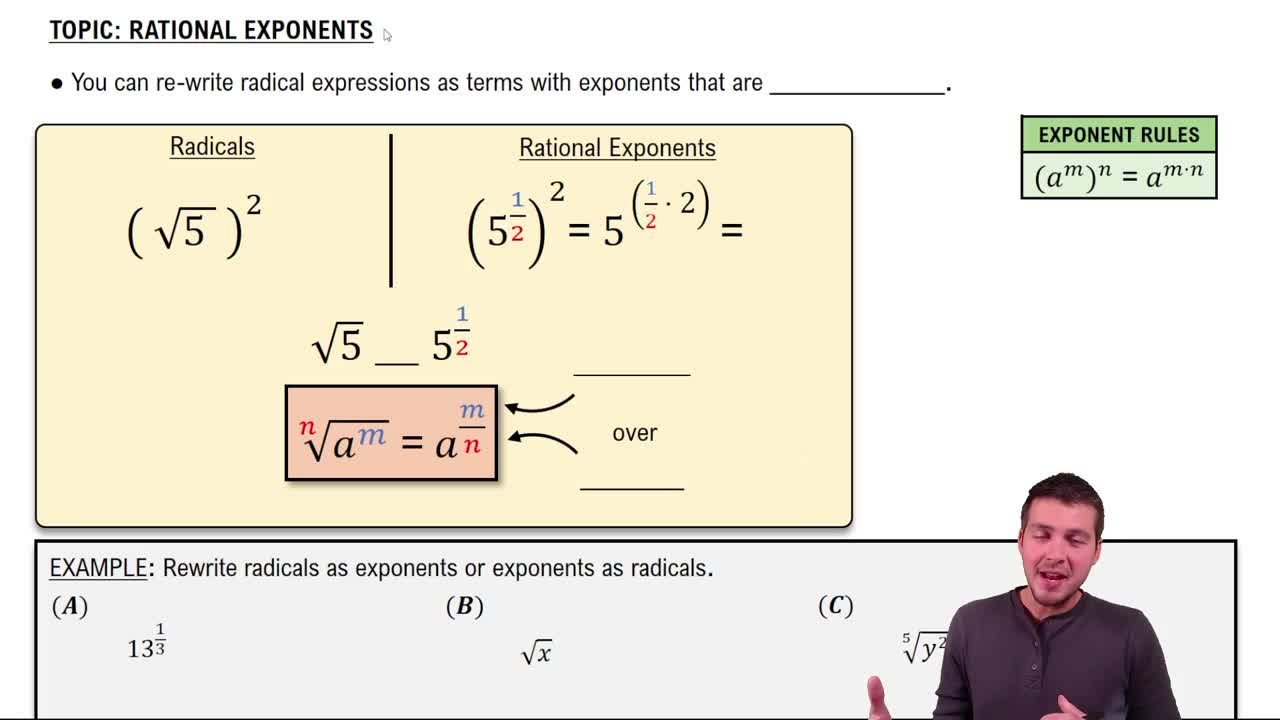
Rewrite the expression using exponents: \( (-343)^{1/3} \).
Recognize that \(-343\) is a negative number, and the cube root of a negative number is also negative.
Find the cube root of the absolute value of \(-343\), which is \(343\).
Determine the cube root of \(343\) by finding a number that, when multiplied by itself three times, equals \(343\).
Verified video answer for a similar problem:
This video solution was recommended by our tutors as helpful for the problem above
Video duration:
1m
Play a video:
Was this helpful?
Key Concepts
Here are the essential concepts you must grasp in order to answer the question correctly.
Roots and Exponents
Roots and exponents are fundamental concepts in algebra that describe the relationship between numbers. The nth root of a number is a value that, when raised to the nth power, gives the original number. For example, the cube root (∛) of a number x is expressed as x^(1/3). Understanding how to convert between roots and exponents is essential for simplifying expressions and solving equations.
When dealing with roots, particularly odd roots like the cube root, negative numbers can yield real results. For instance, the cube root of -343 is -7, since (-7)³ = -343. This contrasts with even roots, where the root of a negative number is not a real number. Recognizing how negative values interact with roots is crucial for accurate evaluations.
Evaluating expressions involves substituting values into mathematical expressions and simplifying them to find a numerical result. In the context of roots, this means calculating the value of the root expression after converting it to its exponential form. Mastery of this concept allows students to solve problems efficiently and accurately, ensuring they can handle various algebraic expressions.