
Textbook Question
Use the product rule to simplify the expressions in Exercises 13–22. In Exercises 17–22, assume that variables represent nonnegative real numbers.
1100
views

 Verified step by step guidance
 04:10
04:10 04:10
04:10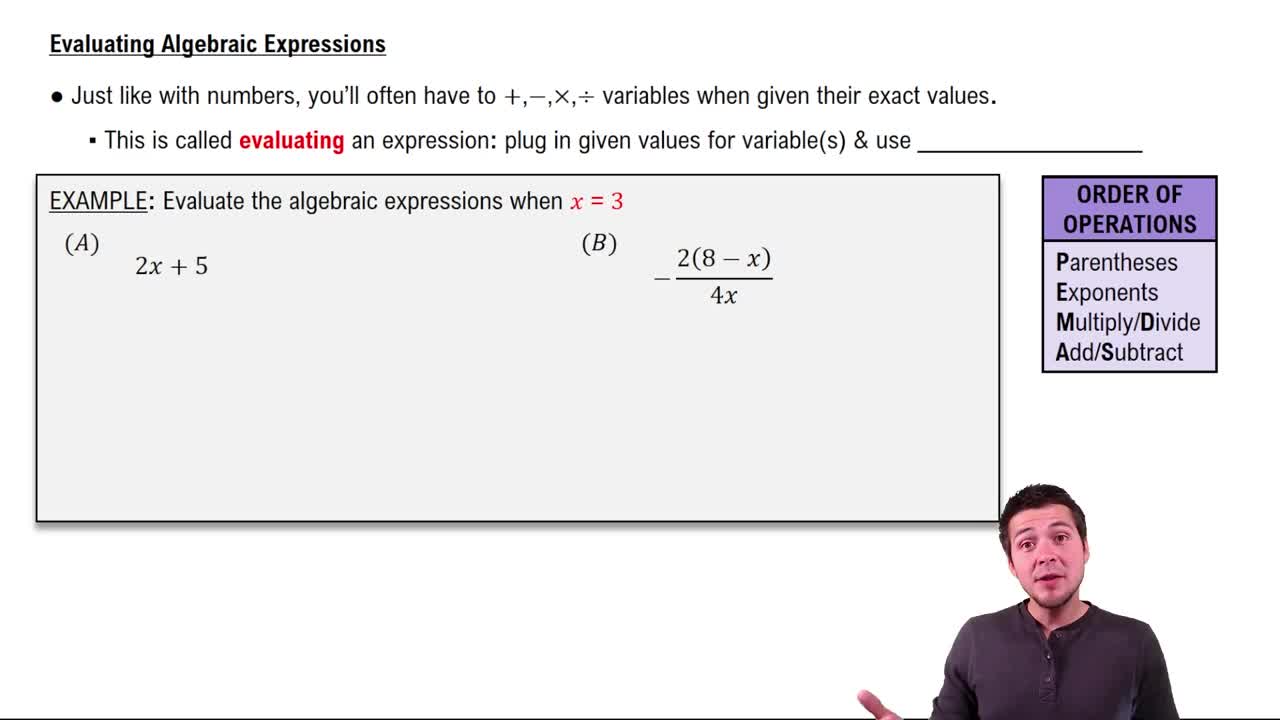 03:11
03:11Use the product rule to simplify the expressions in Exercises 13–22. In Exercises 17–22, assume that variables represent nonnegative real numbers.
The formula C=5/9(F-32) expresses the relationship between Fahrenheit temperature, F, and Celsius temperature, C. In Exercises 17–18, use the formula to convert the given Fahrenheit temperature to its equivalent temperature on the Celsius scale. 50 °F
In Exercises 15–58, find each product. (x+1)(x2−x+1)
In Exercises 15–58, find each product. (2x−3)(x2−3x+5)
In Exercises 1–16, evaluate each algebraic expression for the given value or values of the variable(s). (2x+3y)/(x+1), for x=-2 and y=4
Multiply or divide as indicated.