In Exercises 11–28, add or subtract as indicated. You will need to simplify terms to identify the like radicals.
___ ___
5√45x - 2√20x
Verified step by step guidance
1
Identify the like radicals by simplifying each radical expression.
Simplify \( \sqrt{45x} \) by factoring 45 as \( 9 \times 5 \) and using \( \sqrt{9} = 3 \), so \( \sqrt{45x} = 3\sqrt{5x} \).
Simplify \( \sqrt{20x} \) by factoring 20 as \( 4 \times 5 \) and using \( \sqrt{4} = 2 \), so \( \sqrt{20x} = 2\sqrt{5x} \).
Rewrite the original expression using the simplified radicals: \( 5(3\sqrt{5x}) - 2(2\sqrt{5x}) \).
Combine the like terms by factoring out \( \sqrt{5x} \): \( (5 \times 3 - 2 \times 2)\sqrt{5x} \).
Verified video answer for a similar problem:
This video solution was recommended by our tutors as helpful for the problem above.
Video duration:
5m
Play a video:
0 Comments
Key Concepts
Here are the essential concepts you must grasp in order to answer the question correctly.
Radical Expressions
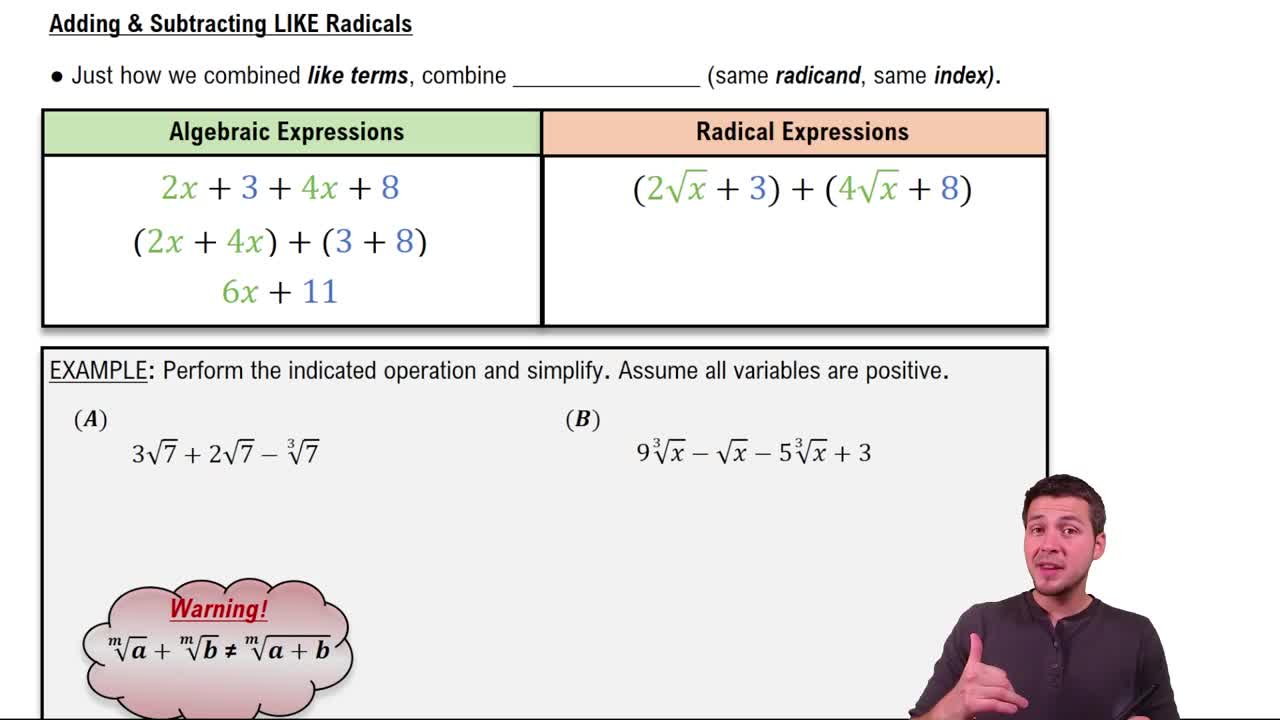
Radical expressions involve roots, such as square roots, cube roots, etc. In this context, we are dealing with square roots, which are denoted by the radical symbol (√). Understanding how to manipulate these expressions, including simplifying them, is crucial for performing operations like addition and subtraction.
Like radicals are terms that have the same radicand (the number or expression inside the radical) and the same index. For example, √20 and √45 are not like radicals because their radicands differ. To add or subtract radical expressions, it is essential to simplify them to like radicals, allowing for straightforward combination of the terms.
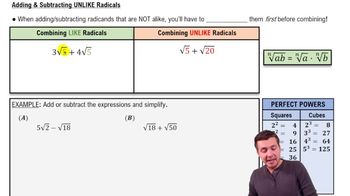
Simplifying radicals involves breaking down the radicand into its prime factors and extracting any perfect squares. For instance, √45 can be simplified to 3√5, as 45 = 9 × 5 and √9 = 3. This process is necessary to identify like radicals and perform addition or subtraction accurately.

 5:16 minutes
 Verified step by step guidance
 05:45
05:45