Recognize that the equation given is in logarithmic form: \( x = \log_7 \sqrt[5]{7} \).
Recall the property of logarithms: \( \log_b a^c = c \cdot \log_b a \).
Apply this property to the equation: \( x = \log_7 (7^{1/5}) \).
Use the property to simplify: \( x = \frac{1}{5} \cdot \log_7 7 \).
Remember that \( \log_b b = 1 \), so \( \log_7 7 = 1 \). Substitute this into the equation to find \( x \).
Verified video answer for a similar problem:
This video solution was recommended by our tutors as helpful for the problem above
Video duration:
3m
Play a video:
Was this helpful?
Key Concepts
Here are the essential concepts you must grasp in order to answer the question correctly.
Logarithms
Logarithms are the inverse operations of exponentiation, allowing us to solve for the exponent in equations of the form a^b = c. The logarithm log_a(c) answers the question: 'To what power must the base a be raised to produce c?' Understanding logarithms is essential for manipulating and solving equations involving exponential relationships.
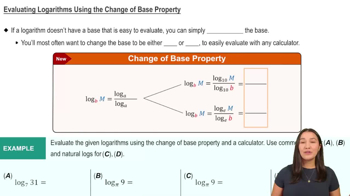
The Change of Base Formula allows us to convert logarithms from one base to another, which is particularly useful when using calculators that typically only compute logarithms in base 10 or base e. The formula states that log_a(b) = log_c(b) / log_c(a), where c is any positive number. This concept is crucial for solving logarithmic equations that involve bases other than those readily available on calculators.
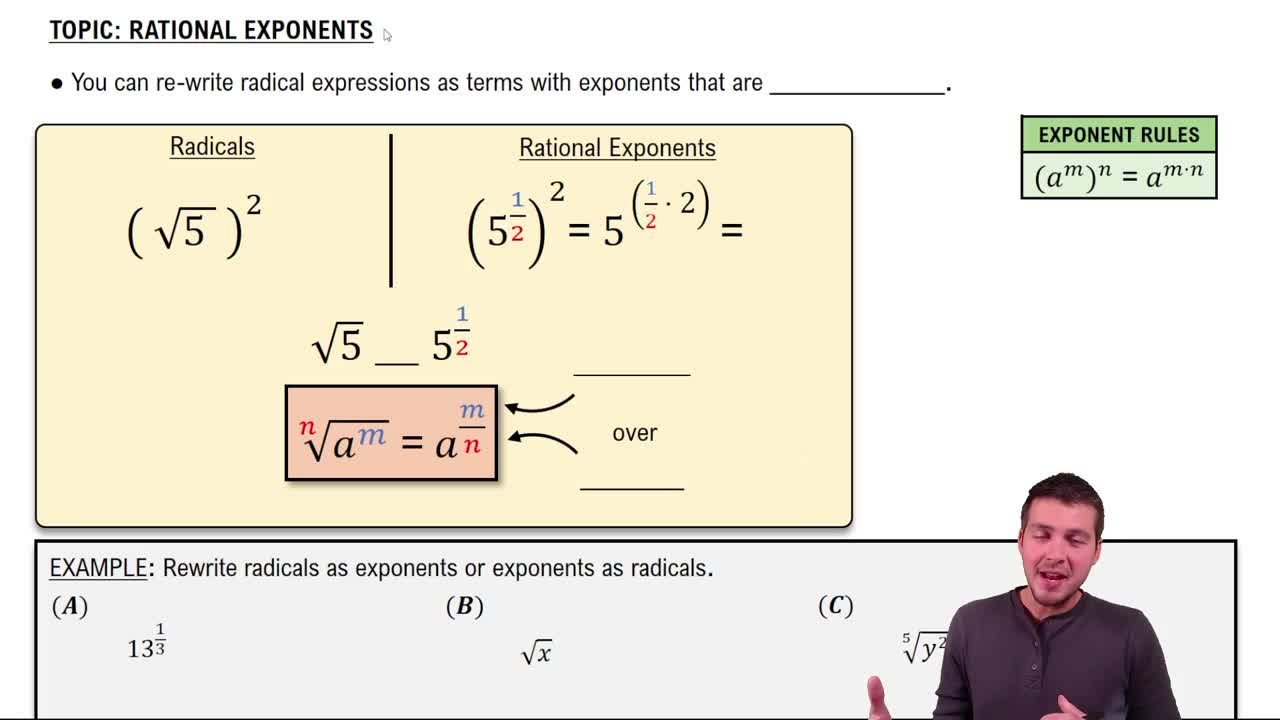
Radicals, such as square roots or cube roots, are expressions that represent the inverse operation of exponentiation. The expression ⁵√7 can be rewritten as 7^(1/5), indicating the fifth root of 7. Understanding how to manipulate radicals and exponents is vital for simplifying expressions and solving equations that involve both logarithmic and radical forms.