Identify the base of the logarithm. The problem is written as \( \log_{x} \frac{27}{64} = 3 \), where \(x\) is the base of the logarithm.
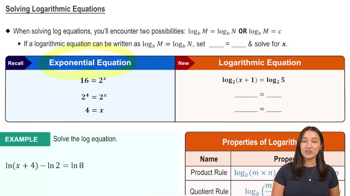
Rewrite the logarithmic equation in its equivalent exponential form. Recall that \( \log_{a} b = c \) means \( a^{c} = b \). So, rewrite as \( x^{3} = \frac{27}{64} \).
Recognize that both \(27\) and \(64\) are perfect powers: \(27 = 3^{3}\) and \(64 = 4^{3}\). Substitute these into the equation to get \( x^{3} = \frac{3^{3}}{4^{3}} \).
Use the property of exponents that \( \frac{a^{n}}{b^{n}} = \left( \frac{a}{b} \right)^{n} \) to rewrite the right side as \( \left( \frac{3}{4} \right)^{3} \). So the equation becomes \( x^{3} = \left( \frac{3}{4} \right)^{3} \).
Since the bases and exponents are equal, conclude that \( x = \frac{3}{4} \).
Verified video answer for a similar problem:
This video solution was recommended by our tutors as helpful for the problem above
Video duration:
1m
Play a video:
Was this helpful?
Key Concepts
Here are the essential concepts you must grasp in order to answer the question correctly.
Logarithmic Equations
A logarithmic equation involves logarithms of variables and constants. Solving such equations often requires rewriting the logarithmic form into its equivalent exponential form to isolate the variable. Understanding how to manipulate and solve these equations is essential for finding the unknown values.
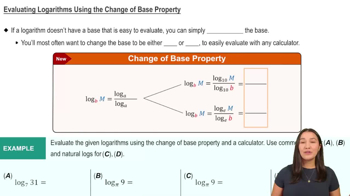
Logarithm properties, such as the product, quotient, and power rules, help simplify expressions. The change of base formula allows converting logarithms to a common base for easier calculation. These properties are crucial for rewriting and solving logarithmic equations efficiently.
Exponents represent repeated multiplication, and fractional exponents correspond to roots. Recognizing how to express numbers like 27 and 64 as powers of common bases (e.g., 3^3 and 4^3) helps in solving equations involving logarithms by equating exponents and simplifying expressions.