In Exercises 45–54, rationalize the denominator. 2/√10
Verified step by step guidance
1
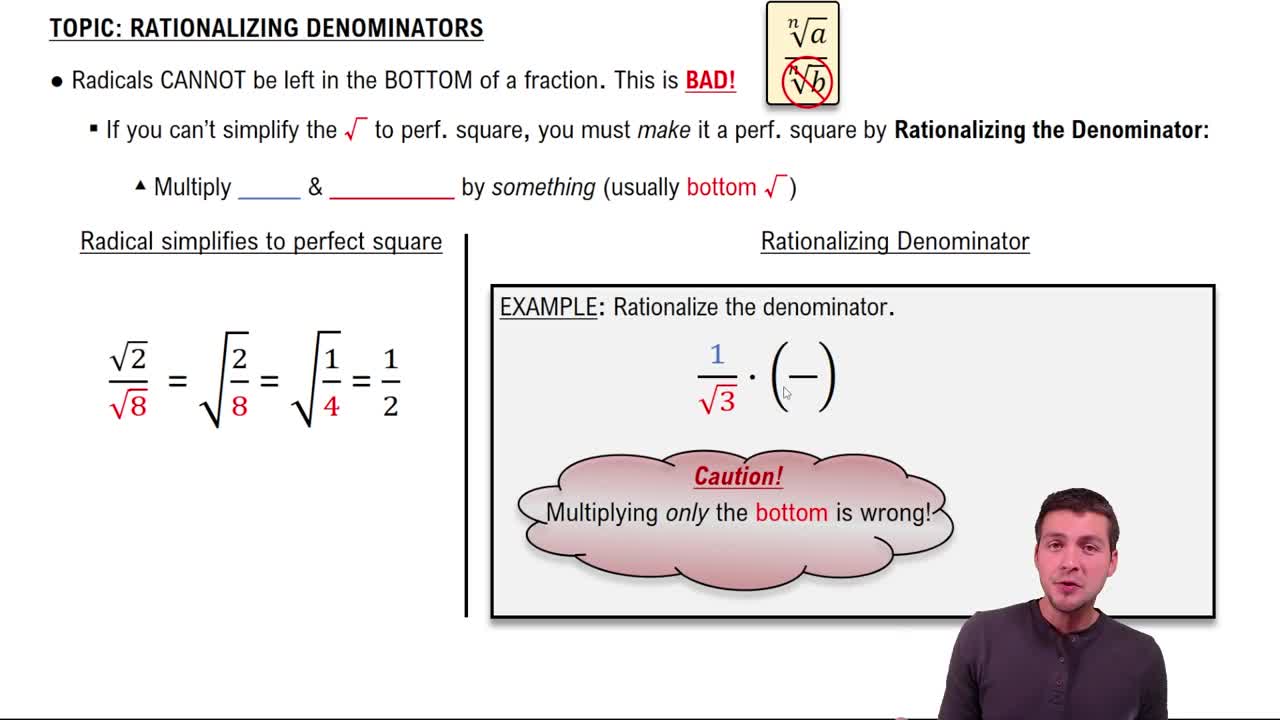
Identify the problem: The denominator contains a square root (√10), which is irrational. To rationalize the denominator, we need to eliminate the square root by multiplying both the numerator and denominator by the same square root.
Multiply both the numerator and denominator by √10. This step ensures that the value of the fraction remains unchanged, as multiplying by √10/√10 is equivalent to multiplying by 1.
Write the expression after multiplication: (2 × √10) / (√10 × √10). Simplify the denominator using the property of square roots: √a × √a = a.
Simplify the denominator: √10 × √10 = 10. The fraction now becomes (2√10) / 10.
Simplify the fraction further if possible by reducing the numerator and denominator. Check if there is a common factor between 2 and 10, and divide both by their greatest common divisor (GCD).
Verified video answer for a similar problem:
This video solution was recommended by our tutors as helpful for the problem above
Video duration:
1m
Play a video:
Was this helpful?
Key Concepts
Here are the essential concepts you must grasp in order to answer the question correctly.
Rationalizing the Denominator
Rationalizing the denominator involves eliminating any irrational numbers from the denominator of a fraction. This is typically achieved by multiplying both the numerator and the denominator by a suitable expression that will result in a rational number in the denominator. For example, to rationalize 2/√10, you would multiply by √10/√10.
Irrational numbers are numbers that cannot be expressed as a simple fraction, meaning they cannot be written as the ratio of two integers. Common examples include square roots of non-perfect squares, such as √2 or √10. In the context of rationalizing denominators, the presence of an irrational number in the denominator is what necessitates the rationalization process.
Multiplication of fractions involves multiplying the numerators together and the denominators together. When rationalizing a denominator, this principle is applied to ensure that the overall value of the fraction remains unchanged while transforming the denominator into a rational number. For instance, in the case of 2/√10, multiplying by √10/√10 results in (2√10)/(10), which simplifies the expression.