Use a graphing calculator to solve each linear equation. 3(2x+1) - 2 (x-2) =5
Verified step by step guidance
1
Start by expanding the expressions on both sides of the equation. Use the distributive property: multiply 3 by each term inside the first parentheses and -2 by each term inside the second parentheses. This gives you \$3 \times (2x + 1)\( and \)-2 \times (x - 2)$.
Rewrite the equation after distribution: \$3 \times 2x + 3 \times 1 - 2 \times x + (-2) \times (-2) = 5$.
Simplify the terms by performing the multiplications: \$6x + 3 - 2x + 4 = 5$.
Combine like terms on the left side: combine \$6x\( and \)-2x\(, and combine the constants \)3\( and \)4$ to get a simpler linear expression.
Isolate the variable term by subtracting the constant from both sides, then solve for \(x\) by dividing both sides by the coefficient of \(x\). This will give you the solution to the equation.
Verified video answer for a similar problem:
This video solution was recommended by our tutors as helpful for the problem above
Video duration:
1m
Play a video:
Was this helpful?
Key Concepts
Here are the essential concepts you must grasp in order to answer the question correctly.
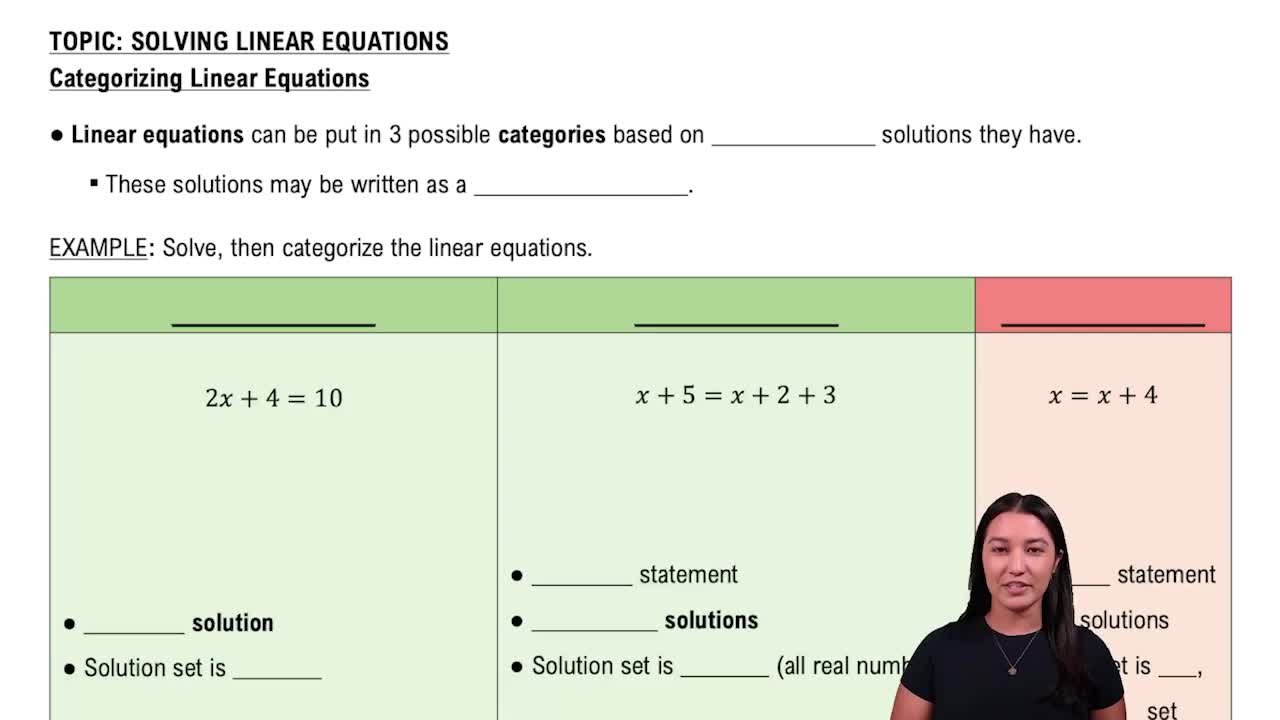
Linear Equations
A linear equation is an algebraic equation in which each term is either a constant or the product of a constant and a single variable. It forms a straight line when graphed. Understanding how to simplify and solve linear equations is essential for finding the value of the variable that satisfies the equation.
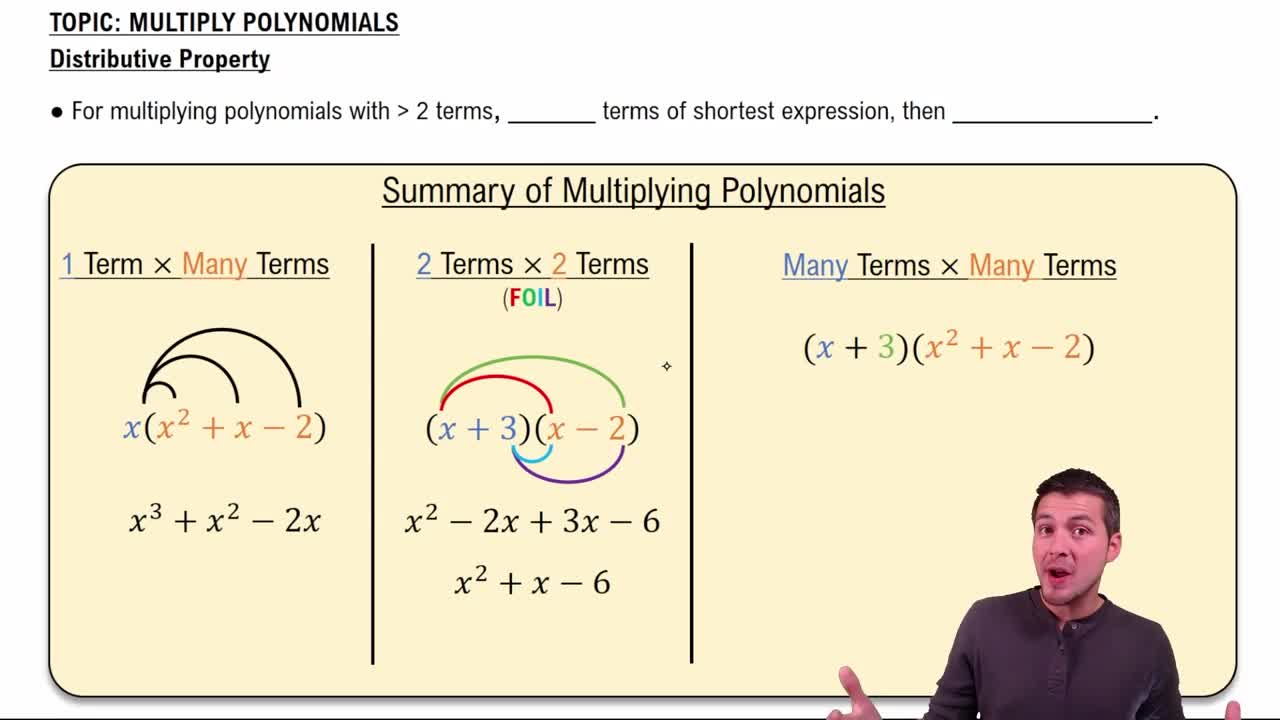
The distributive property allows you to multiply a single term by each term inside parentheses. For example, a(b + c) = ab + ac. Applying this property correctly is crucial to simplify expressions like 3(2x + 1) and -2(x - 2) before solving the equation.
Multiply Polynomials Using the Distributive Property
Using a Graphing Calculator to Solve Equations
A graphing calculator can plot the equation or related functions to visually identify solutions. By graphing both sides of the equation or the difference between them, you can find the x-value where the graphs intersect, which corresponds to the solution of the equation.