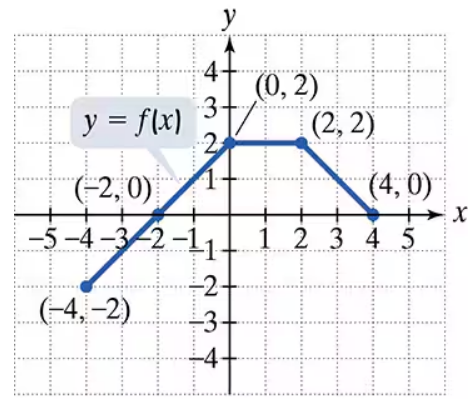
Use the graph of y = f(x) to graph each function g. g(x) = f(-x)
Table of contents
- 0. Review of Algebra4h 18m
- 1. Equations & Inequalities3h 18m
- 2. Graphs of Equations1h 43m
- 3. Functions2h 17m
- 4. Polynomial Functions1h 44m
- 5. Rational Functions1h 23m
- 6. Exponential & Logarithmic Functions2h 28m
- 7. Systems of Equations & Matrices4h 5m
- 8. Conic Sections2h 23m
- 9. Sequences, Series, & Induction1h 22m
- 10. Combinatorics & Probability1h 45m
3. Functions
Common Functions
Problem 50
Textbook Question
Use the graph of y = f(x) to graph each function g. g(x) =(1/2) f(2x)

Verified step by step guidance1
Step 1: Understand the transformations applied to the function f(x). The given function g(x) = (1/2)f(2x) involves two transformations: a horizontal compression by a factor of 2 and a vertical scaling by a factor of 1/2.
Step 2: Start with the horizontal compression. The term f(2x) means that the graph of f(x) is compressed horizontally by a factor of 2. This means that every x-coordinate of the points on the graph of f(x) is divided by 2.
Step 3: Apply the vertical scaling. The term (1/2)f(2x) means that the graph of f(2x) is scaled vertically by a factor of 1/2. This means that every y-coordinate of the points on the graph of f(2x) is multiplied by 1/2.
Step 4: Combine the transformations. To graph g(x), first apply the horizontal compression to f(x), then apply the vertical scaling to the resulting graph.
Step 5: Plot the transformed points. For each point (x, y) on the graph of f(x), calculate the new coordinates as (x/2, y/2) and plot these points to create the graph of g(x).
Verified video answer for a similar problem:This video solution was recommended by our tutors as helpful for the problem above
Video duration:
6mPlay a video:
Was this helpful?
Key Concepts
Here are the essential concepts you must grasp in order to answer the question correctly.
Function Transformation
Function transformation refers to the process of altering the graph of a function through various operations, such as stretching, compressing, or shifting. In the case of g(x) = (1/2) f(2x), the function undergoes both a vertical compression by a factor of 1/2 and a horizontal compression by a factor of 1/2, affecting the overall shape and position of the graph.
Recommended video:
Domain & Range of Transformed Functions
Horizontal Scaling
Horizontal scaling involves changing the input values of a function, which affects how the graph is stretched or compressed along the x-axis. For g(x) = (1/2) f(2x), the '2' inside the function indicates that the graph of f(x) is compressed horizontally by a factor of 2, meaning that points on the graph will be closer together compared to the original function.
Recommended video:
Horizontal Parabolas
Vertical Scaling
Vertical scaling modifies the output values of a function, impacting the graph's height. In g(x) = (1/2) f(2x), the factor of 1/2 indicates a vertical compression, meaning that the output values of f(2x) are halved. This results in the graph being pulled closer to the x-axis, reducing its overall height while maintaining the same x-coordinates.
Recommended video:
Foci and Vertices of an Ellipse
Watch next
Master Graphs of Common Functions with a bite sized video explanation from Patrick
Start learningRelated Videos
Related Practice
Textbook Question
643
views