
Textbook Question
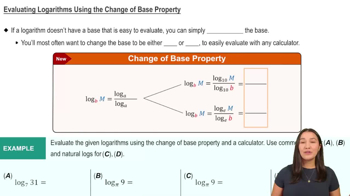
In Exercises 54–57, use properties of logarithms to condense each logarithmic expression. Write the expression as a single logarithm whose coefficient is .
1176
views

 Verified step by step guidance
 5:36
5:36
 5:26
5:26 4:20
4:20In Exercises 54–57, use properties of logarithms to condense each logarithmic expression. Write the expression as a single logarithm whose coefficient is .
Use properties of logarithms to condense each logarithmic expression. Write the expression as a single logarithm whose coefficient is 1. Where possible, evaluate logarithmic expressions without using a calculator. 5 ln x - 2 ln y
Use the compound interest formulas A = P (1+ r/n)nt and A =Pert to solve exercises 53-56. Round answers to the nearest cent. Find the accumulated value of an investment of \$10,000 for 5 years at an interest rate of 1.32% if the money is d. compounded continuously.
Use the compound interest formulas A = P (1+ r/n)nt and A =Pert to solve exercises 53-56. Round answers to the nearest cent. Find the accumulated value of an investment of \$10,000 for 5 years at an interest rate of 1.32% if the money is c. compounded monthly.
Use the compound interest formulas A = P (1+ r/n)nt and A =Pert to solve exercises 53-56. Round answers to the nearest cent. Suppose that you have \$12,000 to invest. Which investment yields the greater return over 3 years: 0.96% compounded monthly or 0.95% compounded continuously?
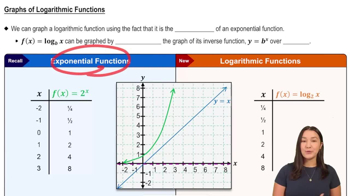
Begin by graphing f(x) = log₂ x. Then use transformations of this graph to graph the given function. What is the vertical asymptote? Use the graphs to determine each function's domain and range. h(x)=1+ log₂ x