Graph each function. Give the domain and range. ƒ(x)=-[[x]]
Verified step by step guidance
1
Identify the function given: \(f(x) = -\lfloor x \rfloor\), where \(\lfloor x \rfloor\) denotes the greatest integer less than or equal to \(x\) (the floor function).
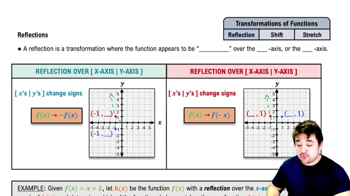
Understand the behavior of the floor function: for any real number \(x\), \(\lfloor x \rfloor\) is an integer that steps up by 1 at each integer value of \(x\). Since the function is \(-\lfloor x \rfloor\), the graph will reflect the floor function values across the x-axis (negated).
To graph the function, plot points for several values of \(x\), especially around integers. For example, for \(x\) in the interval \([0,1)\), \(\lfloor x \rfloor = 0\), so \(f(x) = 0\). For \(x\) in \([1,2)\), \(\lfloor x \rfloor = 1\), so \(f(x) = -1\), and so on. Connect these points as step segments that jump at integer values of \(x\).
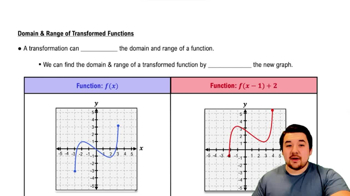
Determine the domain: since the floor function is defined for all real numbers, the domain of \(f(x)\) is all real numbers, expressed as \((-\infty, \infty)\).
Determine the range: because \(\lfloor x \rfloor\) takes all integer values from \(-\infty\) to \(\infty\), and \(f(x) = -\lfloor x \rfloor\), the range is also all integers but negated, which is still all integers \((-\infty, \infty)\).
Verified video answer for a similar problem:
This video solution was recommended by our tutors as helpful for the problem above
Video duration:
15m
Play a video:
0 Comments
Key Concepts
Here are the essential concepts you must grasp in order to answer the question correctly.
Greatest Integer Function (Floor Function)
The greatest integer function, denoted by [[x]] or ⌊x⌋, assigns to each real number x the greatest integer less than or equal to x. It creates a step-like graph where the function value jumps at integer points. Understanding this function is essential to graphing ƒ(x) = -[[x]].
Multiplying the greatest integer function by -1 reflects its graph across the x-axis. This changes the sign of all output values, flipping the step pattern downward. Recognizing this transformation helps in accurately sketching the graph of ƒ(x) = -[[x]].
The domain of the greatest integer function is all real numbers, while its range is all integers. After applying the negative sign, the range becomes all non-positive integers (including zero). Identifying domain and range is crucial for fully describing the function.

 15:55 minutes
 Verified step by step guidance
 4:56
4:56