Graph each piecewise-defined function. See Example 2. ƒ(x)={-2x if x<-3, 3x-1 if -3≤x≤2, -4x if x>2
Table of contents
- 0. Review of Algebra4h 18m
- 1. Equations & Inequalities3h 18m
- 2. Graphs of Equations1h 43m
- 3. Functions2h 17m
- 4. Polynomial Functions1h 44m
- 5. Rational Functions1h 23m
- 6. Exponential & Logarithmic Functions2h 28m
- 7. Systems of Equations & Matrices4h 5m
- 8. Conic Sections2h 23m
- 9. Sequences, Series, & Induction1h 22m
- 10. Combinatorics & Probability1h 45m
3. Functions
Intro to Functions & Their Graphs
Problem 35
Textbook Question
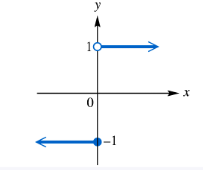
Give a rule for each piecewise-defined function. Also give the domain and range.

Verified step by step guidance1
Step 1: Identify the two pieces of the piecewise function based on the graph. The graph shows two horizontal lines: one starting at (0, 5) and extending to the right, and another starting at (0, -3) and extending to the left.
Step 2: Write the rule for the right piece (x ≥ 0). Since the line is horizontal at y = 5, the function rule for this piece is \(f(x) = 5\) for \(x \geq 0\). Note that the point at (0, 5) is an open circle, so the value at x = 0 is not included in this piece.
Step 3: Write the rule for the left piece (x < 0). The line is horizontal at y = -3, and the point at (0, -3) is a closed circle, so the function rule for this piece is \(f(x) = -3\) for \(x < 0\).
Step 4: Define the domain of the piecewise function. Since the function covers all x-values from negative infinity to positive infinity, the domain is \((-\infty, \infty)\).
Step 5: Define the range of the function. The function only takes the values 5 and -3, so the range is the set \({-3, 5}\).
Verified video answer for a similar problem:This video solution was recommended by our tutors as helpful for the problem above
Video duration:
5mPlay a video:
Was this helpful?
Key Concepts
Here are the essential concepts you must grasp in order to answer the question correctly.
Piecewise-Defined Functions
A piecewise-defined function is a function composed of multiple sub-functions, each applying to a specific interval of the domain. Understanding how to write the rule for each piece involves identifying the function's behavior on different parts of the x-axis, often using inequalities to specify the domain for each piece.
Recommended video:
Domain Restrictions of Composed Functions
Domain and Range
The domain of a function is the set of all possible input values (x-values), while the range is the set of all possible output values (y-values). For piecewise functions, the domain is often split into intervals, and the range is determined by the output values of each piece over its domain.
Recommended video:
Domain & Range of Transformed Functions
Interpreting Graphs with Open and Closed Points
Open and closed points on a graph indicate whether a function includes or excludes a point at a boundary. A closed point means the function value is included at that x-value, while an open point means it is excluded. This distinction is crucial for correctly defining the domain intervals and function values in piecewise functions.
Recommended video:
Guided course
Graphing Equations of Two Variables by Plotting Points
Watch next
Master Relations and Functions with a bite sized video explanation from Patrick
Start learningRelated Videos
Related Practice
Textbook Question
644
views