Perform the indicated computations. Write the answers in scientific notation. If necessary, round the decimal factor in your scientific notation answer to two decimal places.
Table of contents
- 0. Review of Algebra4h 18m
- 1. Equations & Inequalities3h 18m
- 2. Graphs of Equations1h 43m
- 3. Functions2h 17m
- 4. Polynomial Functions1h 44m
- 5. Rational Functions1h 23m
- 6. Exponential & Logarithmic Functions2h 28m
- 7. Systems of Equations & Matrices4h 5m
- 8. Conic Sections2h 23m
- 9. Sequences, Series, & Induction1h 22m
- 10. Combinatorics & Probability1h 45m
0. Review of Algebra
Exponents
Problem 95
Textbook Question
Let U = {0, 1, 2, 3, 4, 5, 6, 7, 8, 9, 10, 11, 12, 13}, M = {0, 2, 4, 6, 8}, N = {1, 3, 5, 7, 9, 11, 13}, Q = {0, 2, 4, 6, 8, 10, 12}, and R = {0, 1, 2, 3, 4}.Use these sets to find each of the following. Identify any disjoint sets. N ∪ ∅
Verified step by step guidance1
Understand the problem: You are given several sets and asked to find the union of set N and the empty set ∅, and also to identify any disjoint sets among the given ones.
Recall the definition of union of two sets: The union of sets A and B, denoted by \(A \cup B\), is the set containing all elements that are in A, or in B, or in both.
Recall the property of the empty set: The empty set \(\emptyset\) has no elements, so the union of any set with \(\emptyset\) is just the original set itself.
Apply the union operation: Since \(N = \{1, 3, 5, 7, 9, 11, 13\}\) and \(\emptyset\) has no elements, \(N \cup \emptyset = N\).
To identify disjoint sets, check pairs of sets to see if they have no elements in common. Two sets are disjoint if their intersection is the empty set.
Verified video answer for a similar problem:This video solution was recommended by our tutors as helpful for the problem above
Video duration:
2mPlay a video:
Was this helpful?
Key Concepts
Here are the essential concepts you must grasp in order to answer the question correctly.
Set Union
The union of two sets combines all elements from both sets without duplication. For example, the union of set N and the empty set ∅ includes all elements of N, since ∅ has no elements. Union is denoted by the symbol ∪.
Recommended video:
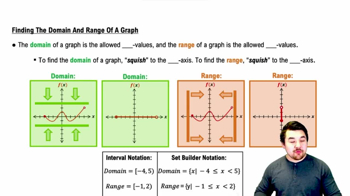
Finding the Domain and Range of a Graph
Empty Set (∅)
The empty set is a set containing no elements. It acts as the identity element for union, meaning any set unioned with ∅ remains unchanged. Understanding the empty set is crucial for operations involving sets.
Recommended video:
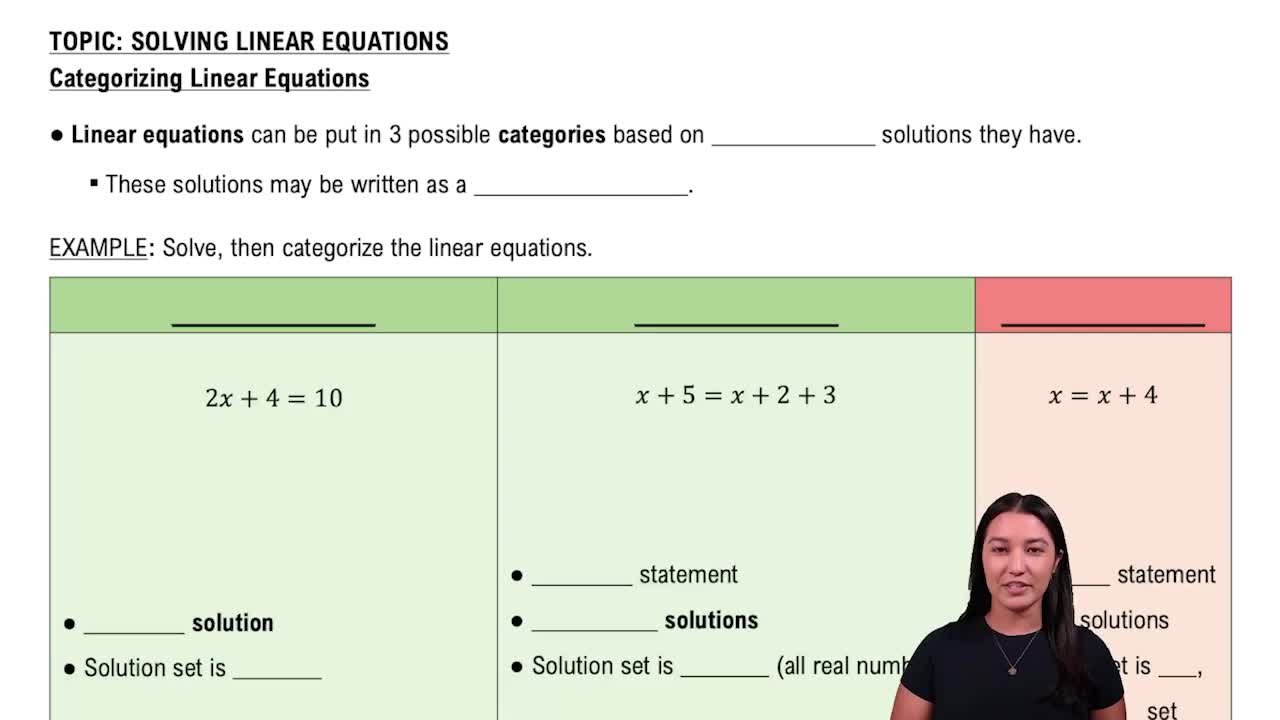
Categorizing Linear Equations
Disjoint Sets
Disjoint sets are sets that have no elements in common. Identifying disjoint sets involves checking if their intersection is empty. This concept helps in understanding relationships between sets and their elements.
Recommended video:
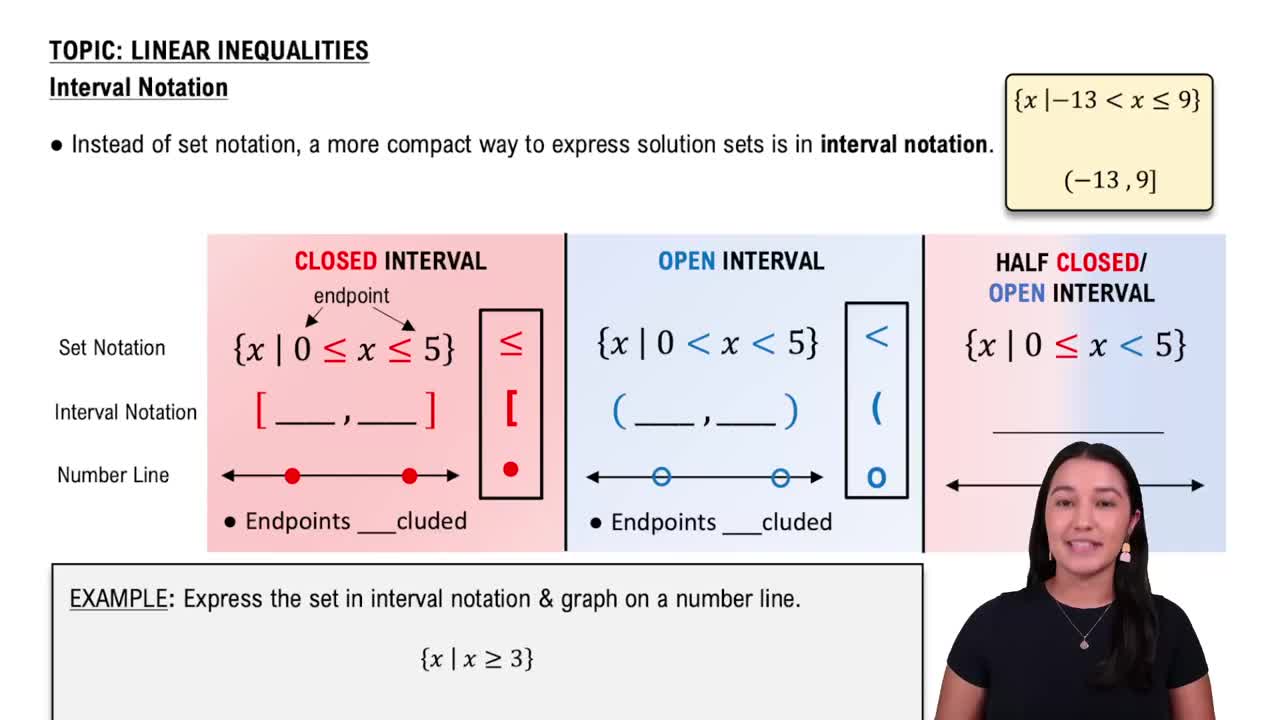
Interval Notation
Watch next
Master Introduction to Exponent Rules with a bite sized video explanation from Patrick
Start learningRelated Videos
Related Practice
Textbook Question
737
views