Solve each equation in Exercises 41–60 by making an appropriate substitution.
Table of contents
- 0. Review of Algebra4h 18m
- 1. Equations & Inequalities3h 18m
- 2. Graphs of Equations1h 43m
- 3. Functions2h 17m
- 4. Polynomial Functions1h 44m
- 5. Rational Functions1h 23m
- 6. Exponential & Logarithmic Functions2h 28m
- 7. Systems of Equations & Matrices4h 5m
- 8. Conic Sections2h 23m
- 9. Sequences, Series, & Induction1h 22m
- 10. Combinatorics & Probability1h 45m
1. Equations & Inequalities
Choosing a Method to Solve Quadratics
Problem 48
Textbook Question
Solve each equation in Exercises 41–60 by making an appropriate substitution. x(-2) - x(-1) - 6 = 0
Verified step by step guidance1
Recognize that the equation involves negative exponents. Rewrite the terms using positive exponents: \( x^{-2} = \frac{1}{x^2} \) and \( x^{-1} = \frac{1}{x} \). The equation becomes \( \frac{1}{x^2} - \frac{1}{x} - 6 = 0 \).
To simplify the equation, make a substitution. Let \( u = \frac{1}{x} \). This means \( \frac{1}{x^2} = u^2 \). Substituting these into the equation gives \( u^2 - u - 6 = 0 \).
Now solve the quadratic equation \( u^2 - u - 6 = 0 \). Factorize the quadratic equation, if possible, or use the quadratic formula \( u = \frac{-b \pm \sqrt{b^2 - 4ac}}{2a} \), where \( a = 1 \), \( b = -1 \), and \( c = -6 \).
Once you find the values of \( u \), substitute back \( u = \frac{1}{x} \) to return to the original variable \( x \). Solve for \( x \) by taking the reciprocal of each \( u \) value: \( x = \frac{1}{u} \).
Check all solutions in the original equation \( x^{-2} - x^{-1} - 6 = 0 \) to ensure they are valid and do not result in division by zero. Discard any extraneous solutions if necessary.
Verified video answer for a similar problem:This video solution was recommended by our tutors as helpful for the problem above
Video duration:
5mPlay a video:
Was this helpful?
Key Concepts
Here are the essential concepts you must grasp in order to answer the question correctly.
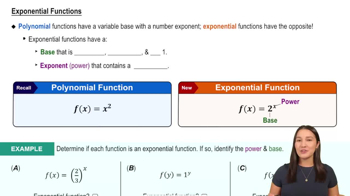
Exponential Functions and Negative Exponents
Exponential functions involve expressions where a variable is raised to a power. Negative exponents indicate the reciprocal of the base raised to the absolute value of the exponent. For example, x^(-1) is equivalent to 1/x, and x^(-2) is equivalent to 1/x^2. Understanding this concept is crucial for simplifying equations that contain negative exponents.
Recommended video:
Exponential Functions
Substitution Method
The substitution method is a technique used to simplify complex equations by replacing a variable or expression with a single variable. In this case, substituting x^(-1) with a new variable, such as y, can transform the equation into a quadratic form, making it easier to solve. This method is particularly useful for equations involving powers and can streamline the solving process.
Recommended video:
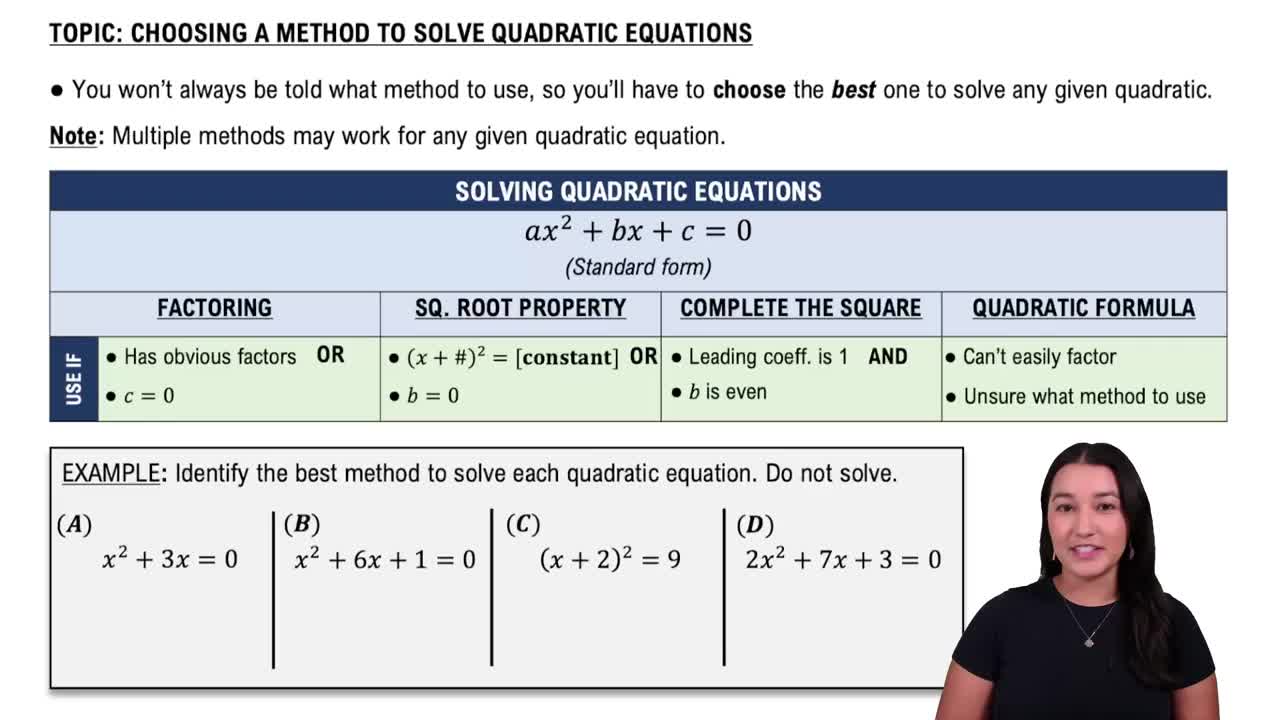
Choosing a Method to Solve Quadratics
Quadratic Equations
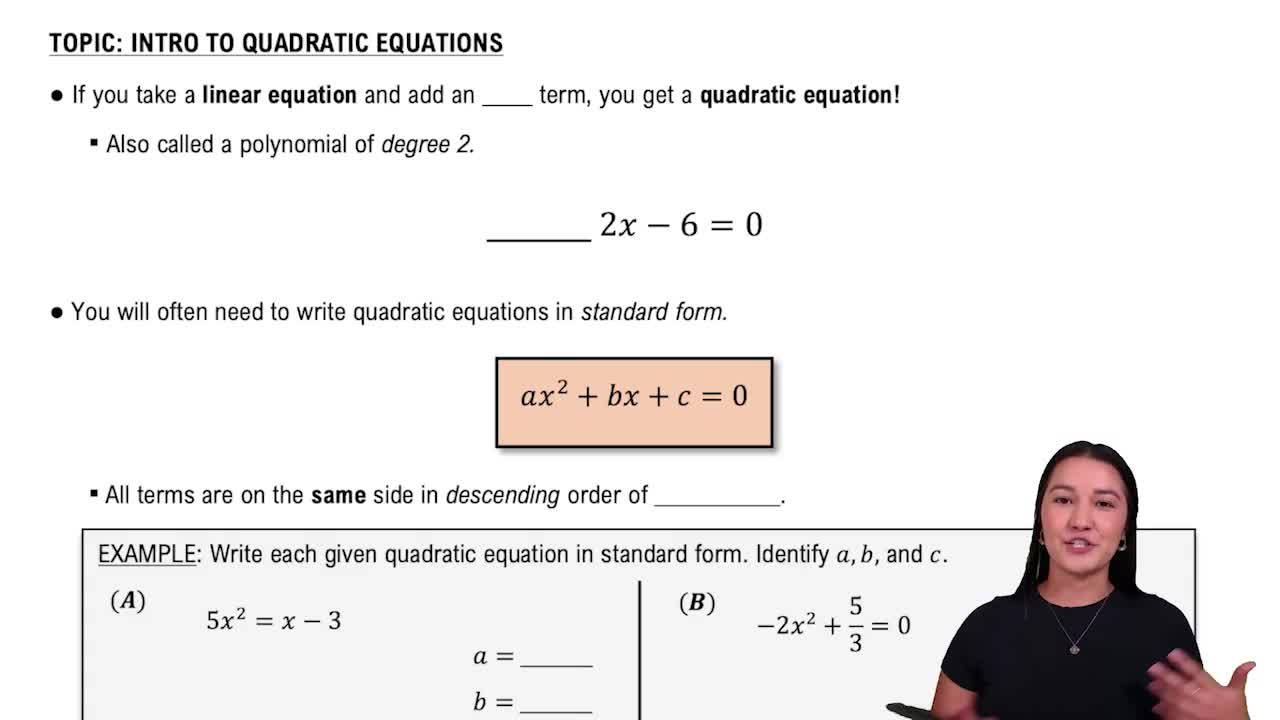
A quadratic equation is a polynomial equation of the form ax^2 + bx + c = 0, where a, b, and c are constants. The solutions to quadratic equations can be found using various methods, including factoring, completing the square, or the quadratic formula. Recognizing the transformed equation as a quadratic is essential for applying these methods effectively to find the values of the original variable.
Recommended video:
Introduction to Quadratic Equations
Watch next
Master Choosing a Method to Solve Quadratics with a bite sized video explanation from Patrick
Start learningRelated Videos
Related Practice
Textbook Question
398
views
