Write each root using exponents and evaluate. - ∛-343
Verified step by step guidance
1
Identify the expression: \(-\sqrt[3]{-343}\).
Recognize that \(-343\) can be rewritten as \(-1 \times 343\).
Express \(343\) as a power of 7: \(343 = 7^3\).
Rewrite the expression using exponents: \(-\sqrt[3]{-1 \times 7^3}\).
Apply the property of cube roots: \(-\sqrt[3]{-1} \times \sqrt[3]{7^3}\).
Verified video answer for a similar problem:
This video solution was recommended by our tutors as helpful for the problem above
Video duration:
1m
Play a video:
Was this helpful?
Key Concepts
Here are the essential concepts you must grasp in order to answer the question correctly.
Radicals
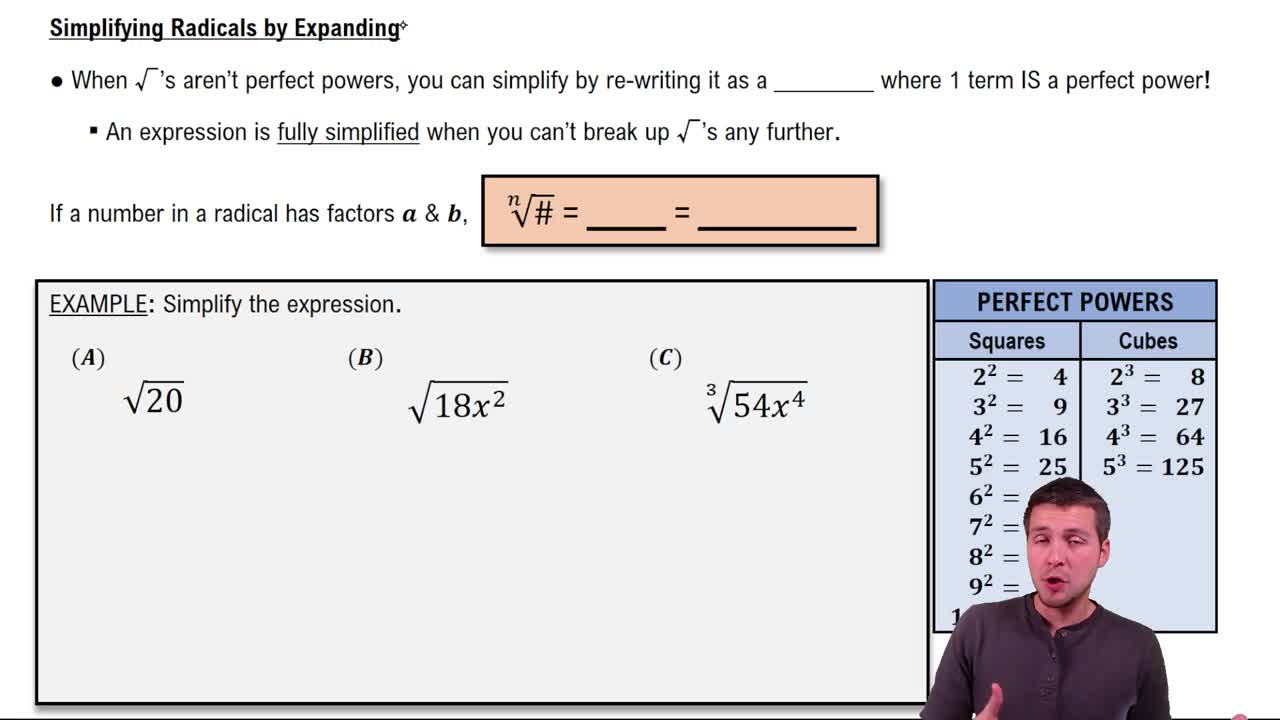
Radicals are expressions that involve roots, such as square roots or cube roots. The notation ∛x represents the cube root of x, which is the value that, when multiplied by itself three times, gives x. Understanding how to manipulate and simplify radical expressions is essential for solving problems involving roots.
When dealing with negative numbers under a radical, it's important to recognize how roots behave. For instance, the cube root of a negative number, like -343, is defined and results in a negative value. This is because multiplying three negative numbers yields a negative product, which is crucial for evaluating expressions involving negative roots.
Exponential notation is a way to express repeated multiplication of a number. For example, the cube root can be expressed using exponents as x^(1/3). This notation is useful for simplifying calculations and understanding the relationship between roots and powers, especially when evaluating expressions like ∛-343.