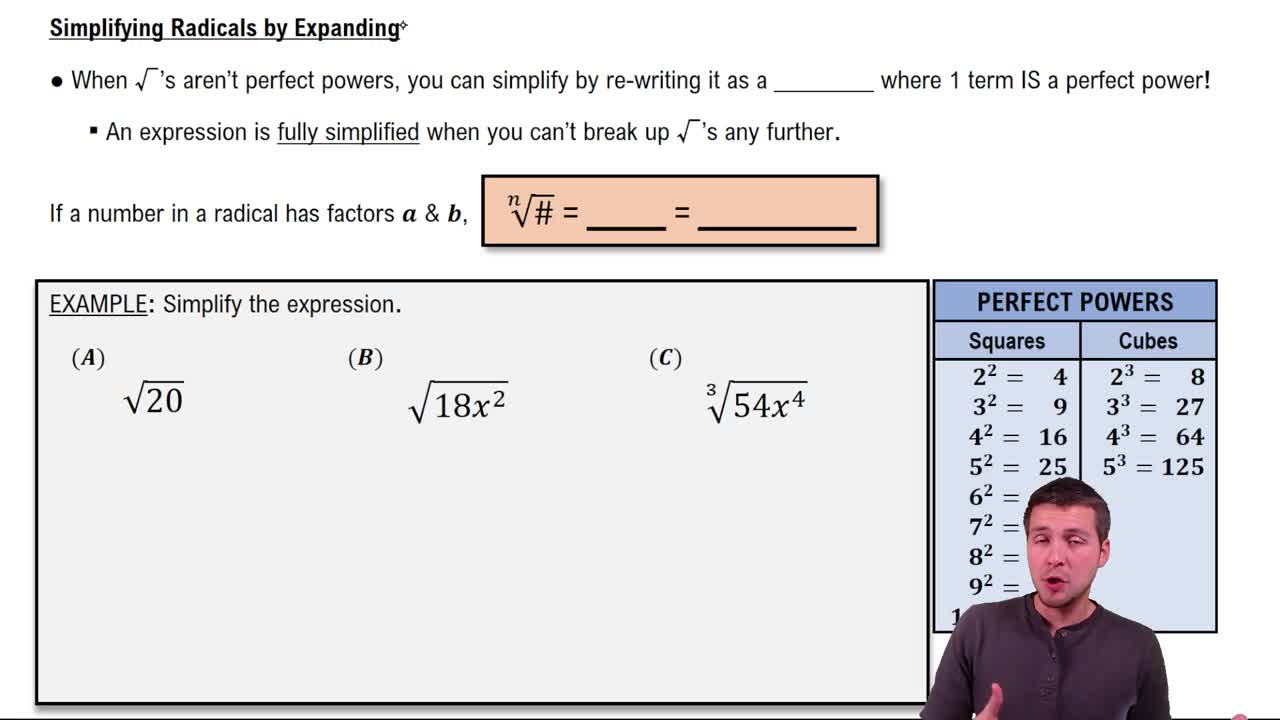
Identify that \( \sqrt{27} \) can be simplified by factoring the number under the square root.
Recognize that 27 can be factored into prime numbers: \( 27 = 3^3 \).
Rewrite \( \sqrt{27} \) as \( \sqrt{3^3} \).
Apply the property of square roots: \( \sqrt{a^2 \cdot b} = a \cdot \sqrt{b} \).
Simplify \( \sqrt{3^3} \) to \( 3 \cdot \sqrt{3} \) by taking \( 3^2 \) out of the square root.
Verified video answer for a similar problem:
This video solution was recommended by our tutors as helpful for the problem above.
Video duration:
2m
Play a video:
0 Comments
Key Concepts
Here are the essential concepts you must grasp in order to answer the question correctly.
Factoring
Factoring is the process of breaking down an expression into a product of simpler expressions, or factors, that when multiplied together yield the original expression. This is essential in simplifying algebraic expressions, as it can reveal common factors and make calculations easier. For example, factoring the expression x^2 - 9 results in (x - 3)(x + 3).
A square root of a number is a value that, when multiplied by itself, gives the original number. In the context of simplifying expressions, understanding square roots is crucial, especially when dealing with perfect squares or simplifying radical expressions. For instance, √27 can be simplified to 3√3, as 27 is 9 times 3, and the square root of 9 is 3.
Radical simplification involves reducing a radical expression to its simplest form. This often includes factoring out perfect squares from under the radical sign and simplifying the expression accordingly. For example, simplifying √(a^2b) results in a√b, demonstrating how to extract factors from within a radical to achieve a more manageable expression.

 2:11 minutes
 Verified step by step guidance
 04:36
04:36