Simplify each exponential expression in Exercises 23–64. x−2y
Verified step by step guidance
1
Identify the expression to simplify: \(x^{-2}y\). Notice that \(x\) has a negative exponent.
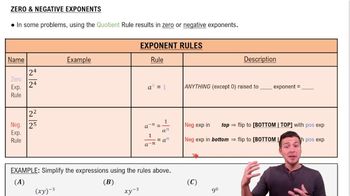
Recall the rule for negative exponents: \(a^{-n} = \frac{1}{a^n}\), where \(a \neq 0\) and \(n\) is a positive integer.
Apply the negative exponent rule to \(x^{-2}\), rewriting it as \(\frac{1}{x^2}\).
Rewrite the entire expression by substituting \(x^{-2}\) with \(\frac{1}{x^2}\), so the expression becomes \(\frac{y}{x^2}\).
Check if the expression can be simplified further. Since \(y\) and \(x^2\) have no common factors, the simplified form is \(\frac{y}{x^2}\).
Verified video answer for a similar problem:
This video solution was recommended by our tutors as helpful for the problem above
Video duration:
49s
Play a video:
Was this helpful?
Key Concepts
Here are the essential concepts you must grasp in order to answer the question correctly.
Negative Exponents
A negative exponent indicates the reciprocal of the base raised to the corresponding positive exponent. For example, x^(-2) equals 1 divided by x squared, or 1/x^2. Understanding this helps simplify expressions with negative powers.
When multiplying expressions with the same base, add their exponents. For instance, x^a * x^b = x^(a+b). This rule is essential when simplifying expressions involving multiple powers of the same variable.
Each variable in an expression is treated independently with its exponent. For example, in x^(-2)y, x and y are separate factors, so the exponent applies only to x. Recognizing this prevents incorrect combining of terms.