Write each root using exponents and evaluate. - ∛-343
Verified step by step guidance
1
Recognize that the expression involves a cube root of a negative number: \(\sqrt[3]{-343}\).
Recall that the cube root of a number \(a\) can be written using exponents as \(a^{\frac{1}{3}}\).
Rewrite the expression using exponents: \((-343)^{\frac{1}{3}}\).
Note that \$343\( is a perfect cube since \)7^3 = 343\(, so \)-343 = -(7^3)$.
Use the property of exponents to simplify: \((-1 \times 7^3)^{\frac{1}{3}} = (-1)^{\frac{1}{3}} \times (7^3)^{\frac{1}{3}}\).
Verified video answer for a similar problem:
This video solution was recommended by our tutors as helpful for the problem above
Video duration:
1m
Play a video:
0 Comments
Key Concepts
Here are the essential concepts you must grasp in order to answer the question correctly.
Cube Roots and Radicals
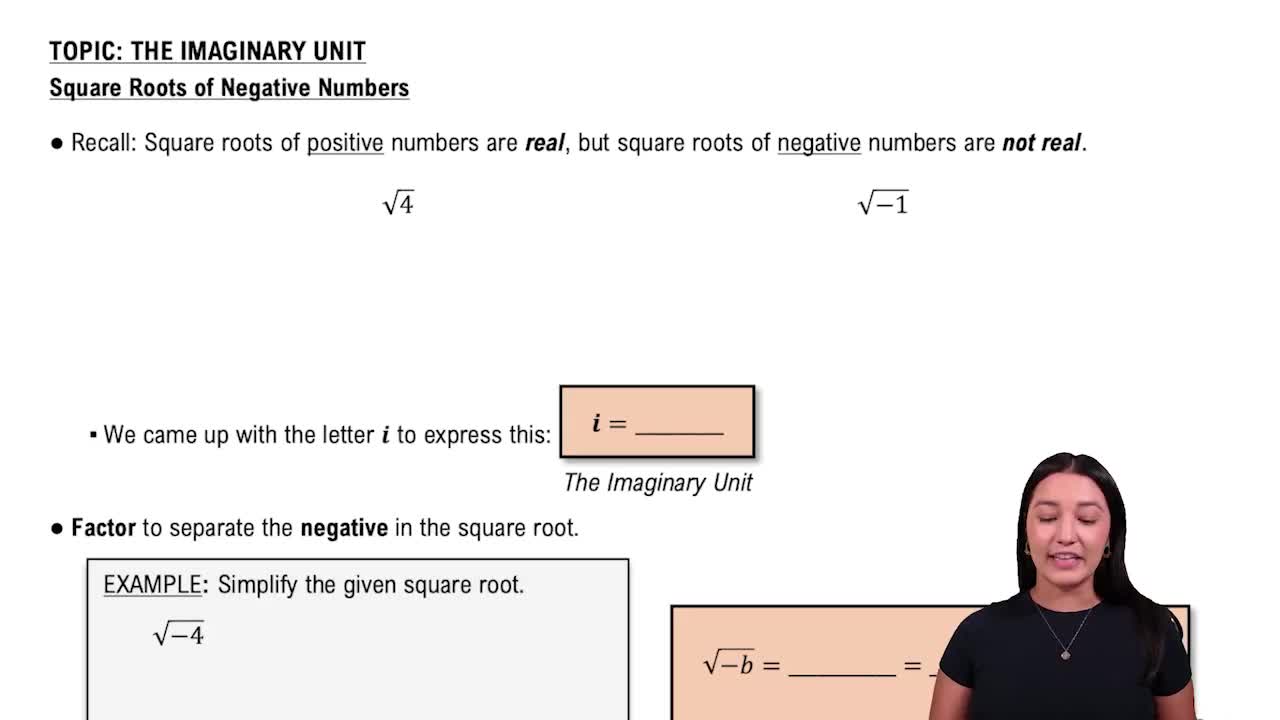
The cube root of a number is a value that, when multiplied by itself three times, gives the original number. It is denoted as ∛a and can be positive or negative depending on the original number. For example, ∛-343 equals -7 because (-7)³ = -343.
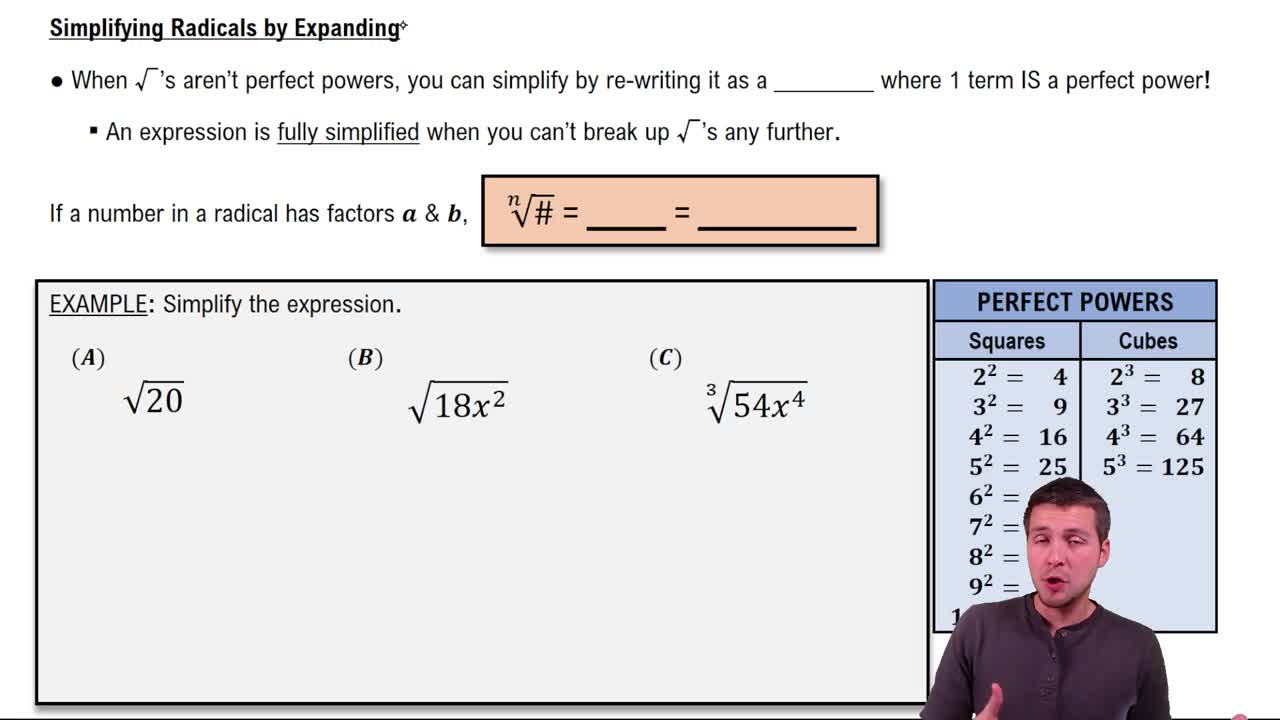
Roots can be expressed using fractional exponents, where the nth root of a number a is written as a^(1/n). For the cube root, ∛a is equivalent to a^(1/3). This notation allows the use of exponent rules to simplify and evaluate roots.
When dealing with negative numbers under odd roots, such as cube roots, the result is also negative because an odd number of negative factors multiply to a negative product. This contrasts with even roots, which are not defined for negative bases in real numbers.

 1:04 minutes
 Verified step by step guidance
 05:20
05:20