In Exercises 65–68, write the given sentences as a system of inequalities in two variables. Then graph the system. The sum of the x-variable and the y-variable is at most 4. The y-variable added to the product of 3 and the x-variable does not exceed 6.
Table of contents
- 0. Review of Algebra4h 18m
- 1. Equations & Inequalities3h 18m
- 2. Graphs of Equations1h 43m
- 3. Functions2h 17m
- 4. Polynomial Functions1h 44m
- 5. Rational Functions1h 23m
- 6. Exponential & Logarithmic Functions2h 28m
- 7. Systems of Equations & Matrices4h 5m
- 8. Conic Sections2h 23m
- 9. Sequences, Series, & Induction1h 22m
- 10. Combinatorics & Probability1h 45m
7. Systems of Equations & Matrices
Graphing Systems of Inequalities
Problem 59
Textbook Question
In Exercises 57–59, graph the region determined by the constraints. Then find the maximum value of the given objective function, subject to the constraints. This is a piecewise function. Refer to the textbook.
Verified step by step guidance1
Identify the constraints provided in the problem. Constraints are inequalities that define the feasible region. For example, they might look like \(x + y \leq 10\), \(x \geq 0\), and \(y \geq 0\). Write down all the constraints clearly.
Graph the constraints on a coordinate plane. For each inequality, first graph the corresponding equation as if it were an equality (e.g., \(x + y = 10\)). Then shade the region that satisfies the inequality. The feasible region is the intersection of all shaded regions.
Determine the vertices of the feasible region. These are the points where the boundary lines of the constraints intersect. Solve the system of equations formed by pairs of boundary lines to find these points.
Substitute the coordinates of each vertex into the given objective function. The objective function is typically a linear equation like \(z = 3x + 2y\). Evaluate the function at each vertex to determine the corresponding values.
Identify the maximum value of the objective function from the values calculated in the previous step. The vertex that gives the highest value is the solution to the optimization problem.
Verified video answer for a similar problem:This video solution was recommended by our tutors as helpful for the problem above
Video duration:
15mPlay a video:
Was this helpful?
Key Concepts
Here are the essential concepts you must grasp in order to answer the question correctly.
Graphing Constraints
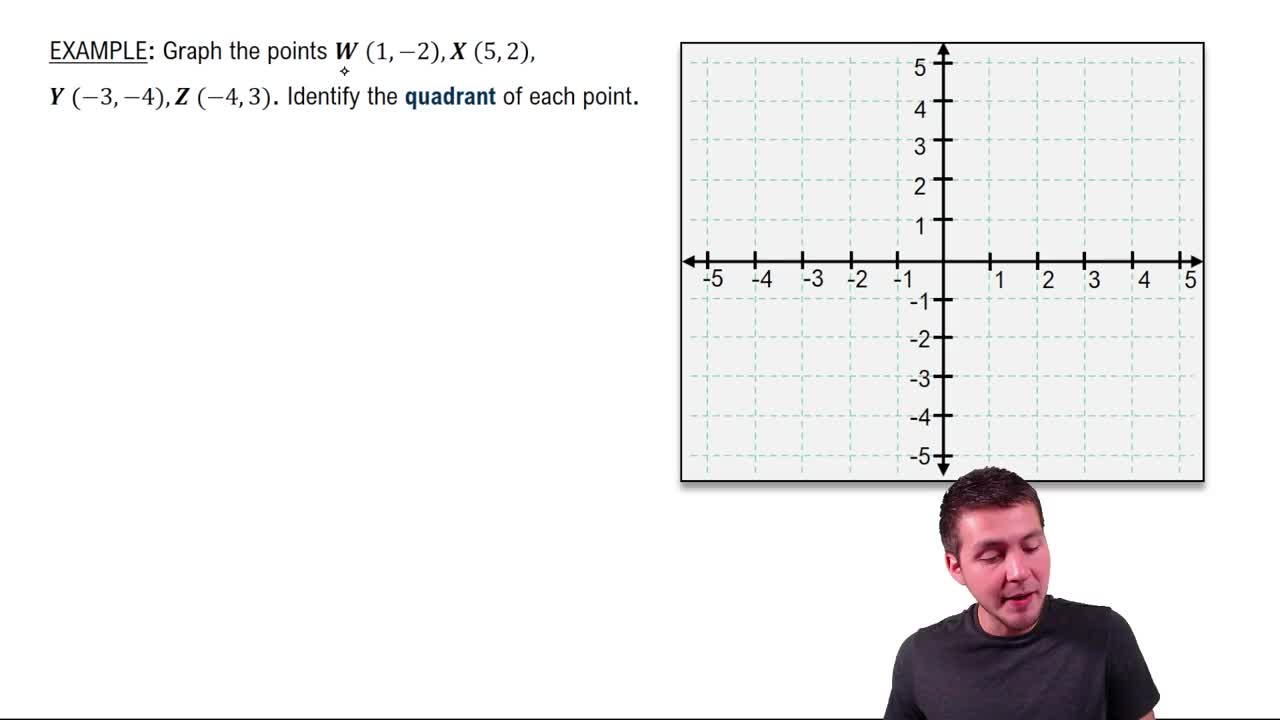
Graphing constraints involves plotting inequalities on a coordinate plane to visualize the feasible region where all constraints are satisfied. Each inequality represents a boundary, and the area where these boundaries overlap indicates the possible solutions. Understanding how to graph these constraints is crucial for identifying the region of interest for optimization problems.
Recommended video:
Guided course
Graphs and Coordinates - Example
Objective Function
An objective function is a mathematical expression that defines the goal of an optimization problem, typically to maximize or minimize a certain quantity. In this context, it is evaluated at various points within the feasible region to determine the best possible outcome. Recognizing how to manipulate and evaluate the objective function is essential for finding optimal solutions.
Recommended video:
Permutations of Non-Distinct Objects
Piecewise Functions
A piecewise function is defined by different expressions based on the input value, which can lead to varying outputs depending on the specified conditions. In optimization problems, understanding how to work with piecewise functions is important, as the function's behavior may change across different segments of the domain, affecting the overall solution and maximum value sought.
Recommended video:
Function Composition
Related Videos
Related Practice
Textbook Question
405
views