Step 4: Repeat the process for \( \sqrt{32m^2} \) and \( \sqrt{18m^2} \). For \( \sqrt{32m^2} \), factor 32 as \( 2^5 \), so \( \sqrt{32} = 4\sqrt{2} \), giving \( \sqrt{32m^2} = 4m\sqrt{2} \). For \( \sqrt{18m^2} \), factor 18 as \( 2 \times 3^2 \), so \( \sqrt{18} = 3\sqrt{2} \), giving \( \sqrt{18m^2} = 3m\sqrt{2} \).
Step 5: Substitute the simplified terms back into the expression: \( 3(6m\sqrt{2}) - 5(4m\sqrt{2}) - 3(3m\sqrt{2}) \). Combine like terms by factoring out \( m\sqrt{2} \).
Verified video answer for a similar problem:
This video solution was recommended by our tutors as helpful for the problem above
Video duration:
3m
Play a video:
Was this helpful?
Key Concepts
Here are the essential concepts you must grasp in order to answer the question correctly.
Radical Expressions
Radical expressions involve roots, such as square roots or cube roots, and are essential in simplifying expressions. Understanding how to manipulate these expressions, including combining like terms and simplifying radicals, is crucial for solving problems that involve them.
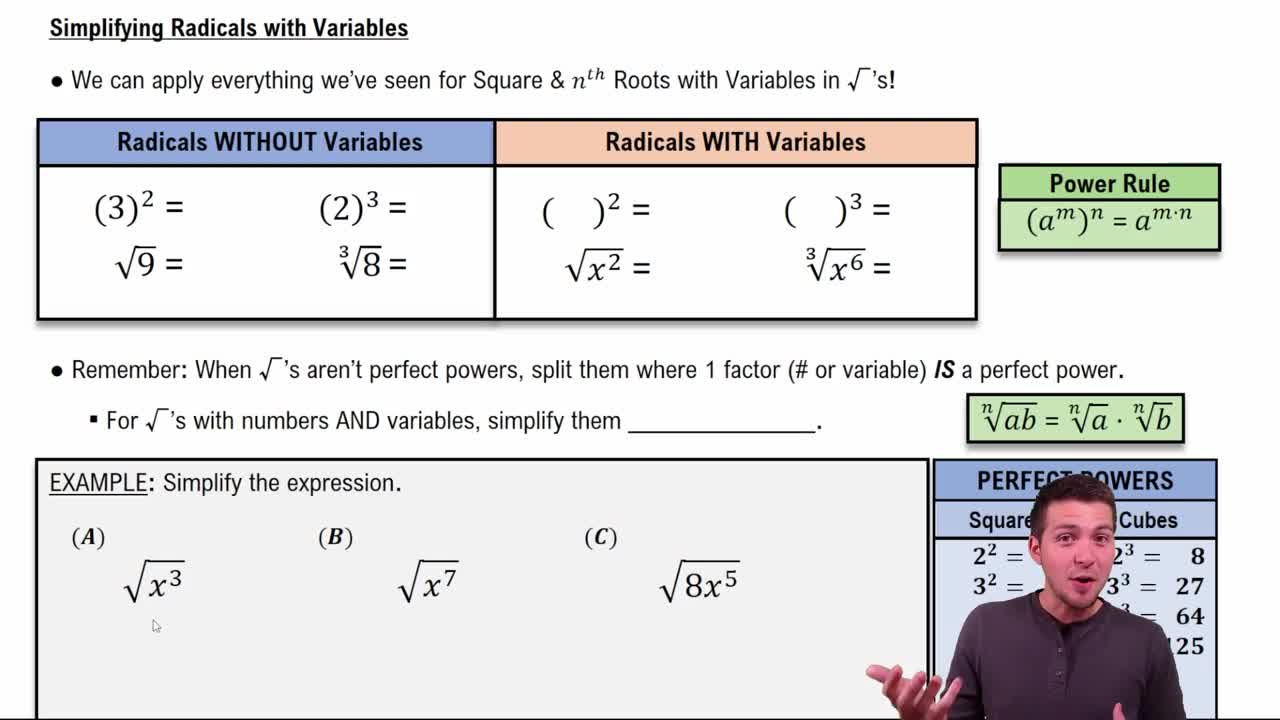
Simplifying radicals means rewriting a radical expression in its simplest form. This often involves factoring out perfect squares or cubes from under the radical sign. For example, √72 can be simplified to 6√2, which makes calculations easier and clearer.
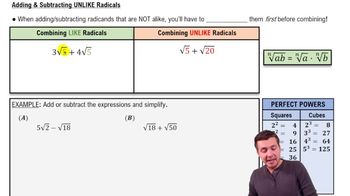
Adding & Subtracting Unlike Radicals by Simplifying
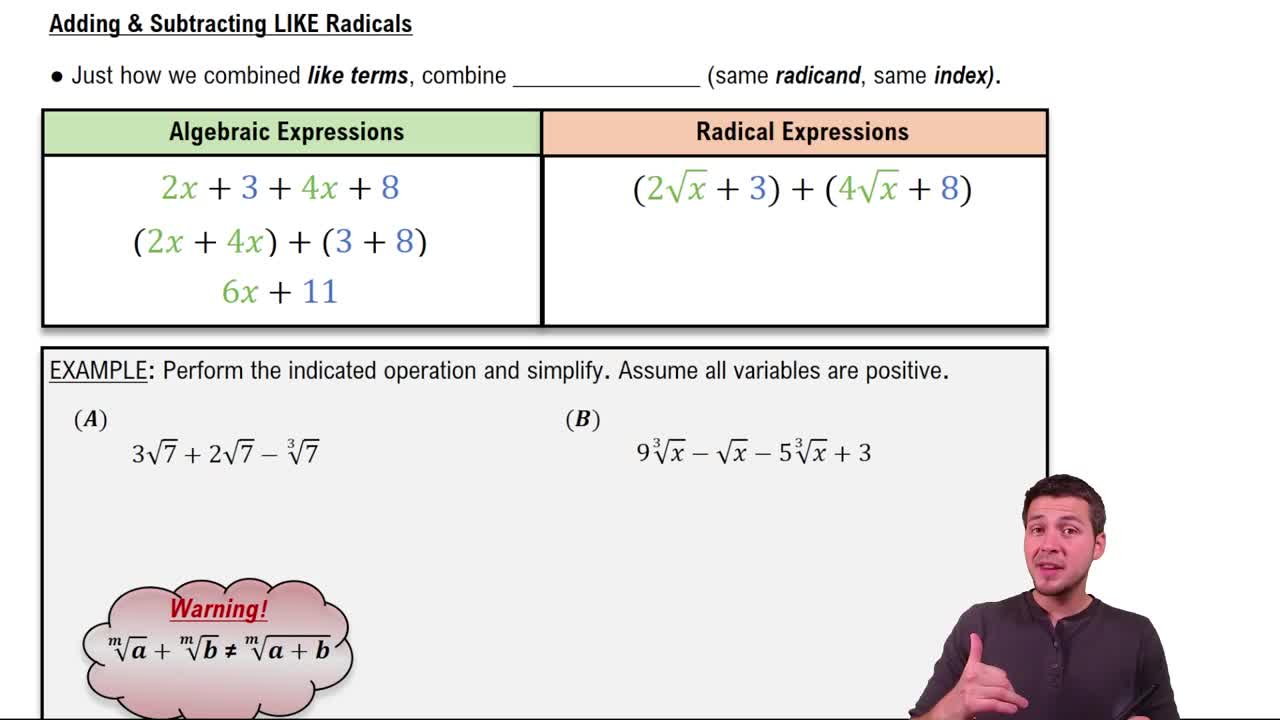
Combining Like Terms
Combining like terms is a fundamental algebraic skill that involves adding or subtracting terms that have the same variable and exponent. In the context of radical expressions, this means only combining terms that have the same radical part, which is necessary for simplifying the overall expression.