Find the sum of the even integers between 21 and 45.
Table of contents
- 0. Review of Algebra4h 18m
- 1. Equations & Inequalities3h 18m
- 2. Graphs of Equations1h 43m
- 3. Functions2h 17m
- 4. Polynomial Functions1h 44m
- 5. Rational Functions1h 23m
- 6. Exponential & Logarithmic Functions2h 28m
- 7. Systems of Equations & Matrices4h 5m
- 8. Conic Sections2h 23m
- 9. Sequences, Series, & Induction1h 22m
- 10. Combinatorics & Probability1h 45m
9. Sequences, Series, & Induction
Arithmetic Sequences
Problem 47
Textbook Question
Write out the first three terms and the last term. Then use the formula for the sum of the first n terms of an arithmetic sequence to find the indicated sum.
Verified step by step guidance1
Identify the arithmetic sequence given by the general term: \(a_i = -3i + 5\) for \(i = 1, 2, \ldots, 30\).
Find the first three terms by substituting \(i = 1, 2, 3\) into the formula:
\( a_1 = -3(1) + 5 \),
\( a_2 = -3(2) + 5 \),
\( a_3 = -3(3) + 5 \).
Find the last term by substituting \(i = 30\) into the formula:
\( a_{30} = -3(30) + 5 \).
Use the formula for the sum of the first \(n\) terms of an arithmetic sequence:
\( S_n = \frac{n}{2} (a_1 + a_n) \)
where \(n = 30\), \(a_1\) is the first term, and \(a_n\) is the last term.
Substitute the values of \(n\), \(a_1\), and \(a_{30}\) into the sum formula to express the sum \(S_{30}\), then simplify the expression to find the sum.
Verified video answer for a similar problem:This video solution was recommended by our tutors as helpful for the problem above
Video duration:
4mPlay a video:
Was this helpful?
Key Concepts
Here are the essential concepts you must grasp in order to answer the question correctly.
Arithmetic Sequence
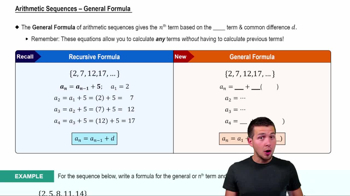
An arithmetic sequence is a list of numbers where each term after the first is found by adding a constant difference to the previous term. In this problem, the sequence is defined by the formula a_i = -3i + 5, which generates terms by substituting i = 1, 2, 3, etc.
Recommended video:
Guided course
Arithmetic Sequences - General Formula
Sum of the First n Terms of an Arithmetic Sequence
The sum of the first n terms of an arithmetic sequence can be found using the formula S_n = n/2 * (a_1 + a_n), where a_1 is the first term and a_n is the nth term. This formula simplifies the addition of many terms by using only the first and last terms.
Recommended video:
Guided course
Arithmetic Sequences - General Formula
Evaluating Terms from a Given Formula
To find specific terms in the sequence, substitute the term number i into the formula a_i = -3i + 5. For example, the first three terms are found by plugging in i = 1, 2, and 3. The last term corresponds to i = 30, as given in the summation.
Recommended video:
Solving Quadratic Equations Using The Quadratic Formula
Watch next
Master Arithmetic Sequences - Recursive Formula with a bite sized video explanation from Patrick
Start learningRelated Videos
Related Practice
Textbook Question
1014
views