In Exercises 5–9, graph f and g in the same rectangular coordinate system. Use transformations of the graph of f to obtain the graph of g. Graph and give equations of all asymptotes. Use the graphs to determine each function's domain and range. f(x) = 3x and g(x) = -3x
Table of contents
- 0. Review of Algebra4h 18m
- 1. Equations & Inequalities3h 18m
- 2. Graphs of Equations1h 43m
- 3. Functions2h 17m
- 4. Polynomial Functions1h 44m
- 5. Rational Functions1h 23m
- 6. Exponential & Logarithmic Functions2h 28m
- 7. Systems of Equations & Matrices4h 5m
- 8. Conic Sections2h 23m
- 9. Sequences, Series, & Induction1h 22m
- 10. Combinatorics & Probability1h 45m
6. Exponential & Logarithmic Functions
Introduction to Exponential Functions
Problem 13
Textbook Question
Graph each function by making a table of coordinates. If applicable, use a graphing utility to confirm your hand-drawn graph. g(x) = (3/2)x
Verified step by step guidance1
Identify the function given: \(g(x) = \left(\frac{3}{2}\right)^x\). This is an exponential function where the base is \(\frac{3}{2}\), which is greater than 1, indicating exponential growth.
Create a table of values by choosing several values for \(x\), including negative, zero, and positive integers. For example, select \(x = -2, -1, 0, 1, 2\) to get a good range of points.
Calculate the corresponding \(g(x)\) values for each chosen \(x\) by substituting into the function: \(g(x) = \left(\frac{3}{2}\right)^x\). Remember that for negative exponents, \(a^{-n} = \frac{1}{a^n}\).
Plot the points \((x, g(x))\) from your table on a coordinate plane. Since the function is exponential growth, the graph should increase as \(x\) increases and approach zero but never touch the \(x\)-axis as \(x\) decreases.
Use a graphing utility to input \(g(x) = \left(\frac{3}{2}\right)^x\) and compare the graph with your hand-drawn points to confirm accuracy and understand the shape of the exponential curve.
Verified video answer for a similar problem:This video solution was recommended by our tutors as helpful for the problem above
Video duration:
3mPlay a video:
Was this helpful?
Key Concepts
Here are the essential concepts you must grasp in order to answer the question correctly.
Exponential Functions
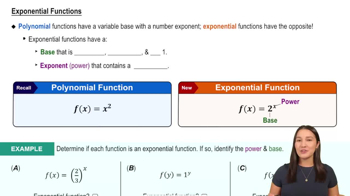
An exponential function has the form f(x) = a^x, where the base a is a positive constant not equal to 1. The function g(x) = (3/2)^x grows as x increases because the base 3/2 is greater than 1, resulting in exponential growth.
Recommended video:
Exponential Functions
Creating a Table of Coordinates
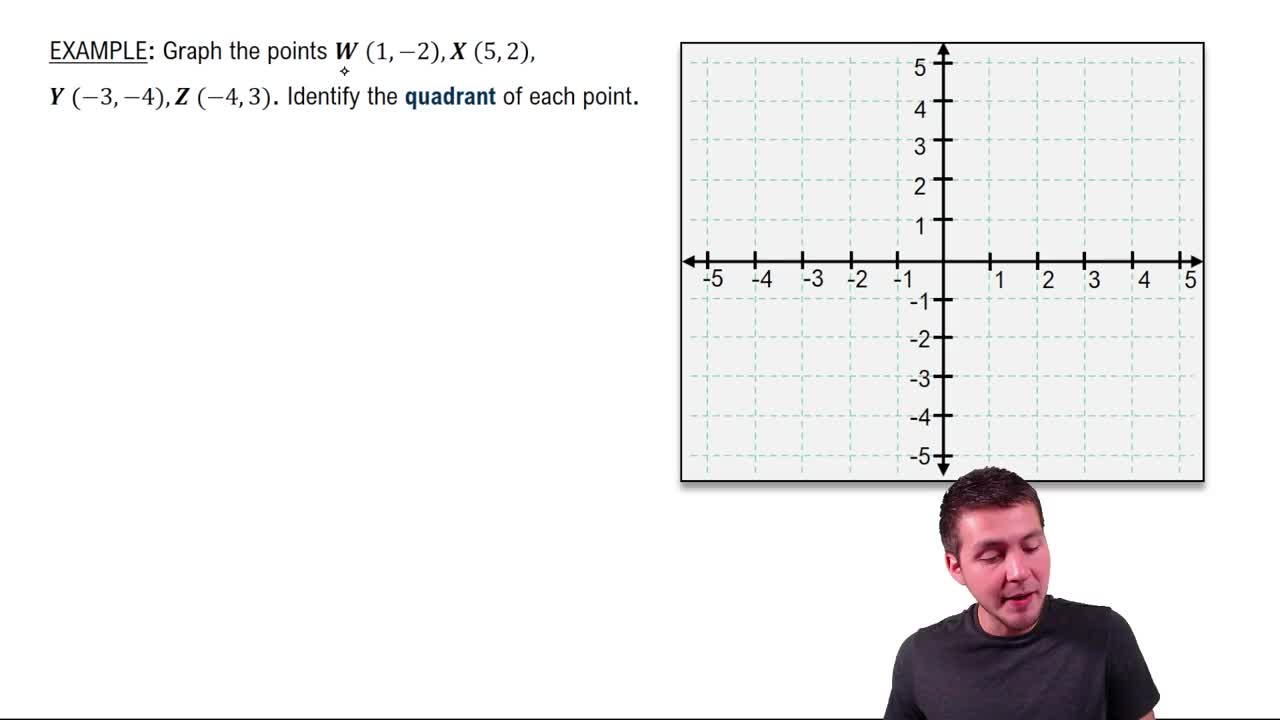
To graph a function by hand, select various x-values, substitute them into the function, and calculate the corresponding y-values. Plotting these (x, y) pairs on a coordinate plane helps visualize the function's shape and behavior.
Recommended video:
Guided course
Graphs and Coordinates - Example
Using Graphing Utilities
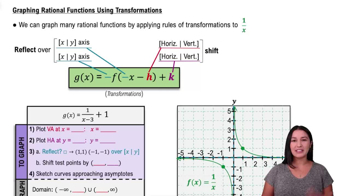
Graphing utilities, such as calculators or software, allow quick and accurate plotting of functions. They help confirm the accuracy of hand-drawn graphs and provide insights into features like intercepts, asymptotes, and growth trends.
Recommended video:
Graphing Rational Functions Using Transformations
Watch next
Master Exponential Functions with a bite sized video explanation from Patrick
Start learningRelated Videos
Related Practice
Textbook Question
868
views