In Exercises 15–58, find each product. (1−y5)(1+y5)
Verified step by step guidance
1
Recognize that the given expression (1−y^5)(1+y^5) is a product of two binomials in the form (a−b)(a+b). This is a difference of squares formula.
Recall the difference of squares formula: (a−b)(a+b) = a^2 − b^2. Here, a = 1 and b = y^5.
Substitute the values of a and b into the formula: a^2 − b^2 becomes 1^2 − (y^5)^2.
Simplify each term: 1^2 simplifies to 1, and (y^5)^2 simplifies to y^(5×2) = y^10.
Combine the simplified terms to get the final expression: 1 − y^10.
Verified video answer for a similar problem:
This video solution was recommended by our tutors as helpful for the problem above
Video duration:
4m
Play a video:
Was this helpful?
Key Concepts
Here are the essential concepts you must grasp in order to answer the question correctly.
Difference of Squares
The difference of squares is a fundamental algebraic identity that states that for any two terms a and b, the expression (a - b)(a + b) equals a² - b². This identity is crucial for simplifying expressions that are structured as a product of a sum and a difference, allowing for easier calculations and factorizations.
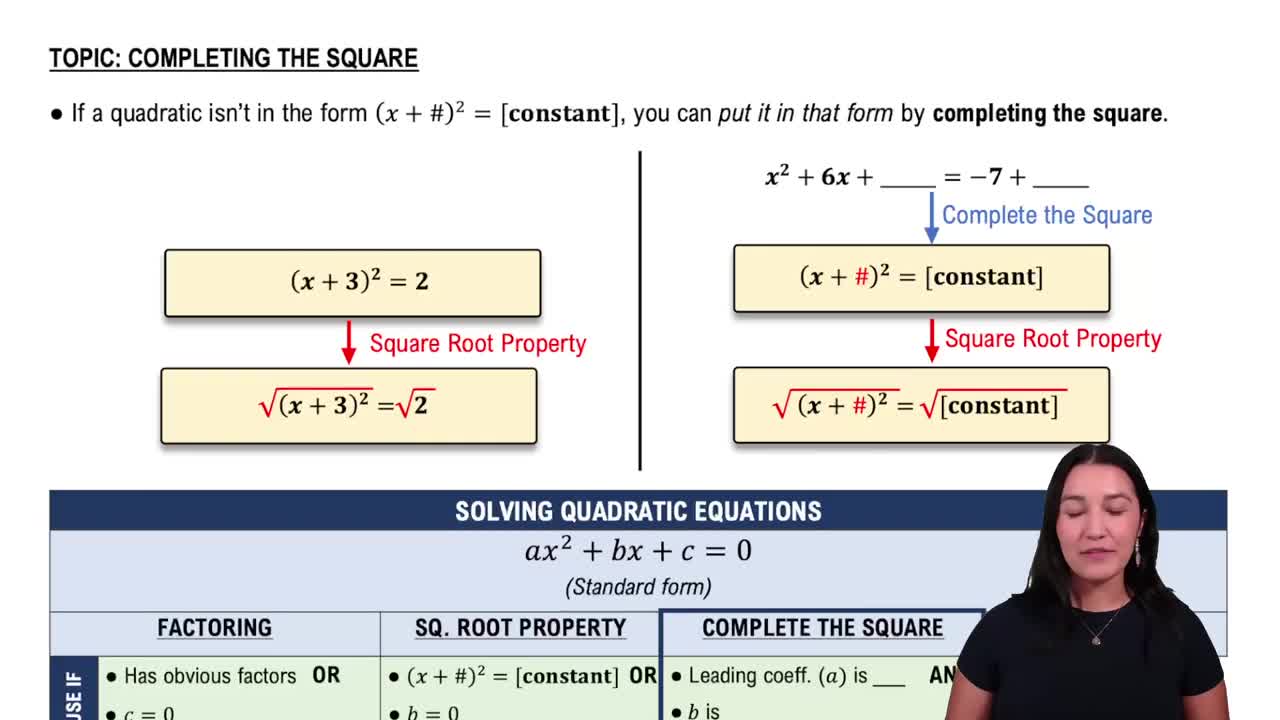
Solving Quadratic Equations by Completing the Square
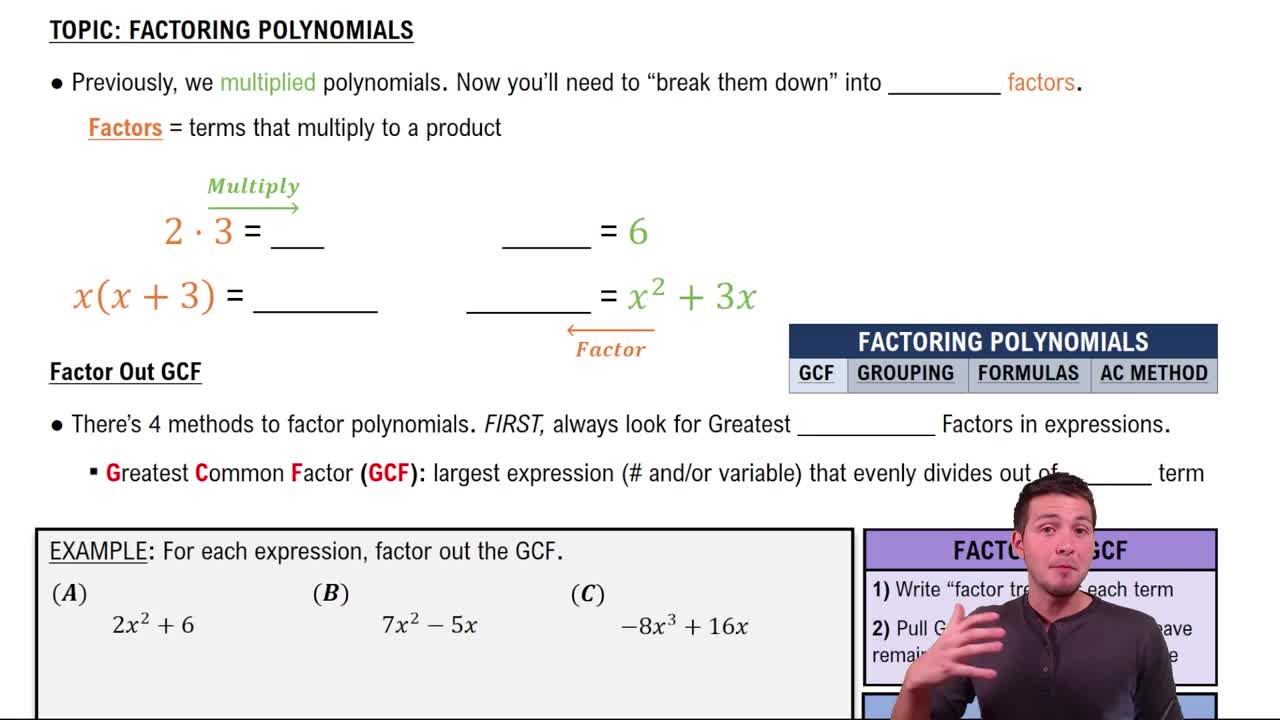
Factoring Polynomials
Factoring polynomials involves rewriting a polynomial as a product of its factors, which can simplify expressions and solve equations. In the context of the given expression, recognizing the structure as a difference of squares allows for straightforward factoring, leading to a more manageable form.
Algebraic manipulation refers to the techniques used to rearrange and simplify algebraic expressions. This includes applying identities, combining like terms, and distributing products. Mastery of these techniques is essential for effectively solving algebraic problems and understanding the relationships between different algebraic forms.