Solve each inequality. Give the solution set in interval notation. | 3/5 + x | < 1
Verified step by step guidance
1
Start by understanding the inequality \(|\frac{3}{5} + x| < 1\). This is an absolute value inequality, which means we need to consider two separate cases.
The first case is when the expression inside the absolute value is positive or zero: \(\frac{3}{5} + x < 1\). Solve this inequality by subtracting \(\frac{3}{5}\) from both sides to isolate \(x\).
The second case is when the expression inside the absolute value is negative: \(\frac{3}{5} + x > -1\). Again, solve this inequality by subtracting \(\frac{3}{5}\) from both sides to isolate \(x\).
Combine the solutions from both cases to find the range of values for \(x\) that satisfy the original inequality.
Express the solution set in interval notation, which will represent all the values of \(x\) that satisfy the inequality.
Verified video answer for a similar problem:
This video solution was recommended by our tutors as helpful for the problem above
Video duration:
2m
Play a video:
Was this helpful?
Key Concepts
Here are the essential concepts you must grasp in order to answer the question correctly.
Absolute Value Inequalities
Absolute value inequalities involve expressions that measure the distance of a number from zero on the number line. The inequality |A| < B means that A lies within the interval (-B, B). Understanding how to manipulate these inequalities is crucial for solving them correctly.
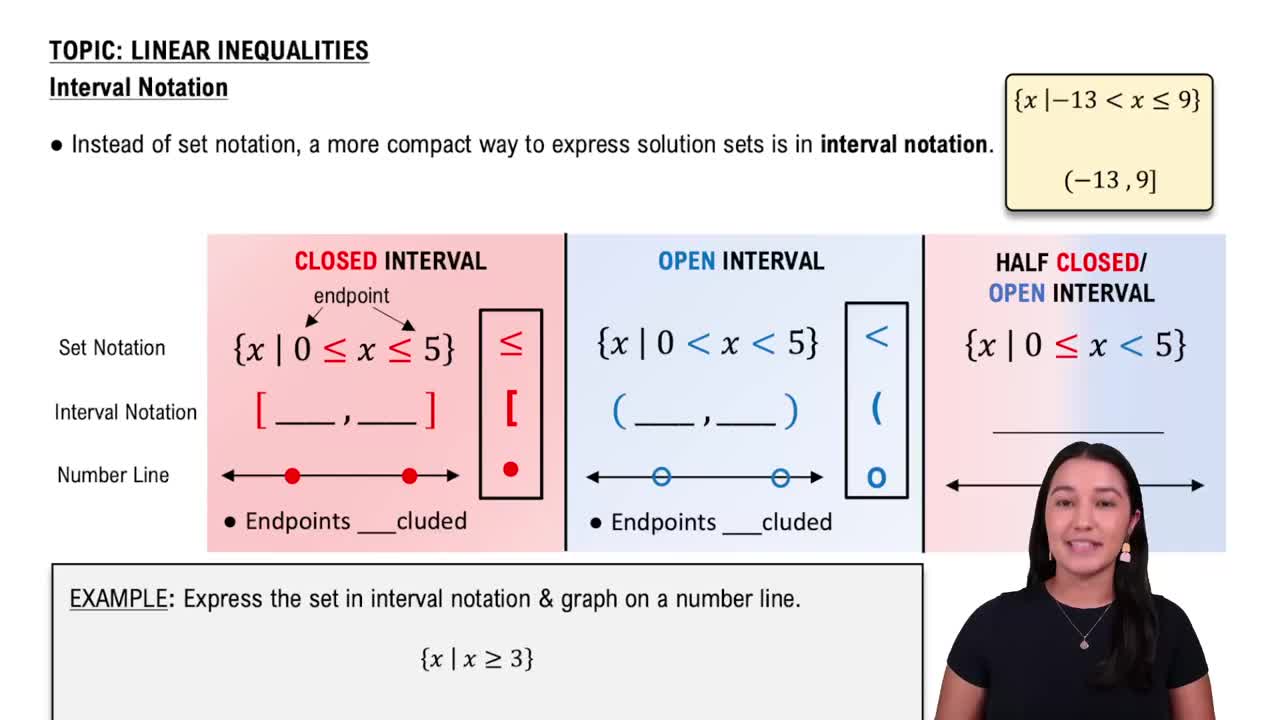
Interval notation is a mathematical notation used to represent a range of values. It uses parentheses and brackets to indicate whether endpoints are included (closed interval) or excluded (open interval). For example, (a, b) means all numbers between a and b, not including a and b, while [a, b] includes both endpoints.
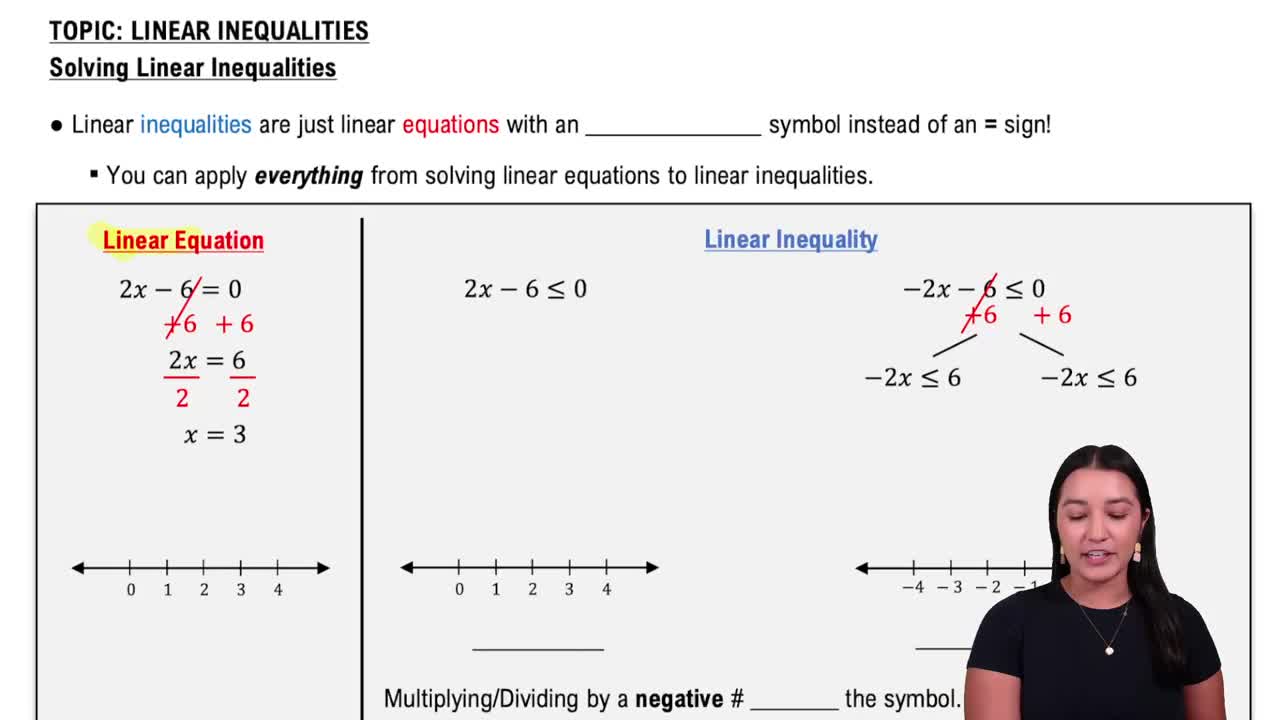
Solving linear inequalities involves isolating the variable on one side of the inequality sign. This process is similar to solving equations but requires special attention to the direction of the inequality sign, especially when multiplying or dividing by negative numbers, which reverses the inequality.