In all exercises, other than exercises with no solution, use interval notation to express solution sets and graph each solution set on a number line. In Exercises 27–50, solve each linear inequality. -9x ≥ 36
Verified step by step guidance
1
Start with the given inequality: \(-9x \geq 36\).
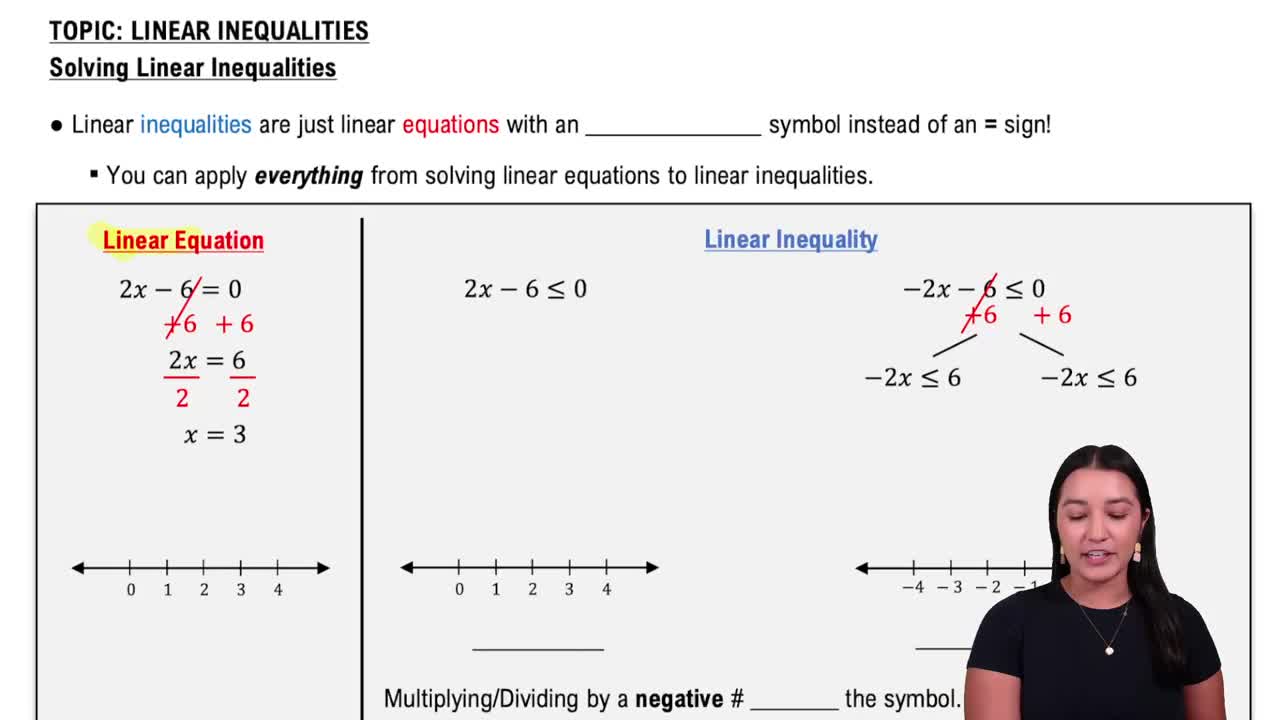
To isolate \(x\), divide both sides of the inequality by \(-9\). Remember, when dividing or multiplying both sides of an inequality by a negative number, the inequality sign must be reversed.
After dividing, the inequality becomes: \(x \leq \frac{36}{-9}\).
Simplify the fraction on the right side to find the numerical value.
Express the solution in interval notation and then graph the solution set on a number line, showing all values of \(x\) that satisfy the inequality.
Verified video answer for a similar problem:
This video solution was recommended by our tutors as helpful for the problem above
Video duration:
2m
Play a video:
Was this helpful?
Key Concepts
Here are the essential concepts you must grasp in order to answer the question correctly.
Solving Linear Inequalities
A linear inequality involves an inequality symbol (>, <, ≥, ≤) with a linear expression. To solve it, isolate the variable on one side by performing inverse operations, similar to solving linear equations, but be mindful of inequality rules.
When multiplying or dividing both sides of an inequality by a negative number, the direction of the inequality sign must be reversed. This is crucial to maintain the truth of the inequality and avoid incorrect solutions.
Interval notation expresses solution sets using parentheses or brackets to indicate open or closed intervals. Graphing on a number line visually represents these solutions, showing which values satisfy the inequality and whether endpoints are included.