Solve each inequality. Give the solution set in interval notation. | 3x - 4 | < 2
Table of contents
- 0. Review of Algebra4h 18m
- 1. Equations & Inequalities3h 18m
- 2. Graphs of Equations1h 43m
- 3. Functions2h 17m
- 4. Polynomial Functions1h 44m
- 5. Rational Functions1h 23m
- 6. Exponential & Logarithmic Functions2h 28m
- 7. Systems of Equations & Matrices4h 5m
- 8. Conic Sections2h 23m
- 9. Sequences, Series, & Induction1h 22m
- 10. Combinatorics & Probability1h 45m
1. Equations & Inequalities
Linear Inequalities
Problem 31
Textbook Question
Solve each inequality. Give the solution set in interval notation. | 1/2 - x | ≤ 2
Verified step by step guidance1
Recognize that the inequality involves an absolute value: \(|\frac{1}{2} - x| \leq 2\). Recall that for any expression \(A\), \(|A| \leq B\) means \(-B \leq A \leq B\).
Apply this property to the inequality: \(-2 \leq \frac{1}{2} - x \leq 2\).
Solve the compound inequality by isolating \(x\). Start with the left part: \(-2 \leq \frac{1}{2} - x\). Subtract \(\frac{1}{2}\) from both sides to get \(-2 - \frac{1}{2} \leq -x\).
Multiply both sides of the inequality by \(-1\) to solve for \(x\). Remember to reverse the inequality signs when multiplying by a negative number. This gives \(x \leq 2 + \frac{1}{2}\).
Now solve the right part of the compound inequality: \(\frac{1}{2} - x \leq 2\). Subtract \(\frac{1}{2}\) from both sides to get \(-x \leq 2 - \frac{1}{2}\). Multiply both sides by \(-1\) (and reverse the inequality) to get \(x \geq -2 + \frac{1}{2}\). Combine both results to write the solution set in interval notation.
Verified video answer for a similar problem:This video solution was recommended by our tutors as helpful for the problem above
Video duration:
2mPlay a video:
Was this helpful?
Key Concepts
Here are the essential concepts you must grasp in order to answer the question correctly.
Absolute Value Inequalities
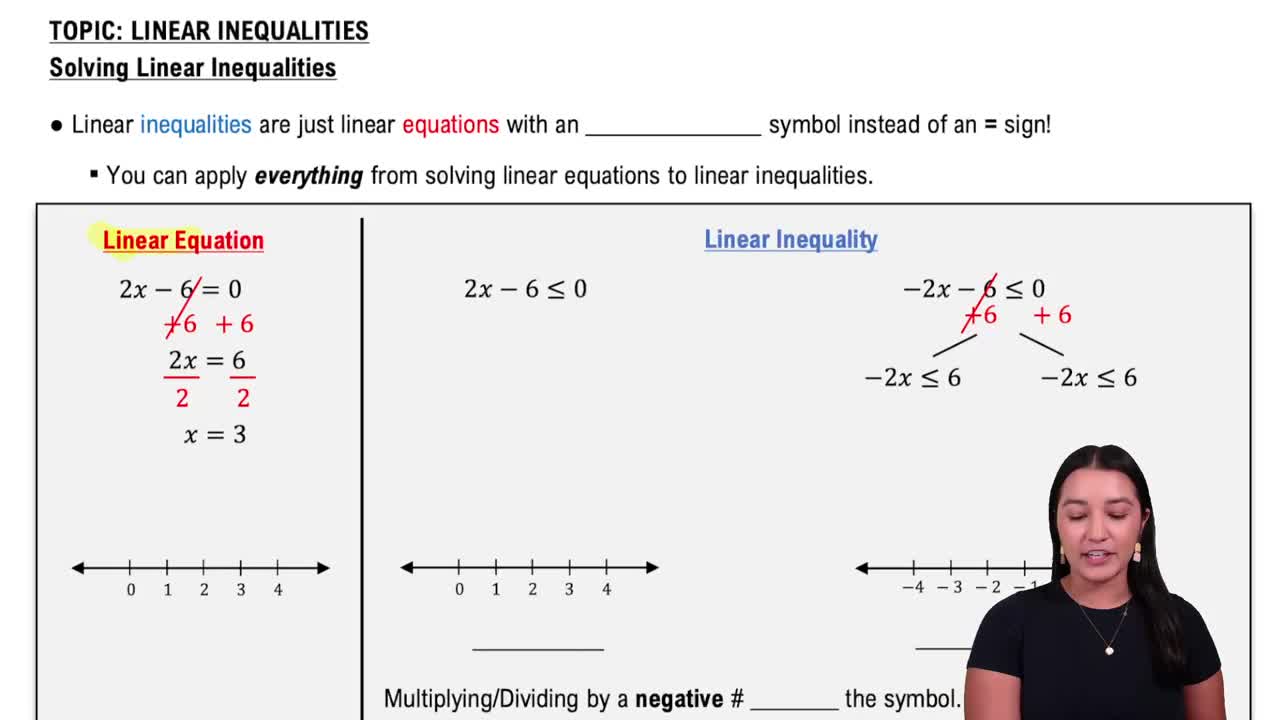
Absolute value inequalities involve expressions where the distance of a number from zero is compared to another value. For inequalities like |A| ≤ B, the solution includes all values of A between -B and B, inclusive. Understanding how to rewrite and solve these inequalities is essential.
Recommended video:
Linear Inequalities
Solving Linear Inequalities
Solving linear inequalities requires isolating the variable on one side while maintaining the inequality's direction. When dealing with compound inequalities, solutions are often expressed as intervals. Mastery of inequality properties helps in correctly manipulating and solving these expressions.
Recommended video:
Linear Inequalities
Interval Notation
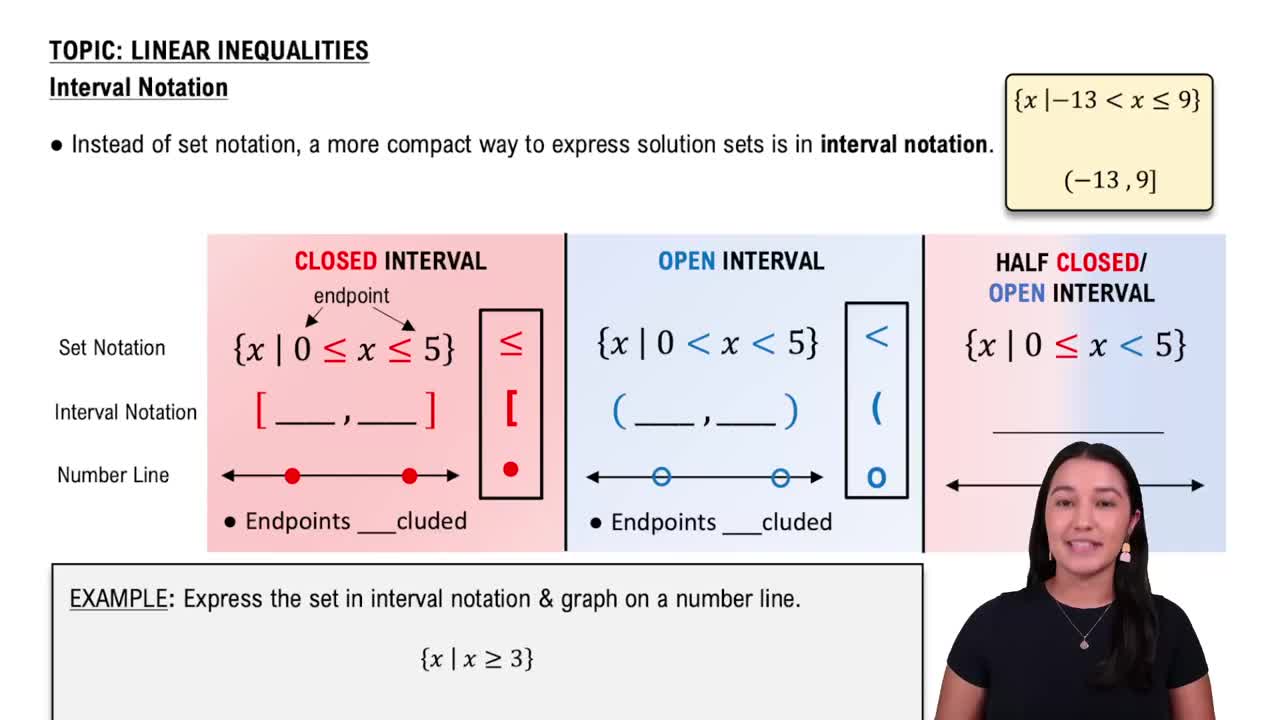
Interval notation is a concise way to represent sets of numbers between two endpoints. Square brackets [ ] indicate inclusion of endpoints, while parentheses ( ) indicate exclusion. Using interval notation correctly communicates the solution set of inequalities clearly and efficiently.
Recommended video:
Interval Notation
Related Videos
Related Practice
Textbook Question
676
views