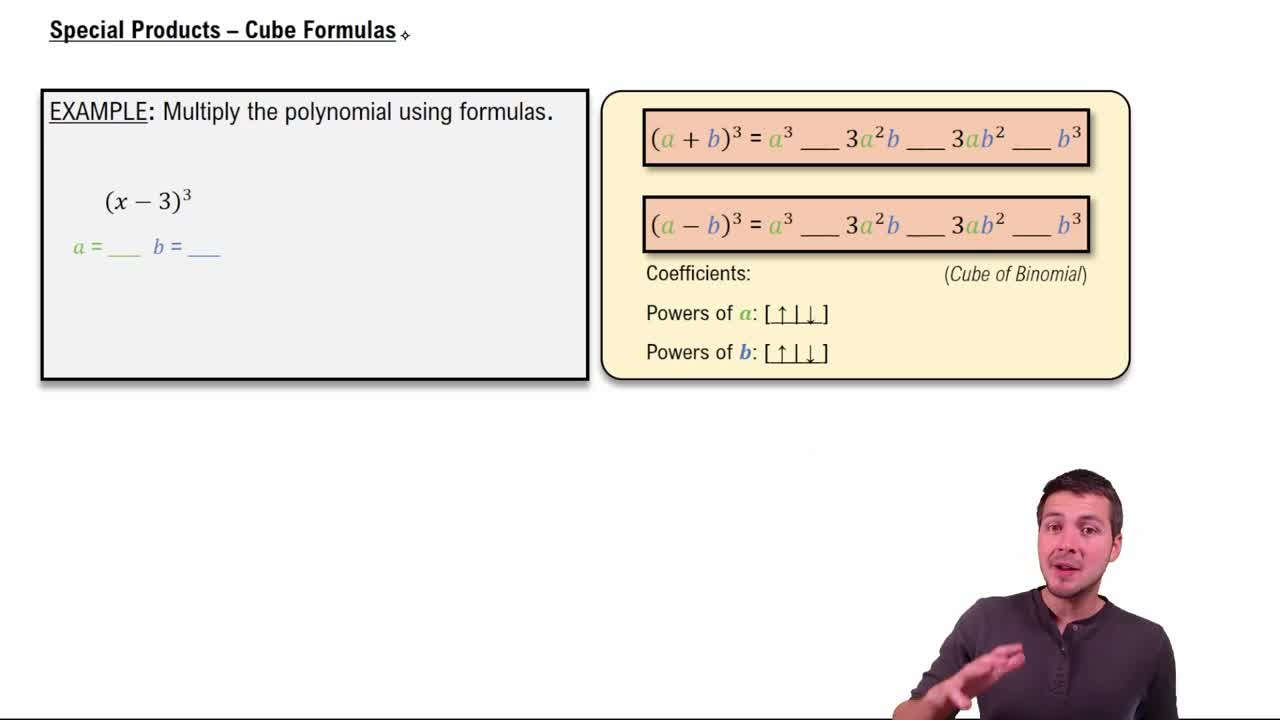
Recognize that the problem involves expanding the cube of a binomial, \((x - 1)^3\). This can be expanded using the Binomial Theorem, which states \((a + b)^n = \sum_{k=0}^n \binom{n}{k} a^{n-k} b^k\).
Identify the components of the binomial: \(a = x\), \(b = -1\), and \(n = 3\). Substitute these values into the Binomial Theorem formula.
Write the expanded form of \((x - 1)^3\) using the Binomial Theorem: \(\binom{3}{0}x^3(-1)^0 + \binom{3}{1}x^2(-1)^1 + \binom{3}{2}x^1(-1)^2 + \binom{3}{3}x^0(-1)^3\).
Simplify each term by calculating the binomial coefficients \(\binom{n}{k}\) and the powers of \(-1\). For example, \(\binom{3}{0} = 1\), \(\binom{3}{1} = 3\), \(\binom{3}{2} = 3\), and \(\binom{3}{3} = 1\).
Combine the simplified terms to write the expanded polynomial. The result will be in the form \(x^3 - 3x^2 + 3x - 1\).
Verified video answer for a similar problem:
This video solution was recommended by our tutors as helpful for the problem above
Video duration:
3m
Play a video:
Was this helpful?
Key Concepts
Here are the essential concepts you must grasp in order to answer the question correctly.
Binomial Expansion
Binomial expansion is a method used to expand expressions that are raised to a power, particularly those in the form of (a + b)^n. The expansion is achieved using the Binomial Theorem, which states that (a + b)^n = Σ (n choose k) * a^(n-k) * b^k, where k ranges from 0 to n. This concept is essential for expanding polynomials like (x - 1)^3.
A cubic function is a polynomial of degree three, typically expressed in the form f(x) = ax^3 + bx^2 + cx + d. Understanding cubic functions is crucial for recognizing the behavior of the graph, including its turning points and intercepts. In the context of the question, expanding (x - 1)^3 will yield a cubic polynomial.
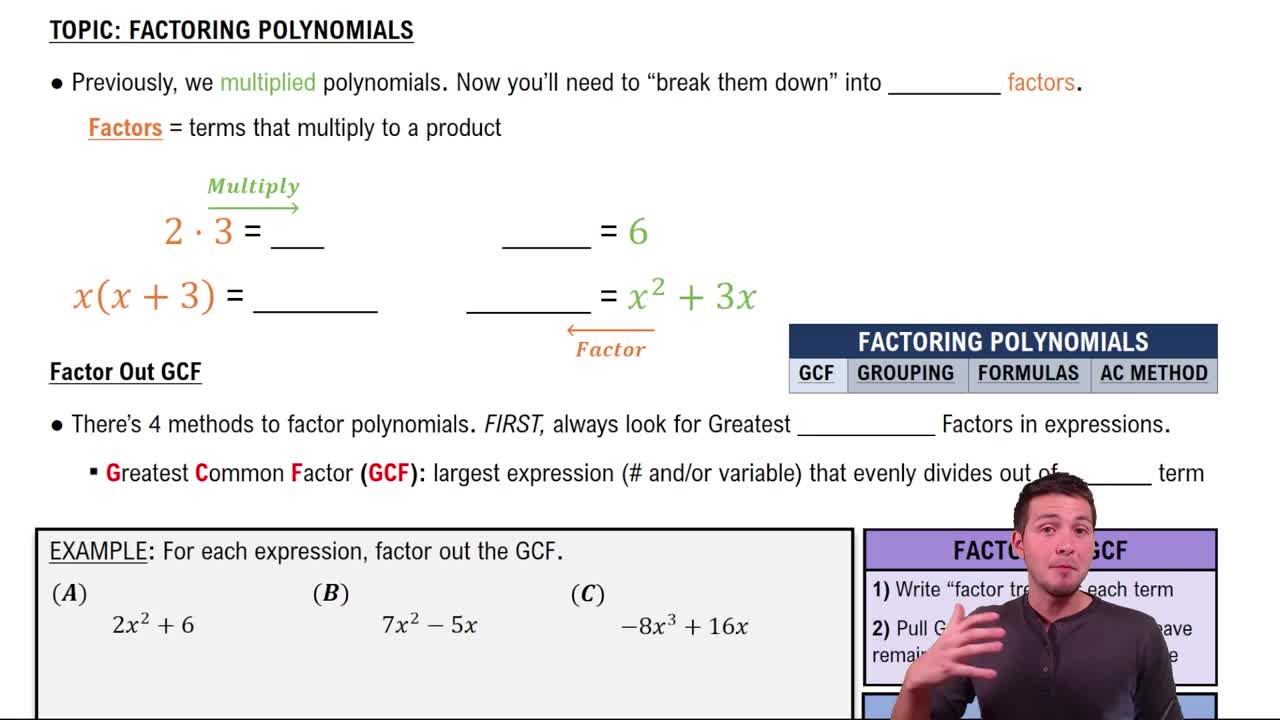
Factoring and simplifying polynomials involves rewriting a polynomial as a product of its factors, which can make it easier to analyze or solve. This process often includes identifying common factors or applying special product formulas. In the case of (x - 1)^3, recognizing it as a repeated factor will aid in both expansion and simplification.