Identify each expression as a polynomial or not a polynomial. For each polynomial, give the degree and identify it as a monomial, binomial, trinomial, or none of these. (3/8)x5-(1/x2)+9
Verified step by step guidance
1
First, write down the given expression clearly: \(\frac{3}{8}x^{5} - \frac{1}{x^{2}} + 9\).
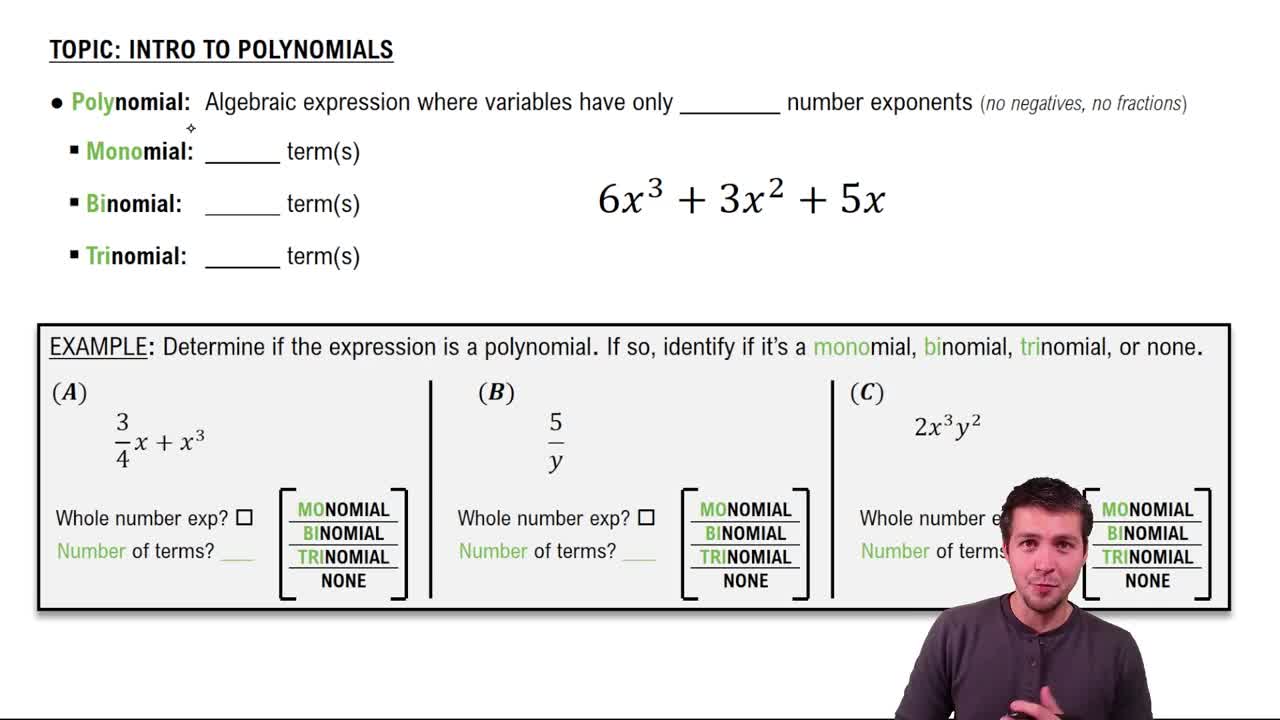
Recall that a polynomial is an expression consisting of terms with non-negative integer exponents of the variable. Terms like \(x^{-2}\) (which is \(\frac{1}{x^{2}}\)) are not allowed in polynomials because the exponent is negative.
Examine each term: \(\frac{3}{8}x^{5}\) has an exponent of 5 (which is non-negative integer), \(-\frac{1}{x^{2}}\) can be rewritten as \(-x^{-2}\) (exponent is negative), and \(9\) is a constant term (which is a polynomial term with degree 0).
Since the term \(-\frac{1}{x^{2}}\) has a negative exponent, the entire expression is not a polynomial.
Therefore, you do not need to determine the degree or classify it as monomial, binomial, or trinomial because the expression is not a polynomial.
Verified video answer for a similar problem:
This video solution was recommended by our tutors as helpful for the problem above
Video duration:
1m
Play a video:
0 Comments
Key Concepts
Here are the essential concepts you must grasp in order to answer the question correctly.
Definition of a Polynomial
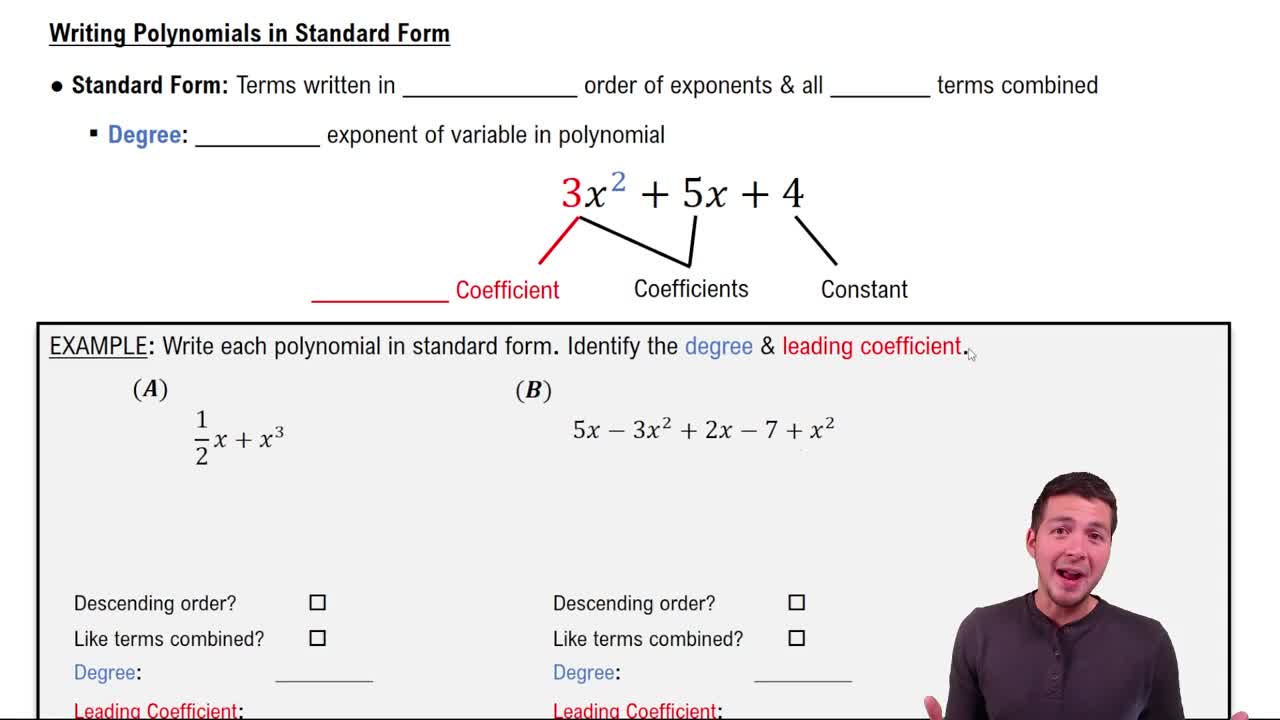
A polynomial is an algebraic expression consisting of variables and coefficients, involving only non-negative integer exponents of the variables. It cannot include variables in denominators, negative exponents, or variables under roots. Recognizing these restrictions helps determine if an expression qualifies as a polynomial.
The degree of a polynomial is the highest power (exponent) of the variable in the expression. It indicates the polynomial's order and affects its graph and behavior. For example, in 3x^5 - 1/x^2 + 9, the term 3x^5 has degree 5, but the term with 1/x^2 is not a polynomial term.
Polynomials are classified based on the number of terms: a monomial has one term, a binomial has two, and a trinomial has three. If a polynomial has more than three terms, it is simply called a polynomial without a special name. This classification helps in understanding and describing polynomial expressions.

 1:39 minutes
 Verified step by step guidance
 05:13
05:13