In Exercises 9–16, a) List all possible rational zeros. b) Use synthetic division to test the possible rational zeros and find an actual zero. c) Use the quotient from part (b) to find the remaining zeros of the polynomial function.
Table of contents
- 0. Review of Algebra4h 18m
- 1. Equations & Inequalities3h 18m
- 2. Graphs of Equations1h 43m
- 3. Functions2h 17m
- 4. Polynomial Functions1h 44m
- 5. Rational Functions1h 23m
- 6. Exponential & Logarithmic Functions2h 28m
- 7. Systems of Equations & Matrices4h 5m
- 8. Conic Sections2h 23m
- 9. Sequences, Series, & Induction1h 22m
- 10. Combinatorics & Probability1h 45m
4. Polynomial Functions
Zeros of Polynomial Functions
Problem 25
Textbook Question
Factor ƒ(x) into linear factors given that k is a zero.
Verified step by step guidance1
First, recognize that since k = -4 is a zero of the polynomial ƒ(x), it means that (x - (-4)) or (x + 4) is a factor of ƒ(x).
Use polynomial division or synthetic division to divide ƒ(x) = -6x^3 - 25x^2 - 3x + 4 by (x + 4). This will give you a quadratic quotient.
Set up synthetic division with -4 as the divisor and the coefficients of ƒ(x): -6, -25, -3, and 4.
Perform the synthetic division step-by-step to find the quotient polynomial, which will be a quadratic expression.
Once you have the quadratic quotient, factor it further into linear factors if possible, so that ƒ(x) is expressed as a product of linear factors including (x + 4).
Verified video answer for a similar problem:This video solution was recommended by our tutors as helpful for the problem above
Video duration:
10mPlay a video:
Was this helpful?
Key Concepts
Here are the essential concepts you must grasp in order to answer the question correctly.
Polynomial Zeros and the Factor Theorem
The Factor Theorem states that if k is a zero of a polynomial ƒ(x), then (x - k) is a factor of ƒ(x). This means substituting k into ƒ(x) yields zero, confirming (x - k) divides the polynomial exactly.
Recommended video:
Guided course
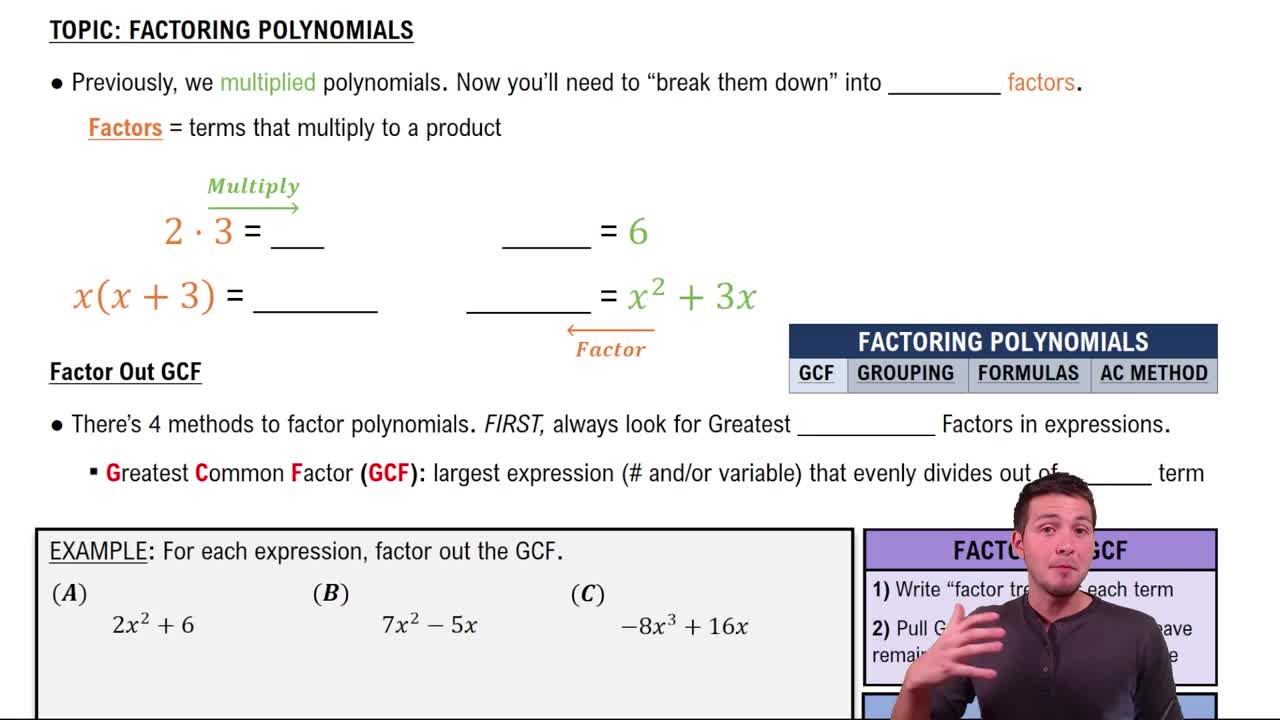
Introduction to Factoring Polynomials
Polynomial Division (Synthetic or Long Division)
Polynomial division is used to divide the original polynomial by the factor (x - k) to reduce its degree. Synthetic division is a shortcut method for dividing by linear factors, simplifying the process of factoring higher-degree polynomials.
Recommended video:
Guided course
Introduction to Factoring Polynomials
Factoring Polynomials into Linear Factors
After dividing out the known factor, the resulting polynomial can be further factored into linear factors by finding its zeros. Fully factoring a cubic polynomial means expressing it as a product of three linear factors, if possible.
Recommended video:
Guided course
Introduction to Factoring Polynomials
Related Videos
Related Practice
Textbook Question
379
views