Evaluate each algebraic expression for the given value or value(s) of the variable(s). 3+6(x-2)3 for x = 4
Verified step by step guidance
1
Identify the given expression and the value of the variable: The expression is \$3 + 6(x - 2)^3\( and the value given is \)x = 4$.
Substitute the value of \(x\) into the expression: Replace every \(x\) with \(4\) to get \$3 + 6(4 - 2)^3$.
Simplify inside the parentheses first: Calculate \$4 - 2\( to simplify the expression to \)3 + 6(2)^3$.
Evaluate the exponent: Calculate \$2^3$ which means \(2 \times 2 \times 2\).
Multiply and add: Multiply the result of the exponent by \(6\), then add \(3\) to find the value of the expression.
Verified video answer for a similar problem:
This video solution was recommended by our tutors as helpful for the problem above
Video duration:
1m
Play a video:
0 Comments
Key Concepts
Here are the essential concepts you must grasp in order to answer the question correctly.
Order of Operations
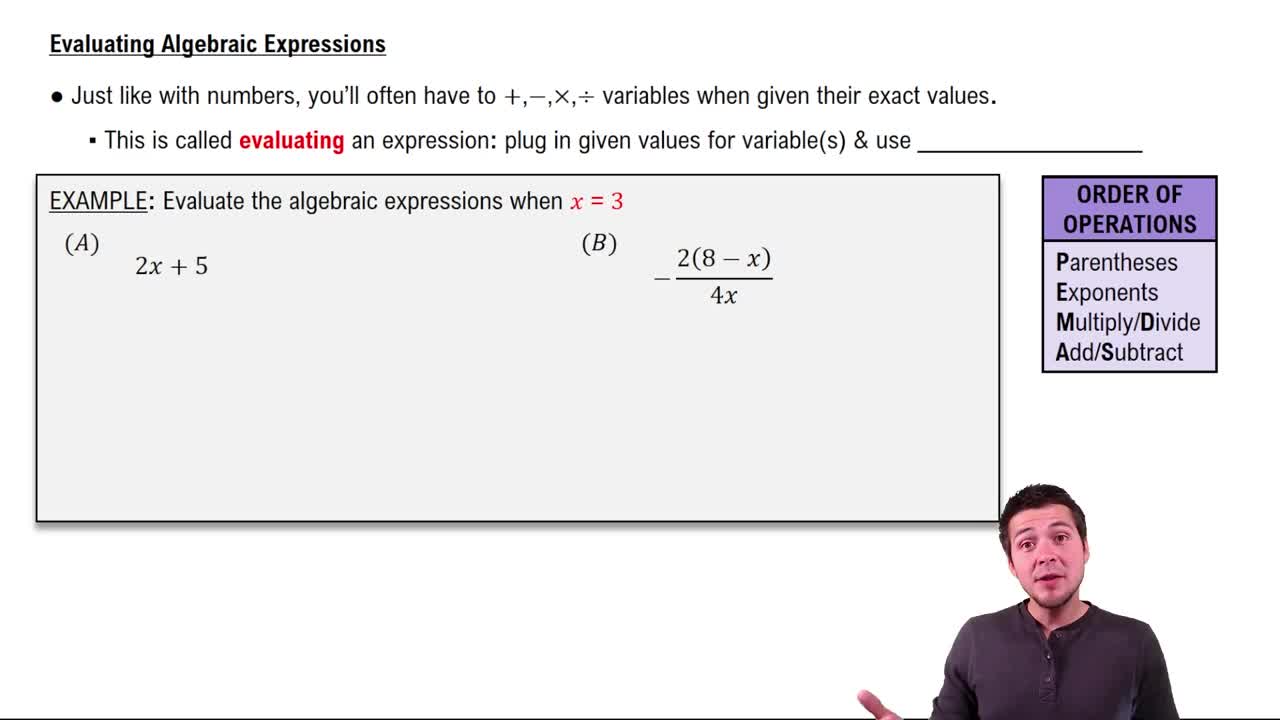
The order of operations is a set of rules that dictate the sequence in which mathematical operations should be performed to correctly evaluate expressions. It follows the PEMDAS/BODMAS rule: Parentheses, Exponents, Multiplication and Division (left to right), Addition and Subtraction (left to right). This ensures consistent and accurate results.
Evaluating an expression involves substituting the given value(s) for the variable(s) and simplifying the result. For example, replacing x with 4 in the expression 3 + 6(x - 2)^3 means calculating 3 + 6(4 - 2)^3 by first simplifying inside the parentheses, then applying exponents, and finally performing multiplication and addition.
Exponents indicate repeated multiplication of a base number. For instance, (x - 2)^3 means multiplying (x - 2) by itself three times. Understanding how to compute powers is essential for simplifying expressions correctly, especially when combined with other operations like addition and multiplication.

 1:41 minutes
 Verified step by step guidance
 8:38
8:38