Solve each formula for the specified variable. Assume that the denominator is not 0 if variables appear in the denominator. z = (x-μ)/σ, for x (standardized value)
Verified step by step guidance
1
Start with the given formula: \(z = \frac{x - \mu}{\sigma}\).
To solve for \(x\), multiply both sides of the equation by \(\sigma\) to eliminate the denominator: \(z \times \sigma = x - \mu\).
Next, isolate \(x\) by adding \(\mu\) to both sides: \(x = z \times \sigma + \mu\).
This expression now represents \(x\) in terms of \(z\), \(\mu\), and \(\sigma\).
Remember that \(\sigma\) (standard deviation) is assumed to be nonzero to avoid division by zero.
Verified video answer for a similar problem:
This video solution was recommended by our tutors as helpful for the problem above
Video duration:
1m
Play a video:
Was this helpful?
Key Concepts
Here are the essential concepts you must grasp in order to answer the question correctly.
Solving Formulas for a Specific Variable
This involves rearranging an equation to isolate the desired variable on one side. It requires applying inverse operations such as addition, subtraction, multiplication, division, and sometimes more advanced algebraic techniques to rewrite the formula clearly in terms of the specified variable.
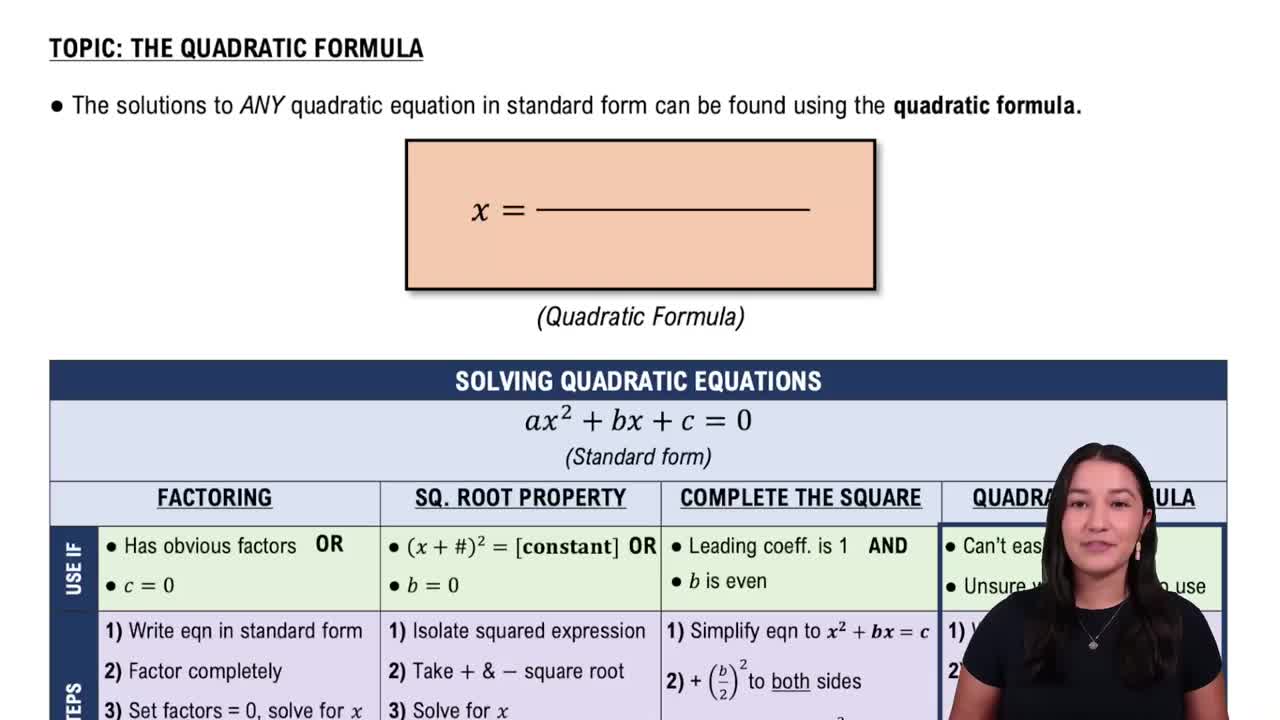
Solving Quadratic Equations Using The Quadratic Formula
Understanding the Standardization Formula
The formula z = (x - μ) / σ represents the standard score or z-score, which measures how many standard deviations a data point x is from the mean μ. Recognizing the roles of each variable helps in correctly manipulating the formula to solve for x.
Solving Quadratic Equations Using The Quadratic Formula
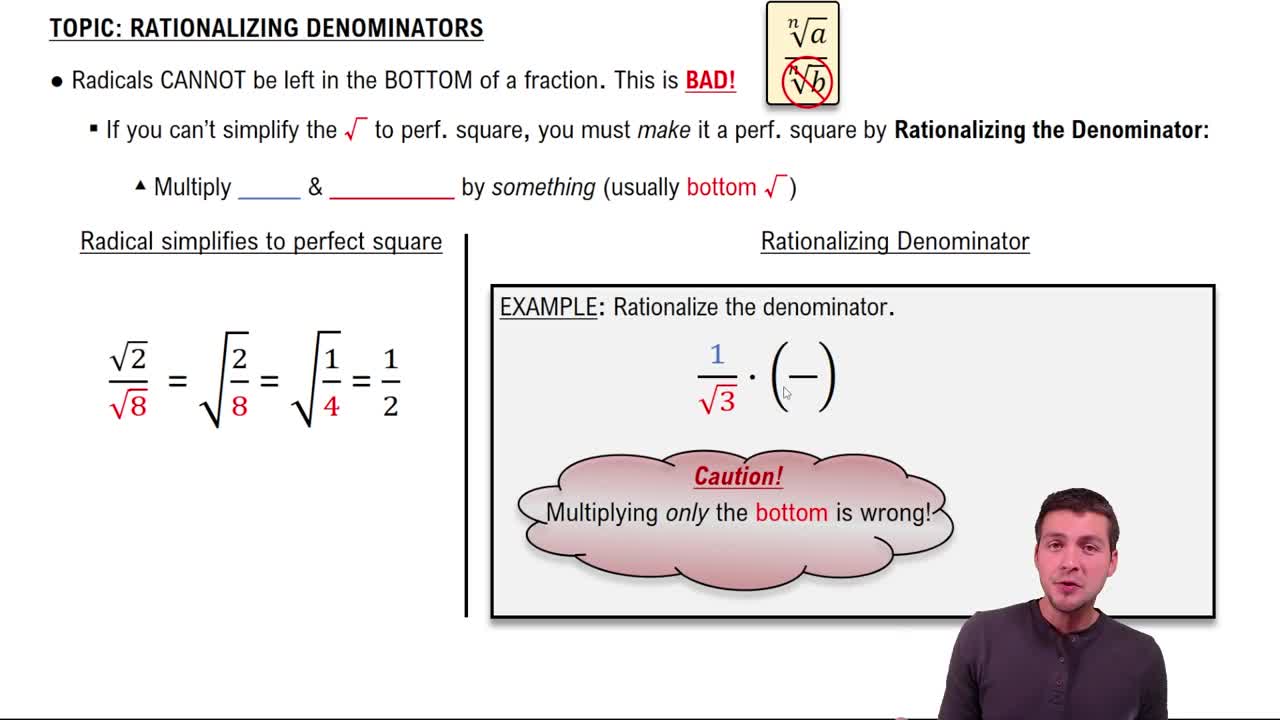
Handling Variables in the Denominator
When variables appear in the denominator, it is important to assume they are nonzero to avoid undefined expressions. This assumption allows safe multiplication across the equation to eliminate fractions and solve for the desired variable without division by zero errors.